In a potential high-intensity conflict across the European theater, two of the most advanced main battle tanks—the Russian T-90M Proryv and the German Leopard 2A8—stand as strategic cornerstones for their respective nations. These machines are not only embodiments of national defense doctrine but also technological testaments to diverging philosophies of modern armored warfare. Both platforms are extensively upgraded from their predecessors, yet how they perform under real-world combat conditions will determine dominance in future clashes where drones, loitering munitions, and electronic warfare redefine survivability.
Diverging Doctrines: Firepower and Lethality
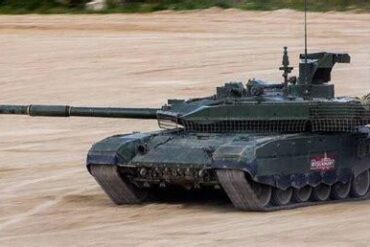
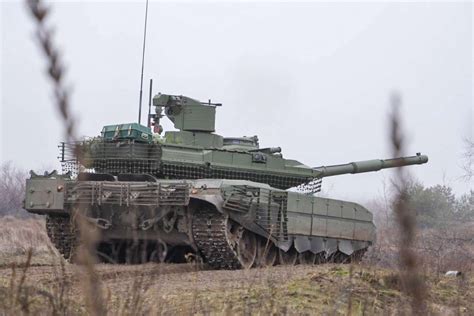
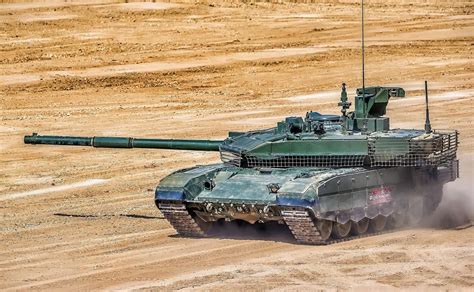
The T-90M is equipped with the formidable 2A82-1M 125mm smoothbore cannon, designed for both traditional and hybrid warfare. This gun supports not only high-velocity armor-piercing rounds such as the Vacuum-1 APFSDS, but also fires 9M119M Refleks-M guided missiles capable of targeting enemy armor and low-flying helicopters up to 5,000 meters away. This integration of missile capability directly through the main gun tube offers the T-90M a unique standoff engagement edge that Western tanks, including the Leopard 2A8, currently lack.
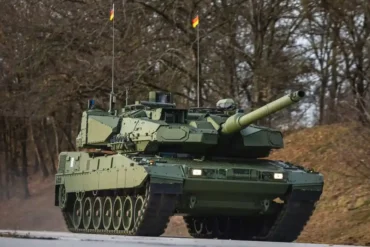
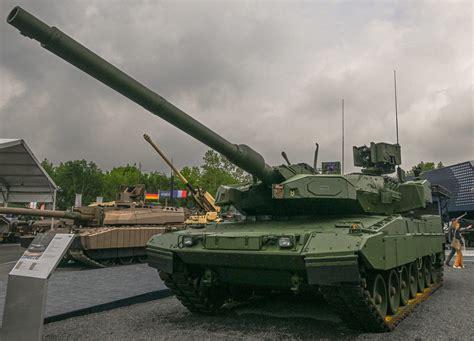
By contrast, the Leopard 2A8 relies on its 120mm L55A1 smoothbore cannon, optimized for the advanced DM73 kinetic energy rounds. While it offers extreme accuracy and high penetrative performance, it is restricted to non-missile munitions. The Leopard’s engagement range tops out at approximately 4,000 meters with kinetic rounds and slightly more with programmable high-explosive ammunition. Despite having excellent fire-control systems and first-hit probability, the lack of missile integration limits its flexibility in long-range or obscured combat scenarios.
Armor and Active Defense Philosophies
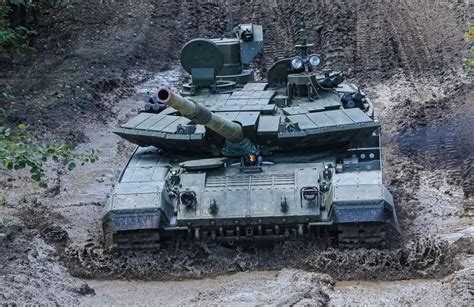
In terms of survivability, the T-90M reveals a rugged, evolving adaptation to modern threats. It features Relikt ERA, one of Russia’s most advanced explosive reactive armor systems, capable of defeating both tandem warheads and kinetic penetrators. Combat experience in Ukraine has pushed additional refinements: cage and slat armor, vertical ERA tiles, UV sensors, and smoke grenade arrays designed for upward dispersal—all to mitigate drone and top-attack threats. These modular, rapidly deployable add-ons underscore Russia’s agile, battlefield-driven innovation model, which favors functional effectiveness over integrated sophistication.
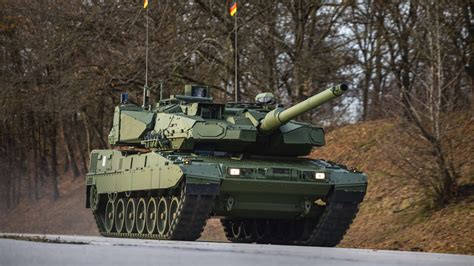
Meanwhile, the Leopard 2A8 adopts a high-technology, passive protection philosophy. Its modular armor package, developed by Rheinmetall, includes advanced nano-ceramic composites and steel layers designed for shaped charges and kinetic threats. Its crew compartment is surrounded by spall liners, while ammunition is stored in armored compartments with blowout panels, ensuring NATO-compliant survivability standards. However, its glaring omission is the lack of an integrated Active Protection System (APS). Although the EuroTrophy APS is available as an option, current Leopard 2A8 units do not field it. As loitering munitions, suicide drones, and FPV kamikaze systems gain dominance, this is a major vulnerability for a tank with otherwise world-class protection.
Mobility in the European Theatre
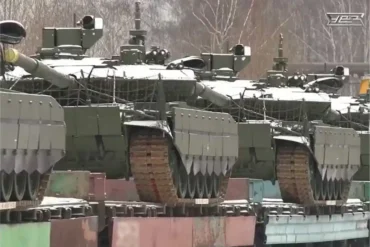
On the move, the T-90M’s design emphasizes strategic mobility. At 48 tons, powered by a 1,130 hp V-92S2F diesel engine, it achieves a 23.5 hp/ton power-to-weight ratio. With a top speed of 60 km/h and 15 km/h reverse, the tank can rapidly reposition on rugged terrain. It boasts a 550 km operational range, extendable with external drums, and fits within logistical infrastructure, making it ideal for rapid rail or truck transport across Eastern Europe. Its torsion bar suspension and clutch-brake steering system are time-tested for durability in austere conditions.
The Leopard 2A8, in contrast, is a heavy armor colossus. Tipping the scales at over 67 tons, it is driven by a 1,500 hp MTU MB 873 Ka-501 diesel engine, delivering a slightly lower 22.3 hp/ton. Its speed peaks at 70 km/h, but its off-road maneuverability is moderated by its mass and footprint. A revised Renk HSWL 354 transmission enables improved reverse speeds of 31 km/h, a tactical necessity. Yet, its operational range of 450 km and requirement for specialized transport restrict its strategic flexibility in a fast-moving, high-tempo European war.
Sensor Fusion vs. Combat Realism
The Leopard 2A8 excels in digital integration, network-centric warfare, and real-time threat analytics. Its sensor fusion, panoramic commander sights, thermal imaging, and digital battlefield interfaces allow for superior crew situational awareness and coordinated operations within NATO doctrines. These strengths are invaluable in multi-domain operations but assume that enemy threats conform to symmetrical warfare patterns.
The T-90M, by contrast, favors practical battlefield efficacy. While its sensors and fire-control suite are not as advanced as those of the Leopard, the tank compensates with proven resilience and the capability to rapidly evolve under fire. Its integration of multi-spectral camouflage, electronic warfare countermeasures, and adaptable armor shows a dynamic readiness that is not bound by doctrine but by survival.
Survivability in Drone-Dominated Warfare
Both tanks must contend with the new reality of top-attack munitions. The Ukraine conflict has proven that even well-armored vehicles are susceptible to cheap, disposable drones, loitering munitions like Lancet, or kamikaze UAVs armed with RPGs. The T-90M’s battlefield add-ons—including UV/radar detectors linked to soft-kill systems—are crude but effective. These offer at least a partial counter-drone capability that Western tanks, ironically, still lack in production configurations.
The Leopard 2A8’s Achilles’ heel lies here. Despite its high-end passive protection, its lack of integrated hard-kill APS or drone mitigation systems renders it vulnerable in scenarios resembling modern Ukraine or hypothetical Baltic flashpoints. Until the EuroTrophy becomes standard issue—or a superior APS is fielded—the Leopard remains exposed to the most common threats on contemporary battlefields.
Final Assessment: Adaptation Over Perfection
The T-90M and Leopard 2A8 represent two paths in armored warfare: one pragmatic and reactive, the other precise and predictive. The T-90M has already survived countless battlefield stress tests, refining its design under fire and demonstrating flexibility in real time. Its combination of missile launch capability, layered protection, and combat-driven upgrades make it a powerful threat—even when facing technologically superior foes.
The Leopard 2A8, meanwhile, offers unmatched sensor fusion, ergonomics, and crew safety features, positioning it as a strategic centerpiece for any NATO ground force. But unless it receives comprehensive counter-drone systems and real-world adaptive enhancements, it risks becoming a high-value casualty in environments where the threat axis comes from above.
In future European conflicts—where aerial threats, urban combat, and electronic warfare will dominate—the victor won’t be the tank with the best specifications on paper, but the one that can adapt fastest to the evolving kill chain. For now, the T-90M evolves in combat. The Leopard 2A8, for all its brilliance, must still prove itself in battle.