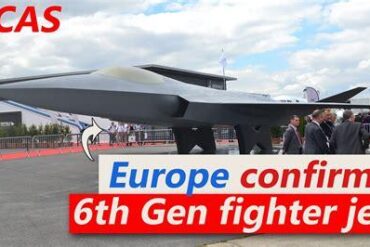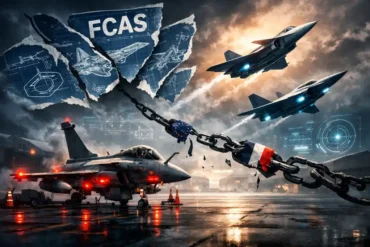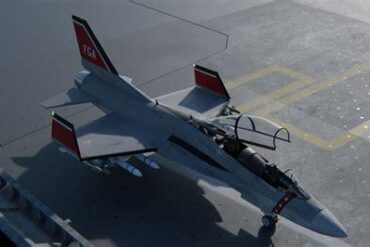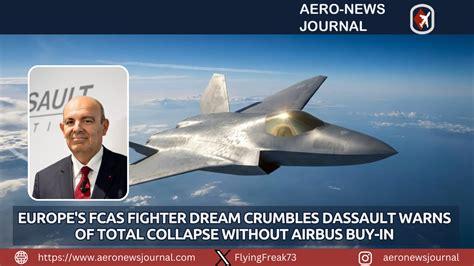
The Future Combat Air System (FCAS) was intended to become Europe’s most ambitious military aviation program since the Cold War. Designed as a revolutionary family of interconnected combat systems rather than a single aircraft, the project promised to deliver a sixth-generation fighter capable of replacing both the Dassault Rafale and the Eurofighter Typhoon while strengthening Europe’s strategic autonomy for decades.
Instead, after nearly nine years of negotiations, political summits, industrial agreements, and billions committed to research, the flagship fighter program collapsed before a single prototype ever left the ground. On June 8, 2026, German Chancellor Friedrich Merz confirmed that the crewed Next Generation Fighter (NGF) component had officially been cancelled, bringing an end to what had become Europe’s largest failed defense aerospace project.
Rather than being defeated by technology, budget shortages, or engineering challenges, FCAS fell apart because Europe’s aerospace champions—Dassault Aviation and Airbus Defence and Space—could never agree on one fundamental question: who would truly control the aircraft’s development?
The collapse represents far more than the cancellation of a fighter aircraft. It exposes deep structural weaknesses inside multinational European defense cooperation, raises questions about Europe’s ability to independently develop advanced military technology, and dramatically reshapes the global race toward sixth-generation combat aviation.
After years of political optimism, the world’s most expensive future fighter program became an extraordinary example of how industrial rivalry can overpower strategic necessity.
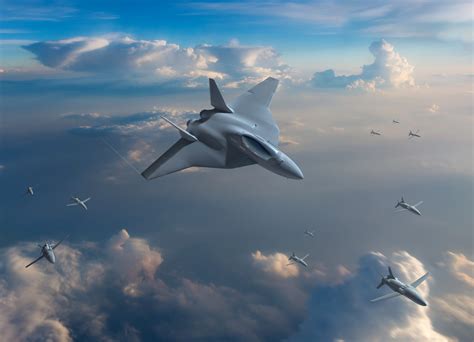
FCAS Was Designed as Much More Than a Fighter Aircraft
From its announcement during the 2017 ILA Berlin Air Show, FCAS was never marketed as a conventional aircraft replacement. French President Emmanuel Macron and German Chancellor Angela Merkel presented the initiative as the technological foundation for European air combat through the middle of the twenty-first century.
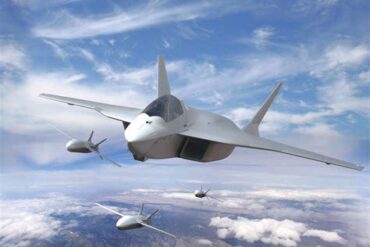
The centerpiece was the Next Generation Fighter, but the aircraft represented only one part of an integrated ecosystem. Designers envisioned intelligent autonomous Remote Carrier drones operating alongside the crewed fighter while an advanced Combat Cloud continuously exchanged battlefield information between aircraft, satellites, naval assets, land forces, and command centers.
Artificial intelligence would assist pilots by processing enormous quantities of sensor information in real time, dramatically shortening the decision cycle while allowing every participating platform to operate as one synchronized combat network.
Instead of measuring combat effectiveness by the performance of an individual aircraft, FCAS sought to redefine aerial warfare around interconnected systems capable of overwhelming opponents through superior information sharing and collaborative engagement.
The vision was technologically ambitious, strategically attractive, and politically symbolic. It represented Europe’s determination to reduce long-term dependence on American defense technology while maintaining global competitiveness against rapidly advancing military powers.
Political Ambition Created Momentum Before Industrial Reality Intervened
The geopolitical environment surrounding FCAS’s birth explains why European leaders attached such importance to the program.
Following Brexit, increasing uncertainty regarding future American foreign policy, and renewed security concerns across Eastern Europe, political leaders believed Europe required independent military-industrial capabilities capable of sustaining advanced defense technologies without external reliance.
France and Germany therefore launched FCAS as a flagship demonstration of European strategic sovereignty.
Spain formally joined the partnership in 2019, expanding both financial support and industrial participation. Expectations quickly grew that the three nations would jointly develop Europe’s first genuine sixth-generation combat aircraft.
However, political enthusiasm consistently outpaced industrial agreement.
Although governments repeatedly announced new phases of development, many of the most fundamental industrial arrangements remained unresolved. Questions surrounding governance, leadership responsibilities, intellectual property ownership, engineering authority, manufacturing distribution, software access, and future export rights continued to generate disagreements that accumulated over several years.
As political leaders publicly promoted European unity, negotiations behind closed doors became increasingly contentious.
Nine Years Passed Without a Single Flying Demonstrator
The most remarkable aspect of FCAS’s history is not merely that it failed but that nearly a decade elapsed without producing a flying technology demonstrator.
Phase 1A officially began in 2021, focusing on technologies that would eventually support the Next Generation Fighter. Early schedules envisioned demonstrator flights before the end of the decade.
Those milestones never materialized.
Every major engineering objective became dependent upon industrial negotiations that repeatedly stalled.
Governments attempted multiple rounds of mediation. Senior ministers organized emergency meetings. Political leaders personally intervened. Deadlines were extended repeatedly while negotiations continued to revolve around the same unresolved issues.
By March 2026, French President Emmanuel Macron and German Chancellor Friedrich Merz attempted another high-level intervention during discussions in Brussels.
Germany appointed a dedicated mediator tasked with finding a compromise acceptable to both industrial partners.
That mediation concluded only weeks later that building a jointly managed fighter was no longer realistic.
The final political announcement merely confirmed what many defense analysts had already concluded privately: the industrial relationship had become impossible to repair.
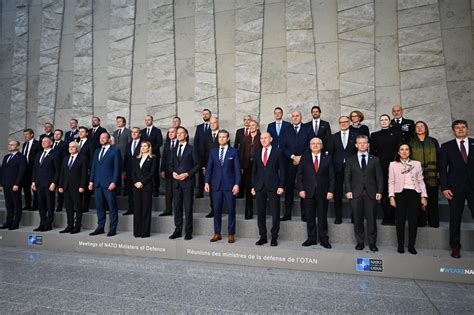
The Dassault-Airbus Workshare Conflict Became Impossible to Resolve
At the center of the FCAS collapse stood a surprisingly straightforward disagreement.
Who would lead development of Europe’s next fighter?
For Dassault Aviation, the answer appeared obvious.
The French manufacturer had independently designed every major French combat aircraft for decades, culminating in the internationally successful Rafale. Company leadership argued that preserving technical coherence required one company maintaining primary design authority throughout the aircraft’s development.
Airbus Defence and Space viewed the issue from an entirely different perspective.
Since Germany, France, and Spain were contributing comparable levels of public investment, Airbus maintained that industrial participation also needed to remain balanced. Equal financial commitments demanded equitable engineering responsibilities, manufacturing workshare, and long-term economic returns.
Reports indicated that Dassault sought approximately eighty percent responsibility for the fighter itself.
Such a proposal effectively positioned Airbus as a major subcontractor instead of a genuine co-developer.
For Germany, accepting those conditions would have significantly weakened its domestic aerospace sector despite billions invested by German taxpayers.
Neither position could realistically coexist.
Every attempted compromise ultimately left one side believing it had sacrificed too much strategic influence.
Why Intellectual Property Became Even More Valuable Than Manufacturing
The disagreement extended well beyond factory jobs.
Modern fighter aircraft derive enormous commercial value from proprietary technologies, software architectures, flight control systems, stealth techniques, sensor integration, and mission system design.
Whoever owns these technologies controls future exports, modernization programs, derivative aircraft, and decades of maintenance contracts.
For Dassault, surrendering shared authority over core technologies threatened one of France’s most valuable defense industries.
The Rafale’s international export success depends heavily upon France’s ability to offer sovereign control over every major system without requiring foreign approval.
Sharing proprietary technologies with Airbus could eventually weaken Dassault’s competitive position in future export campaigns.
Germany reached the opposite conclusion.
Without meaningful intellectual property participation, German industry would contribute funding while failing to acquire technological independence.
Consequently, both sides viewed intellectual property not simply as engineering documentation but as national strategic capital.
Compromise became increasingly difficult because every concession appeared capable of reshaping Europe’s defense industry for generations.
France and Germany Were Designing Different Aircraft
Industrial rivalry alone does not fully explain FCAS’s failure.
The participating nations also required fundamentally different aircraft.
France insisted that the Next Generation Fighter remain capable of carrier operations aboard future French aircraft carriers.
Carrier aviation imposes exceptionally demanding engineering constraints involving structural reinforcement, landing gear strength, folding mechanisms, compact dimensions, and strict weight limitations.
The aircraft additionally needed certification for France’s airborne nuclear deterrent mission.
Germany possessed entirely different priorities.
Its future fighter emphasized land-based air superiority, NATO interoperability, larger conventional weapon payloads, and optimized operations across continental Europe.
Without naval aviation requirements or nuclear carrier operations, German planners naturally preferred a larger aircraft optimized for endurance and payload capacity.
These competing priorities influenced nearly every aspect of aircraft design, from wing geometry and structural weight to fuel capacity and internal volume.
Designing one aircraft capable of fully satisfying both philosophies proved increasingly unrealistic.
History Repeated Itself Decades After the Eurofighter Split
Ironically, FCAS recreated many of the same disagreements that had previously divided European fighter development during the 1980s.
France originally participated in what eventually evolved into the Eurofighter program.
However, disagreements regarding industrial leadership and aircraft requirements ultimately convinced Paris to withdraw.
That decision eventually produced the Rafale while Britain, Germany, Italy, and Spain continued developing the Eurofighter Typhoon.
FCAS attempted to reunite many of those same industrial interests decades later.
The underlying national priorities, however, had changed remarkably little.
France still prioritized sovereign leadership, carrier compatibility, and independent technological authority.
Germany continued emphasizing multinational industrial participation and collective governance.
The result demonstrated that unresolved strategic differences had merely been postponed rather than solved.
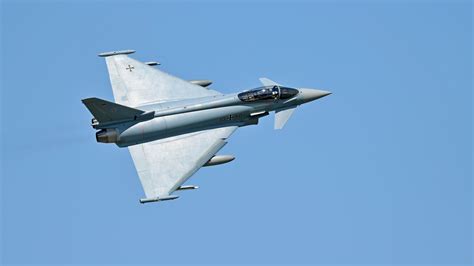
Some FCAS Technologies Will Continue to Survive
Although the crewed fighter has been cancelled, not every FCAS technology disappeared alongside it.
Governments agreed that several supporting technologies remain sufficiently valuable to justify continued cooperation.
The Combat Cloud remains one of the project’s most promising innovations.
Its objective is to connect aircraft, unmanned systems, satellites, naval vessels, and ground forces into a unified digital combat network capable of exchanging information almost instantaneously.
Similarly, development of various autonomous drone concepts may continue under revised multinational or national programs.
France appears increasingly interested in pursuing sovereign drone development led primarily by Dassault.
Germany likewise continues evaluating alternative collaborative approaches for future unmanned capabilities.
Consequently, many technological investments made under FCAS could still influence future European military systems even without the original fighter.
Germany Quickly Began Looking Beyond FCAS
The cancellation immediately accelerated discussions regarding Germany’s long-term combat aviation strategy.
A consortium known as Team Gen 6, consisting of multiple German aerospace companies, rapidly presented proposals advocating development of a new German-led sixth-generation fighter initiative.
The emergence of Team Gen 6 suggested German industry had already anticipated FCAS’s possible failure.
Sweden also entered discussions as a potential future industrial partner, with Saab frequently mentioned as an attractive collaborator possessing extensive fighter development experience.
Whether Berlin ultimately finances an entirely new national program remains uncertain.
Nevertheless, Germany clearly intends to preserve advanced combat aircraft design expertise regardless of FCAS’s outcome.
GCAP Has Become Europe’s Leading Sixth-Generation Fighter Program
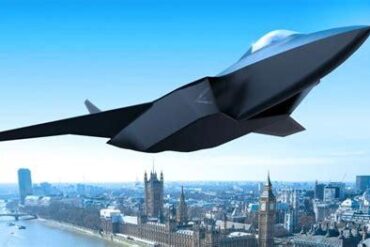
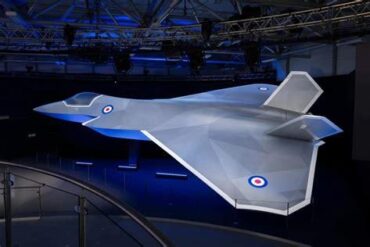
The greatest strategic beneficiary of FCAS’s collapse is almost certainly the Global Combat Air Programme (GCAP).
Originally developed from Britain’s Tempest initiative, GCAP now unites the United Kingdom, Italy, and Japan under a legally structured partnership emphasizing equal governance and clearly defined industrial responsibilities.
Unlike FCAS, governance arrangements were established before major engineering work accelerated.
That organizational clarity has allowed technical development to proceed with considerably fewer political disruptions.
Demonstration aircraft continue advancing toward flight testing, while operational service remains targeted for approximately 2035.
This schedule places GCAP substantially ahead of where FCAS had progressed before cancellation.
For Germany and Spain, the success of GCAP creates increasing pressure.
Every year that passes reduces opportunities to influence core aircraft architecture while simultaneously increasing dependence upon alternative procurement decisions.
Europe’s Strategic Challenge Has Become More Urgent
The broader consequences extend beyond industrial politics.
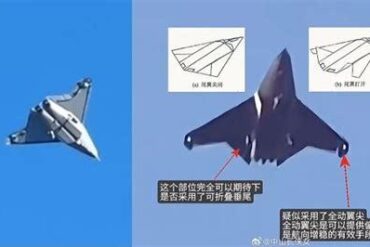
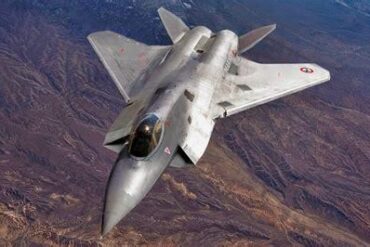
The United States continues advancing sixth-generation capabilities through programs including the Boeing F-47, while China reportedly continues testing multiple advanced combat aircraft concepts.
Against this increasingly competitive backdrop, Europe’s most ambitious collaborative fighter effort failed before demonstrating even a prototype.
The contrast is difficult to ignore.
Rather than showcasing European technological independence, FCAS exposed institutional weaknesses surrounding multinational defense cooperation, industrial governance, and competing national priorities.
The cancellation also leaves significant uncertainty regarding future force planning.
France appears likely to continue evolving the Rafale into future F5 and successor configurations.
Germany and Spain must now identify alternative pathways capable of replacing aging fighter fleets without introducing dangerous capability gaps during the 2030s and beyond.
Those decisions will shape European military aviation for decades.
The Real Lesson Behind FCAS’s Failure
The collapse of FCAS will likely be remembered less as an engineering disappointment than as a governance failure.
No revolutionary technology proved impossible.
No catastrophic budget crisis emerged.
No prototype crashed.
Instead, Europe’s largest combat aviation project became trapped between competing industrial champions whose commercial interests reflected equally legitimate national priorities.
Dassault sought to protect decades of sovereign fighter expertise.
Airbus defended Germany’s expectation of equal participation.
Both positions possessed strategic logic.
Unfortunately, those objectives could not coexist inside a single development framework.
The result is one of the most expensive program cancellations in European aerospace history.
FCAS began as a vision of European unity built around cutting-edge military technology. It ultimately demonstrated that advanced engineering can succeed only when political ambition, industrial governance, national strategy, and commercial incentives move in the same direction. Without that alignment, even a €100 billion program supported by Europe’s largest governments can spend nearly a decade in development without producing the aircraft it was created to build.