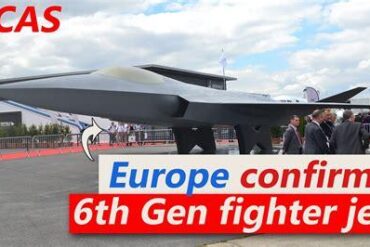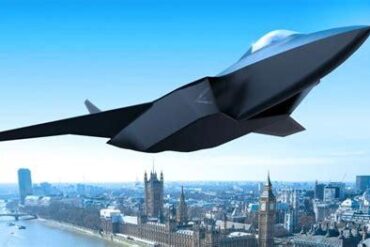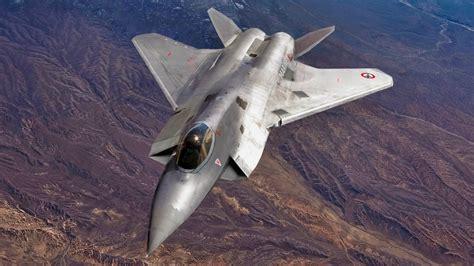
Europe’s ambitious €100 billion Future Combat Air System (FCAS) was conceived as a symbol of strategic unity — a sixth-generation air combat ecosystem designed to replace the Dassault Rafale and Eurofighter Typhoon while anchoring Europe’s technological sovereignty. Instead, it now stands at the brink of fragmentation. Mounting industrial tensions between Airbus, Dassault Aviation, and their respective national backers have raised a once-unthinkable scenario: a split into two separate fighter programs.
The implications stretch far beyond corporate rivalry. At stake is Europe’s defense-industrial architecture, its autonomy from American suppliers, and the financial logic of pooling resources to compete in a brutally expensive era of next-generation air warfare.
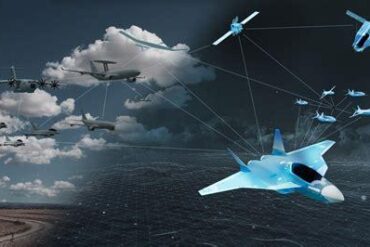
FCAS was never meant to be just another fighter jet. It is an integrated system-of-systems — a manned Next Generation Fighter (NGF) connected to unmanned remote carriers, advanced sensors, and a combat cloud network capable of orchestrating data dominance in contested environments. The vision promised scale, interoperability, and a unified European answer to the American F-35 Lightning II.
The Leadership Clash at the Core of FCAS
At the center of the dispute lies the NGF pillar. Dassault Aviation, prime contractor for the French-led element, insists on control over critical flight-control technologies and intellectual property. Airbus, representing German and Spanish interests, demands equitable workshare and influence proportionate to funding contributions. This is not a minor contractual disagreement; it is a contest over who defines Europe’s sixth-generation fighter DNA.
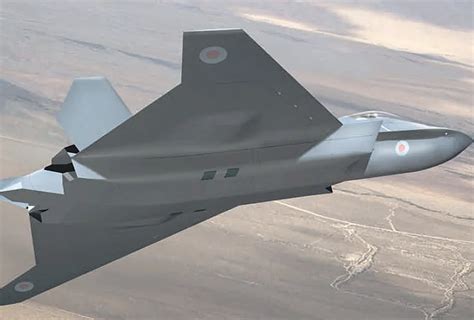
Airbus CEO Guillaume Faury has publicly signaled frustration. While calling for cooperation, he has also stated that Airbus possesses the industrial capacity to develop a fighter independently if necessary. The message is unmistakable: Airbus will not accept a subordinate role in a program financed heavily by Berlin and Madrid.
France, meanwhile, views sovereign control over combat aircraft as a non-negotiable strategic asset. Dassault’s stewardship of the Rafale is seen in Paris as proof that centralized leadership ensures coherence. Germany’s position is more complex. Berlin has openly questioned whether a nuclear-capable design aligns with its doctrine, and it continues to hedge with additional purchases of the American F-35 Lightning II to maintain NATO nuclear-sharing commitments.
The political undercurrents are impossible to ignore. France wants industrial primacy. Germany seeks balanced partnership. Spain, though quieter, aligns broadly with the German position. Without decisive alignment, the industrial tension calcifies into structural fracture.
Two Fighters, One Architecture? The Modular Split Scenario
One emerging compromise envisions a dual-fighter model: a French-led aircraft and a German-Spanish-led variant sharing common architecture, standards, and network integration. In theory, drones, sensors, and combat cloud components would remain unified, preserving partial economies of scale.
This approach attempts to ring-fence the NGF leadership dispute while keeping momentum alive in other FCAS pillars. The modularity concept hinges on interoperable interfaces and shared digital standards. If executed rigorously, Europe could field two aircraft that operate seamlessly within a single combat ecosystem.
Yet the risks are formidable. Two manned fighters mean duplicated research and development, parallel certification processes, and higher long-term sustainment costs. Defense budgets, even in an era of accelerated rearmament, are not infinite. History is littered with multinational programs that fractured under political strain.
The worst-case outcome would be technological divergence — two incompatible ecosystems locking Europe into decades of fragmentation. That scenario would weaken collective bargaining power with suppliers and undermine the strategic logic that justified FCAS in the first place.
Strategic Autonomy vs. Industrial Nationalism
Europe’s drive for defense autonomy has accelerated since Russia’s invasion of Ukraine. Governments are pouring funds into rearmament while pledging to reduce reliance on American platforms. FCAS was positioned as a flagship of that ambition.
But autonomy demands unity. Splitting the program could paradoxically reinforce dependence on non-European alternatives if one branch falters. Germany’s F-35 acquisitions illustrate the gravitational pull of proven systems when uncertainty clouds domestic projects.
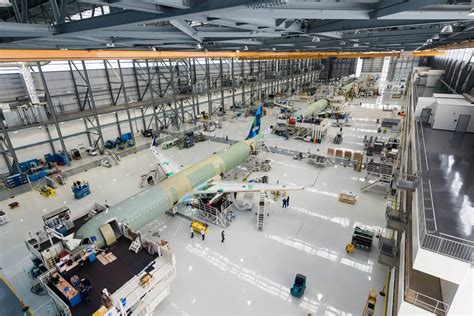
From an industrial perspective, Airbus commands formidable capabilities in systems integration, digital design, and cross-border production. Its defense and space division offers diversification against the cyclical volatility of commercial aviation. A German-Spanish-led fighter under Airbus control could secure decades of high-value engineering work and strengthen Europe’s technological base.
Dassault, for its part, is a highly profitable defense champion with deep expertise in advanced aerodynamics and combat aircraft integration. The company argues that centralized authority prevents diffusion of responsibility — a common ailment in multinational programs.
The clash, therefore, is not about competence. It is about governance philosophy. One side favors concentrated leadership. The other insists on distributed equity.
Financial Markets and the Cost of Fragmentation
Investors view FCAS through a lens of risk allocation. A clean political decision that clarifies leadership could unlock funding for the next development phase and stabilize expectations. Continued ambiguity, however, fuels concerns about duplicated spending and margin volatility.
Defense programs are capital-intensive and politically sensitive. Cost overruns, schedule delays, and shifting requirements can erode shareholder confidence. Airbus recently faced earnings pressure in its commercial segment; a protracted FCAS dispute adds another layer of uncertainty.
If Airbus assumes lead responsibility for a breakaway fighter, it could gain long-term strategic visibility in defense revenues. Yet it would also absorb substantial development risk. Markets reward clarity. They punish unresolved industrial chess matches.
Europe’s Defense Industry at a Crossroads
The broader European defense ecosystem watches FCAS closely. A split would send a signal about the limits of multinational cooperation in high-end military technology. It could reshape supplier relationships, research collaborations, and export strategies for decades.
The opportunity cost is significant. Sixth-generation fighters demand breakthroughs in stealth, artificial intelligence-assisted mission systems, advanced propulsion, and electronic warfare resilience. Pooling intellectual and financial capital was supposed to accelerate these innovations. Fragmentation may slow them.
At the same time, competition can catalyze progress. Two parallel programs might spur faster iteration, prevent complacency, and open alternative export pathways. The aerospace sector has long thrived on rival design philosophies. Innovation rarely emerges from uniformity alone.
Still, duplication without coordination is expensive ambition. Europe’s defense planners must weigh whether strategic symbolism justifies parallel development tracks.
The Decisive Months Ahead for FCAS
A near-term decision by France, Germany, and Spain is increasingly unavoidable. Without political arbitration, industrial negotiations risk stalling critical milestones. The transition from concept demonstrators to full-scale development requires contractual clarity and defined authority.
The choice is stark: consolidate under a unified structure or formalize a controlled split with enforceable interoperability standards. Drifting between those poles risks eroding both confidence and capability.
FCAS was envisioned as Europe’s answer to the evolving character of air warfare — a digital, networked, survivable combat system designed for mid-century threats. Whether it becomes a testament to continental cooperation or a case study in industrial divergence now depends on decisions taken in Berlin, Paris, and Madrid.
Europe stands at a paradoxical moment. It seeks unity in defense while navigating national priorities that pull in different directions. The €100 billion FCAS program was meant to embody shared ambition. Its future will reveal how far that ambition can stretch before it fractures — and whether Airbus’s willingness to go solo becomes leverage for compromise or the first step toward a divided European sky.