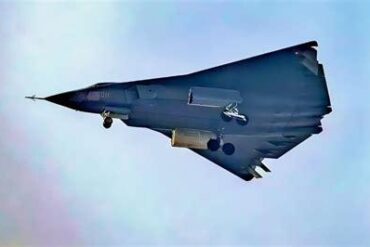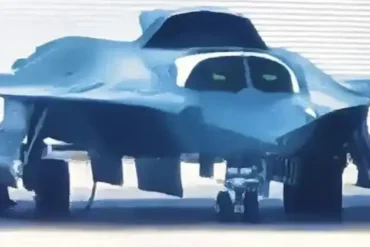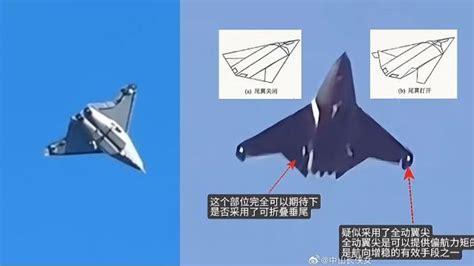
China’s pursuit of sixth-generation fighter technology has become one of the most closely watched developments in global military aviation. Among the most prominent voices dissecting this progress is Justin Bronk, a respected airpower specialist at the Royal United Services Institute (RUSI). His insights into China’s J36 and J50 programs offer rare depth in an arena often clouded by secrecy and speculation. As Bronk outlines, the existence of two parallel sixth-generation aircraft programs signals not only China’s evolving aerospace ambitions but also fundamental differences in strategic thought compared to the United States.
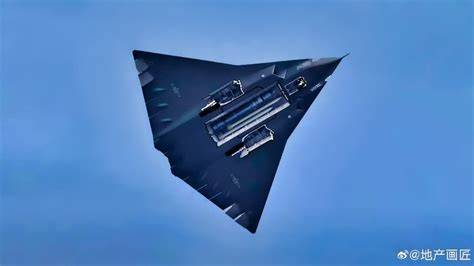
The Shenyang J50 and Chengdu J36—as these next-generation Chinese fighters are commonly referred to—have already made public test flights, a rare move that seems aimed at showcasing Beijing’s technological leap. These aircraft depart significantly from the stealth-fighter archetypes of the fifth generation, such as the J-20 and F-35, and represent a radical shift in form and function, underscoring China’s broader ambitions for air superiority, power projection, and electronic dominance.
A Dual-Track Strategy: Why Two Sixth-Gen Fighters?
Western observers might question why China is developing two different sixth-generation platforms instead of streamlining efforts into a single, more economical fighter. As Bronk highlights, this divergence is not unusual for China. The nation has a long-standing precedent of conducting parallel military aircraft development programs—a practice that diverges sharply from the more centralized, cost-sensitive approaches typically seen in Western defense procurement.
China’s military-industrial complex, still deeply rooted in state-controlled structures, often prioritizes industrial scale, employment, and technological diversification over streamlined efficiency. By sustaining both Shenyang Aircraft Corporation and Chengdu Aerospace Corporation as viable design competitors, China hedges its bets and fosters technological innovation across distinct aerospace disciplines. This strategic redundancy is seen not as wasteful but as a mechanism to preserve and expand industrial capacity, workforce expertise, and strategic options.
Design Philosophies: J50 vs J36
At a technical level, the J50 and J36 represent dramatically different design philosophies, suggesting divergent operational roles.
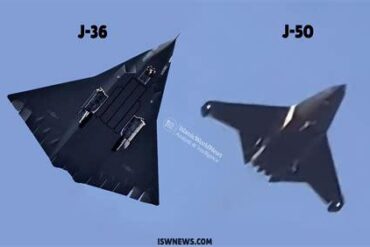
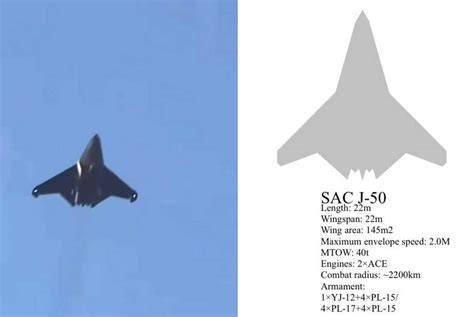
The Shenyang J50, according to Bronk, is the smaller of the two and adheres more closely to the traditional fighter profile in terms of size and assumed performance envelope. Its cranked-diamond fuselage, twin intakes, and twin-engine layout evoke the aerodynamic efficiency required for air superiority missions. However, its tailless structure and broadband stealth features indicate a clear push toward radar invisibility across a wider range of frequencies—surpassing the stealth performance of earlier Chinese fighters like the J-20 or J-35.
Meanwhile, the Chengdu J36 is a behemoth by comparison. With a triple-engine configuration, dorsal and ventral intakes, and a radically futuristic airframe, the J36 is likely tailored for deep-strike roles, long-range missions, and persistent electronic warfare capabilities. Bronk describes it as akin to a “double Dorito” in shape—an unorthodox form that maximizes stealth while hinting at high internal fuel and payload capacities. This aircraft seems built for sustained operations at high altitudes and speeds, placing it in a category closer to a stealthy strategic bomber than a conventional multirole fighter.
Public Demonstrations as Geopolitical Signaling
Unlike previous generations of Chinese aircraft that were shrouded in mystery until operational deployment, both the J50 and J36 have appeared in public test flights—some even in broad daylight over populated regions. Bronk interprets this as intentional signaling, targeting multiple audiences.
Domestically, these flights demonstrate technological prowess, reinforcing the Communist Party’s narrative of national rejuvenation through innovation. Regionally, they serve as a message to rivals like Japan, South Korea, and India that China is not just catching up—it is potentially leapfrogging. For the United States and NATO, the sight of such advanced demonstrators in open skies is a geopolitical declaration that China is an independent force in the development of sixth-gen military aviation.
This transparency also contrasts with the American NGAD (Next Generation Air Dominance) program, where secrecy is tightly held and demonstrators are rarely seen. Bronk notes that while the U.S. also ran parallel prototypes before choosing Boeing’s design for the F-47, these were not made visible to the public, reflecting divergent strategies in information warfare and deterrence.
Industrial Parallelism as Policy
China’s approach to military R\&D is deeply influenced by its political economy. As Bronk suggests, the legacy of centralized state planning continues to shape defense decisions. Multiple projects run in parallel not simply for redundancy but to ensure widespread employment, stimulate regional economies, and maintain strategic autonomy across industrial domains.
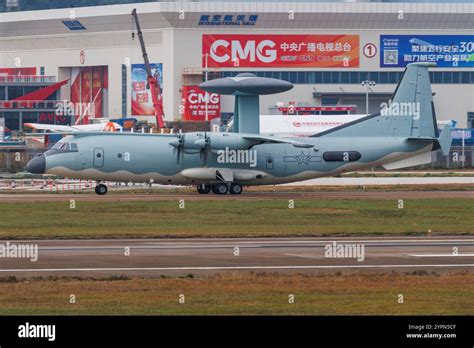
This philosophy is evident not just in fighters but across the Chinese military aviation landscape. For instance, China’s airborne early warning and control (AEW\&C) development includes simultaneous programs like the KJ-2000, based on the Russian Il-76 airframe; the KJ-500, a turboprop solution; and other platforms like the KJ-600 for naval applications. The result is a diverse, layered force structure that doesn’t depend on single-point solutions but instead builds resiliency through redundancy.
Strategic Roles and Mission Profiles
From a strategic lens, the divergence in design between the J50 and J36 suggests multi-layered mission differentiation. The J50 appears optimized for tactical air dominance, potentially operating as an airspace denier in contested environments. With its focus on agility, stealth, and presumably high-speed performance, it may serve roles akin to the F-22 Raptor—fast, nimble, lethal, and hard to see.
The J36, in contrast, hints at something closer to the U.S. B-21 Raider in strategic utility. Its immense size and likely internal volume suggest an aircraft capable of carrying hypersonic weapons, EW payloads, and perhaps even autonomous drone control systems. Its ability to fly long distances undetected could give China first-strike capabilities against hardened targets across the Indo-Pacific and beyond, directly challenging U.S. force projection norms.
What We Still Don’t Know
Despite visible prototypes and speculation, much about both aircraft remains unknown. Key areas include:
- Propulsion systems: There’s no confirmed data on the engines powering either platform. China’s previous reliance on Russian designs makes this a critical unknown.
- Sensor fusion and avionics: True sixth-gen capabilities depend on data integration, AI, and electronic warfare systems, none of which have been publicly detailed.
- Networking and loyal wingman integration: It is unclear whether either aircraft is designed to operate autonomously or as part of a larger AI-assisted combat cloud.
- Production timelines: While test flights indicate significant progress, full-scale production, especially of such complex platforms, remains a massive undertaking.
Conclusion: A Pivotal Shift in Airpower Doctrine
Bronk’s assessment of China’s sixth-generation programs underscores a transformative moment in global airpower. For decades, the United States led not only in technology but also in the philosophy of how air superiority should be pursued. China, through its dual development of the J36 and J50, is challenging that paradigm—not just by replicating capabilities but by innovating independently and redefining the fighter concept itself.
If successful, these platforms will not only give China unmatched operational flexibility but will also force a recalibration of Western air strategies, particularly across the Indo-Pacific. The rise of China’s sixth-gen fighters is not just about technology—it is about shaping the rules of future conflict. The world should be watching very closely.