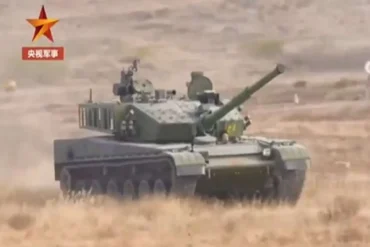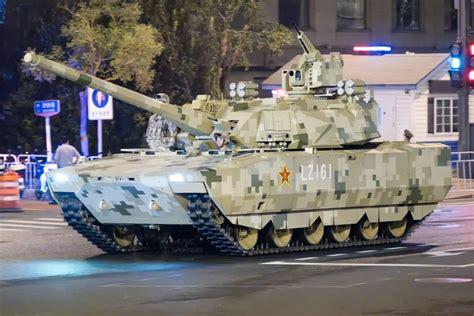
China’s People’s Liberation Army (PLA) has officially begun deploying its new Type 100 main battle tank (MBT) — a fourth-generation armored platform designed for beyond visual line of sight (BVLOS) targeting and network-centric warfare. According to the Global Times report dated October 13, 2025, this advanced combat system marks a defining evolution in China’s ground forces, transforming tanks from traditional close-range brawlers into digitally integrated strike nodes within a multi-domain battlefield network.
A New Era of Networked Armored Warfare
The Type 100, also referred to as the ZTZ-100, is developed by the 201st Research Institute and produced at the Baotou Tank Plant. It embodies China’s strategic shift toward data-driven, connected warfare, integrating optical, infrared, and radar sensors that communicate in real time with aviation, artillery, and electronic warfare assets. This capability allows tank crews to detect, track, and strike enemy targets at long range — even when they remain hidden from direct sightlines.
During recent combined-arms exercises, PLA commanders demonstrated how augmented reality (AR) interfaces and hybrid propulsion systems enabled the tanks to identify and destroy targets beyond visual range. Tank commander Sun Yongming explained that the system allows operators to perceive the battlefield “from all directions,” effectively transitioning from conventional close-range combat to extended-distance engagements. Another officer, identified as Commander Yuan, described how joint communications link the tank battalion to other branches, allowing synchronized operations with drones, rocket artillery, and EW (electronic warfare) units.
Technical Foundation: A Fourth-Generation Tank Philosophy
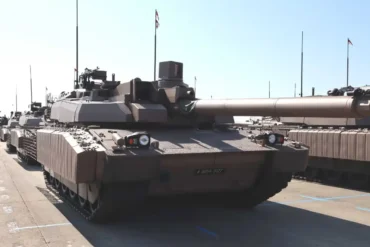
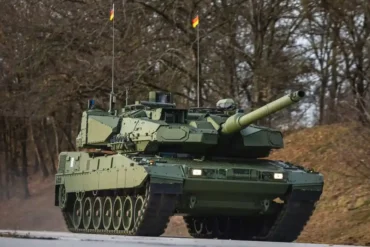
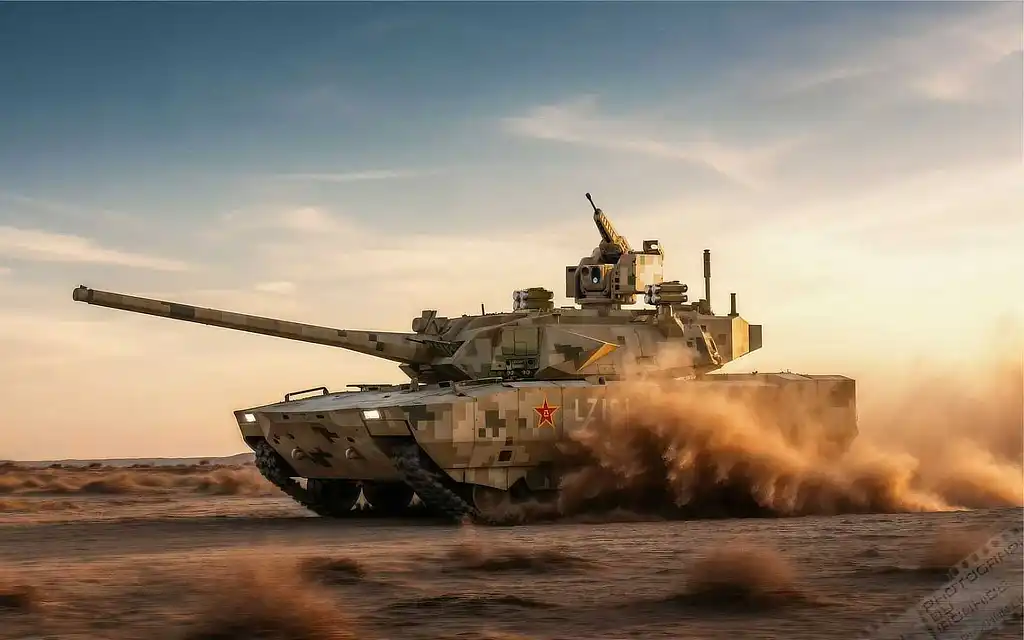
Unlike earlier PLA designs emphasizing heavy armor, the Type 100 represents a conceptual leap. It prioritizes situational awareness, networked engagement, and survivability through active defense rather than sheer armor thickness. Its design philosophy mirrors trends seen in next-generation Western armored systems, such as the U.S. Optionally Manned Tank (OMT) concept and Russia’s T-14 Armata.
The Type 100 is reported to feature a hybrid diesel-electric powertrain generating approximately 1,500 horsepower. This configuration allows a top road speed of 80 km/h and 50 km/h off-road, combining power and stealth. The hybrid system supports limited electric-only movement, enabling the tank to approach silently while minimizing infrared and acoustic signatures — an advantage in drone-dense battlefields. It also powers onboard sensors, radar, and defensive systems independently of the combustion engine, ensuring operational continuity even when stationary.
Armament and Fire Control: Precision Beyond Line of Sight
The tank’s 105 mm autoloaded main gun delivers muzzle velocities near 1,706 meters per second, rivaling the performance of NATO’s 120 mm and Russia’s 125 mm smoothbore cannons. This weapon is optimized for long-range, precision-guided munitions, leveraging sensor fusion from onboard and remote data feeds. The unmanned turret design enables increased ammunition storage and protection for the crew, who operate from a sealed armored capsule in the front hull.
Secondary armament includes a coaxial 7.62 mm machine gun and a 12.7 mm remote weapon station for anti-aircraft and counter-drone defense. Integrated with radar and optical tracking systems, the tank can automatically engage aerial or ground threats detected within its network grid.
Layered Protection and Active Defense Systems
Protection on the Type 100 is achieved through an intricate multi-spectral active defense system. The tank employs two GL-6 active protection modules, each with four countermeasure launchers, coordinated by phased-array radar panels located at each turret corner. These panels provide 360-degree threat coverage, intercepting anti-tank guided missiles (ATGMs), rocket-propelled grenades (RPGs), and top-attack munitions before they strike.
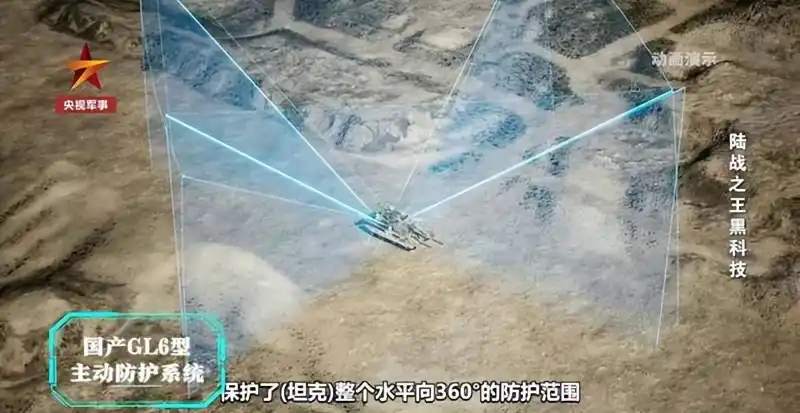
Complementing this setup are laser warning receivers, ultraviolet sensors, and multi-band optical arrays that feed data into the crew’s AR system. The hull’s polygonal, faceted design enhances radar deflection and contributes to the tank’s low observable signature, while also accommodating electronic warfare components that can jam or spoof enemy sensors. In the event of internal explosions or pressure buildup, the turret’s automated venting system channels energy away from the crew capsule, maintaining survivability.
Augmented Reality and the Digital Crew Capsule
Inside the Type 100, the three-person crew operates using augmented reality headsets connected to a 360-degree network of cameras, radars, and sensors. These headsets create a composite external view, effectively allowing operators to “see through” armor plating. Real-time overlays display targeting data, vehicle health, and environmental readings, ensuring instantaneous situational awareness.
This system allows the gunner to aim and fire simply by aligning their gaze, while the commander can oversee multiple feeds and issue coordinated commands across the network. The driver navigates using AR-enhanced terrain mapping, enabling precision maneuvers even in low-visibility conditions. Analysts note that this setup resembles the U.S. Army’s Integrated Visual Augmentation System (IVAS) and the Apache AH-64’s Helmet Mounted Display, suggesting an international convergence in armored-crew interface design.
Operational Concept: Tanks as Digital Warfare Nodes
The Type 100 represents more than a new tank — it’s a redefinition of armored warfare doctrine. Instead of functioning as isolated heavy platforms, tanks now act as battlefield data relays, linking ground, air, and electronic units into a single combat network. During exercises, the Type 100 coordinated with rocket artillery batteries, electronic warfare vehicles, and reconnaissance drones, each feeding live data into a unified command structure.
This networked ecosystem allows tank formations to detect and destroy threats long before enemy sensors locate them. Chinese military commentators argue that this integration of long-range sensors and indirect fire assets brings ground warfare closer to air and naval engagement standards, extending the reach and speed of PLA responses.
The Companion Platform: Type 100 Fire Support Vehicle
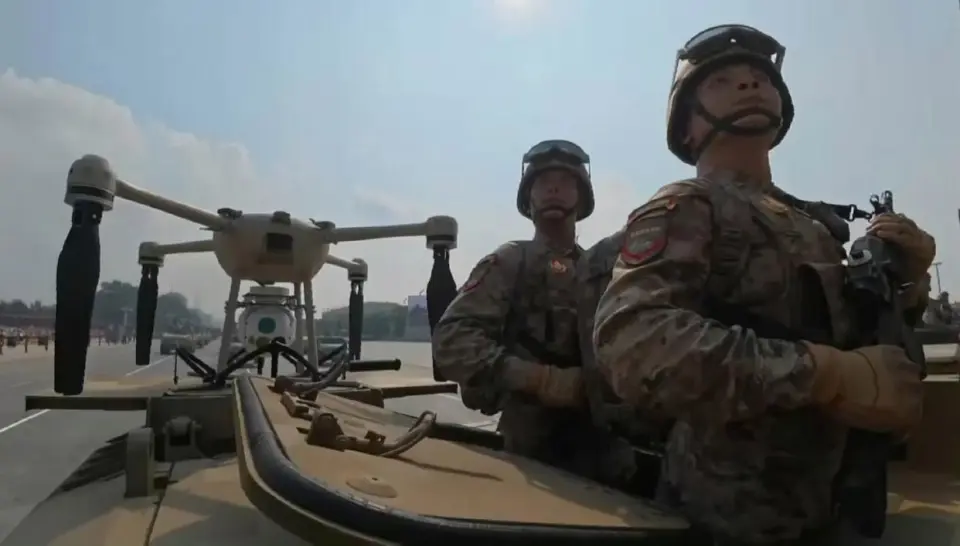
Accompanying the main battle tank is the Type 100 Fire Support Vehicle (FSV) — a variant unveiled during the same Victory Day parade in Beijing. The FSV uses the same hybrid propulsion system but is fitted with a 30 or 35 mm automatic cannon for anti-infantry and light armor support. It carries two reconnaissance drones mounted at the rear for real-time surveillance and target acquisition.
This companion vehicle also features a GL-6-derived active protection suite, mirroring the tank’s defensive layout, and includes an auxiliary power unit (APU) for silent electronic operations. With space for a small infantry team, it supports combined arms tactics, functioning as both scout and shield for the main tank.
Strategic Implications and Global Context
The introduction of the Type 100 aligns with China’s broader defense modernization blueprint, which emphasizes artificial intelligence integration, electronic warfare, and autonomous vehicle operations. Analysts suggest that this tank may serve as a testing platform for AI-assisted combat algorithms, capable of sharing threat data across PLA networks in milliseconds.
Internationally, the move places China alongside the few nations pursuing true fourth-generation armored systems, a category characterized by unmanned turrets, hybrid propulsion, and integrated battlefield networking. The PLA’s focus on BVLOS engagement also reflects lessons learned from observing modern conflicts — particularly the Ukraine war, where drones and networked targeting reshaped the dynamics of tank warfare.
Western military experts note that, if fielded in significant numbers, the Type 100 could transform PLA ground operations by merging speed, stealth, and sensor fusion into a single operational package. Its ability to function within multi-domain coordination frameworks makes it a strategic multiplier, extending the PLA’s reach without necessarily increasing visible force presence.
The Future Battlefield: Silent, Networked, and Autonomous
As the Type 100 begins integration into PLA armored divisions, it symbolizes the future of mechanized warfare — one where mobility, information dominance, and survivability outweigh brute armor thickness. The combination of hybrid-electric stealth, AI-assisted targeting, and AR-driven crew coordination positions this tank as a core instrument of China’s next-generation warfighting strategy.
Experts predict that future iterations could incorporate autonomous navigation, swarm coordination with drones, and direct satellite uplinks, effectively blending ground armor into the digital command web that underpins the PLA’s broader military transformation. With these advancements, the Type 100 is more than a weapon — it is a manifestation of China’s intent to lead the next era of land warfare technology.

Conclusion
The unveiling and fielding of the Type 100 main battle tank represent a turning point in Chinese armored warfare evolution. By integrating beyond-visual-line-of-sight strike capability, multi-spectral protection, and networked operations, the tank transcends traditional battlefield limitations. Its hybrid powertrain, AR command systems, and active defense architecture make it one of the most technologically advanced armored vehicles currently in service. As the PLA continues refining its digital combat doctrine, the Type 100 stands as a visible symbol of China’s ambition — to dominate future conflicts not through sheer mass, but through intelligence, integration, and precision.