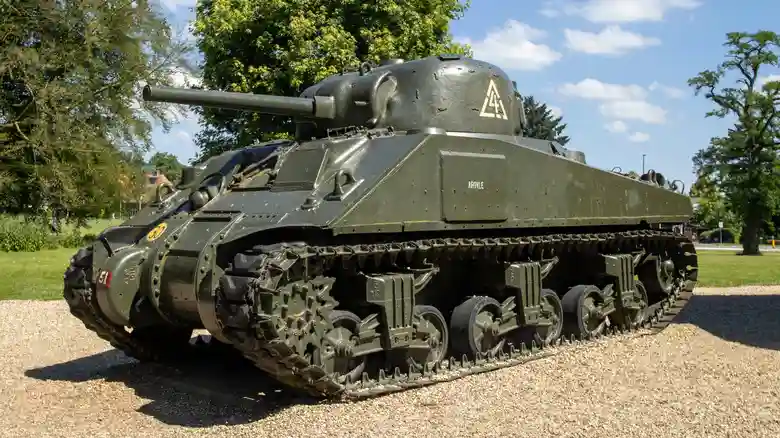
The M4A4 Sherman occupies a unique place in military history because it carried one of the most unconventional engines ever installed in a mass-produced armored vehicle. While the Sherman family became synonymous with Allied industrial might during the Second World War, the M4A4 distinguished itself by solving a manufacturing crisis with remarkable creativity. Instead of relying on a traditional single engine, Chrysler engineers effectively merged five separate automobile engines into a single powerplant, creating a massive 30-cylinder machine that helped keep American tank production moving at full speed during one of history’s most demanding industrial mobilizations.
The result was neither elegant nor simple, yet it proved that necessity truly is the mother of invention. The M4A4 demonstrated that engineering brilliance does not always mean designing something entirely new. Sometimes it means taking proven technology, adapting it in unexpected ways, and delivering exactly what wartime production requires.
Why America Needed An Unconventional Sherman Tank Engine
By the time the United States fully entered World War II after 1941, military production expanded at an extraordinary pace. Thousands of armored vehicles were required not only for American forces but also for Allied nations fighting across Europe, North Africa, and the Pacific. Factories capable of producing tanks multiplied rapidly, but one critical problem soon emerged: there simply were not enough suitable tank engines available.
Aircraft manufacturers understandably received priority for powerful radial engines, while other heavy-duty engines faced overwhelming competition from multiple military programs. Rather than allowing engine shortages to slow Sherman production, American planners encouraged multiple manufacturers to develop different solutions that could power essentially the same tank design. This flexible manufacturing philosophy became one of the defining strengths of the Sherman program.
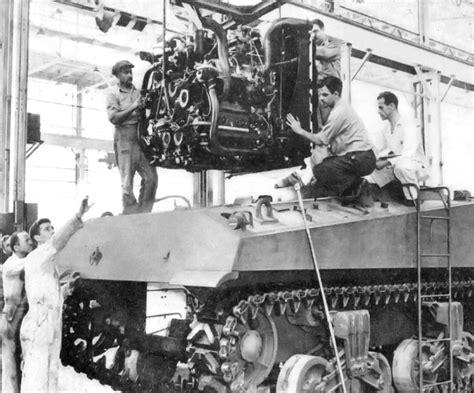
Instead of depending on a single supplier, several Sherman variants entered production using entirely different powerplants. This approach ensured that if one production line encountered shortages, other factories could continue building tanks using alternative engines without interrupting overall output.
Chrysler’s Brilliant Yet Bizarre A57 Multibank Engine
Among all the available solutions, Chrysler’s answer was undoubtedly the most extraordinary. Rather than spending valuable months designing an entirely new military engine, the company looked toward something it already produced in large numbers: its dependable 251-cubic-inch flathead inline-six automobile engine.
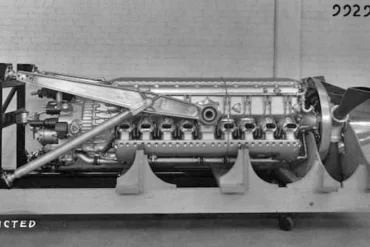
Engineers arranged five identical six-cylinder engines around a common central gearbox, connecting all five crankshafts to a single output shaft. Together, these independent engines functioned as one enormous 30-cylinder A57 Multibank engine weighing roughly two tons.
The specifications sounded almost unbelievable. The engine contained five carburetors, five distributors, thirty spark plugs, five water pumps, and numerous interconnected mechanical systems that all had to operate in harmony. Combined displacement exceeded 1,250 cubic inches, while total output reached approximately 370 horsepower, more than sufficient to move the 30-ton Sherman across difficult terrain.
Although mechanically intimidating, Chrysler relied heavily on components already proven in civilian production. This reduced manufacturing complexity while allowing existing factories to continue producing familiar parts instead of retooling for an entirely new engine design.
How The Multibank Engine Changed The M4A4 Sherman
The enormous engine inevitably altered the tank itself. The A57 occupied significantly more space than competing Sherman powerplants, forcing engineers to stretch the rear hull by nearly 11 inches. This modification increased the spacing between the suspension bogies and gave the M4A4 its instantly recognizable profile among Sherman variants.
Despite these structural changes, the tank preserved the characteristics that made the Sherman one of the war’s most successful medium tanks. It remained mechanically dependable, relatively easy to manufacture, straightforward to repair in combat zones, and offered an effective balance between mobility, armor protection, and firepower.
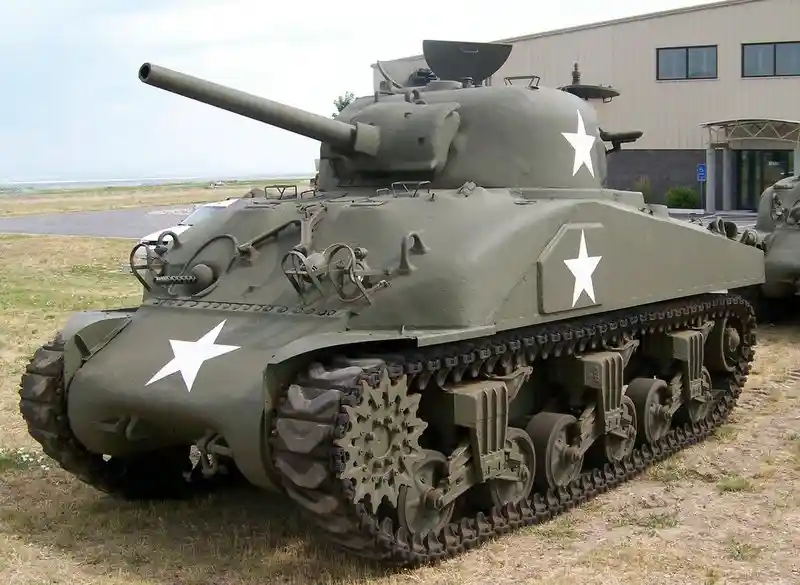
The M4A4 therefore represented far more than simply an unusual engineering experiment. It became tangible proof that intelligent manufacturing adaptations could solve enormous logistical challenges without compromising battlefield performance.
The Sherman Variant Built For Allied Armies
Ironically, although the M4A4 rolled off American production lines, relatively few entered service with the U.S. Army itself. American armored forces generally preferred the Ford GAA V8-powered M4A3, which eventually became the Army’s favored Sherman model.
Instead, the overwhelming majority of M4A4 tanks traveled overseas through the Lend-Lease program, supplying Britain and numerous Allied nations with desperately needed armored vehicles. British forces designated the vehicle the Sherman V, and it became a familiar sight throughout the Italian Campaign, Northwest Europe, and following the Normandy landings.
Production numbers reflected the importance of the design. Approximately 7,499 M4A4 tanks were manufactured, with more than 7,400 ultimately serving Allied forces outside the United States. This remarkable distribution highlighted America’s role as the industrial backbone supporting coalition warfare across multiple continents.
Reliability Improved As Wartime Experience Grew
Early production naturally experienced growing pains. Maintaining five interconnected engines demanded new procedures, while cooling systems, piston rings, and exhaust valves required refinement before achieving their intended reliability.
Engineers continuously improved these systems throughout production. As modifications accumulated, the A57 became steadily more dependable, eventually passing the U.S. Army’s demanding 400-hour endurance test during 1944. By then, the M4A4 had earned recognition as one of the most reliable Sherman variants, surpassed only by the exceptionally successful M4A3.
Its complexity never disappeared entirely. Fuel consumption remained relatively high, and servicing multiple carburetors and ignition systems required additional time. Nevertheless, mechanics gradually discovered that the engine’s modular nature actually simplified many repair tasks because each six-cylinder bank closely resembled familiar civilian automobile engines.
As experience increased, maintenance crews developed confidence in diagnosing and repairing the unusual powerplant, transforming what initially appeared to be a liability into a manageable maintenance routine.
An Unexpected Battlefield Advantage: Built-In Redundancy
Perhaps the most fascinating characteristic of the Chrysler Multibank was its remarkable redundancy. Since the engine effectively consisted of five separate six-cylinder units, damage to one section did not automatically disable the entire vehicle.
Chrysler famously claimed that the M4A4 could continue operating even after losing up to 12 of its 30 cylinders. Although performance would obviously suffer, retaining mobility under combat conditions could mean the difference between escape and destruction.
For tank crews operating under constant threat from anti-tank guns, mines, and artillery, this redundancy represented far more than an engineering curiosity. A damaged tank that could still retreat behind friendly lines dramatically improved crew survival while preserving valuable equipment for repair.
This resilience helped strengthen the M4A4’s battlefield reputation and demonstrated that unconventional engineering occasionally produced unexpected tactical benefits beyond its original manufacturing purpose.
The Legacy Of The Five-Engine Sherman
The M4A4 Sherman remains one of the most fascinating examples of wartime innovation because it perfectly illustrates how industrial necessity shaped military technology. Chrysler’s decision to combine five reliable automobile engines into one enormous powerplant solved a production bottleneck without delaying tank manufacturing at a moment when every completed vehicle mattered.
Although later overshadowed by more conventional Sherman variants, the M4A4 proved that creative engineering could overcome shortages through adaptation rather than reinvention. Its distinctive silhouette, unforgettable 30-cylinder Chrysler A57 Multibank, and extensive service with Allied forces transformed what initially seemed like an awkward compromise into one of the Second World War’s most successful examples of practical industrial ingenuity. The five-engine Sherman ultimately became far more than an engineering oddity—it became a powerful symbol of how innovation, flexibility, and mass production combined to help secure Allied victory.