Classification of Airspace
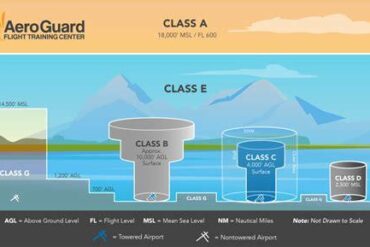
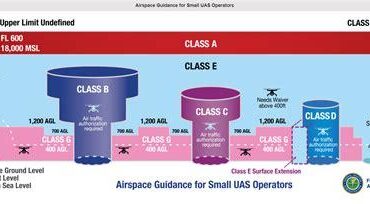
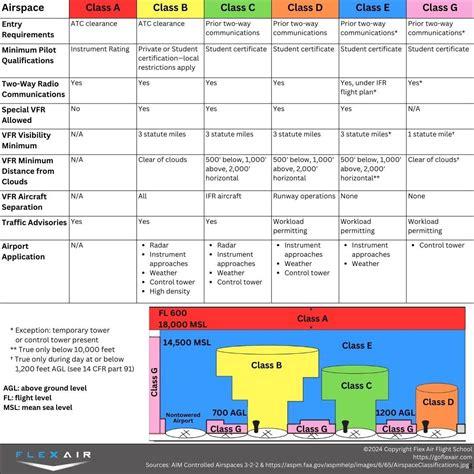
Airspace is divided into different classes to ensure safety and efficiency in aviation. Here’s a breakdown of each class:
Class A: Only IFR flights are allowed here. All aircraft receive air traffic control (ATC) service, ensuring they are separated from each other.
Class B: Both IFR and VFR flights can operate in this space. Again, ATC service is provided, maintaining separation between all aircraft.
Class C: This class also accommodates IFR and VFR flights. IFR flights are separated from other IFR flights as well as VFR flights. VFR flights receive traffic information about other VFR flights.
Class D: IFR and VFR flights are permitted. ATC provides service, separating IFR flights from one another while giving VFR flights traffic information about all other flights.
Class E: IFR and VFR flights may operate here. IFR flights receive ATC service and are separated from other IFR flights. All flights get traffic information where practical. Note that Class E cannot be used for control zones.
Class F: Both IFR and VFR flights can participate. IFR flights receive advisory services, while all flights can request flight information services.
Class G: This is uncontrolled airspace where both IFR and VFR flights are allowed. They can also request flight information services.
Here’s a summary of the services and requirements for each airspace class:
Airspace Classification Table
| Class | Type of Flight | Separation | Service Provided | Speed Limitation | Radio Communication Requirement | ATC Clearance |
|---|---|---|---|---|---|---|
| A | IFR only | All aircraft | Air traffic control service | Not applicable | Continuous two-way | Yes |
| B | IFR | All aircraft | Air traffic control service | Not applicable | Continuous two-way | Yes |
| VFR | All aircraft | Air traffic control service | Not applicable | Continuous two-way | Yes | |
| C | IFR | IFR from IFR/VFR | Air traffic control service | Not applicable | Continuous two-way | Yes |
| VFR | VFR from IFR | Traffic information service | 250 kts IAS below 10,000 ft | Continuous two-way | Yes | |
| D | IFR | IFR from IFR | ATC service, traffic info on VFR | 250 kts IAS below 10,000 ft | Continuous two-way | Yes |
| VFR | Nil | Traffic information service | 250 kts IAS below 10,000 ft | Continuous two-way | Yes | |
| E | IFR | IFR from IFR | ATC service, traffic info on VFR | 250 kts IAS below 10,000 ft | Continuous two-way | Yes |
| VFR | Nil | Traffic information service | 250 kts IAS below 10,000 ft | No | No | |
| F | IFR | IFR from IFR | Advisory service; flight info | 250 kts IAS below 10,000 ft | Continuous two-way | No |
| VFR | Nil | Flight information service | 250 kts IAS below 10,000 ft | No | No | |
| G | IFR | Nil | Flight information service | 250 kts IAS below 10,000 ft | Continuous two-way | No |
| VFR | Nil | Flight information service | 250 kts IAS below 10,000 ft | No | No |
Important Notes:
- In Class D airspace, both IFR and VFR traffic must follow ATC clearances. However, ATC is only responsible for separation between IFR flights.
- In Class E airspace, ATC does not provide separation between IFR and VFR traffic. IFR traffic shares the responsibility for separation with uncontrolled VFR traffic.