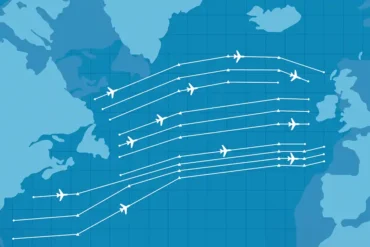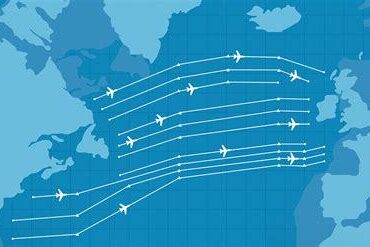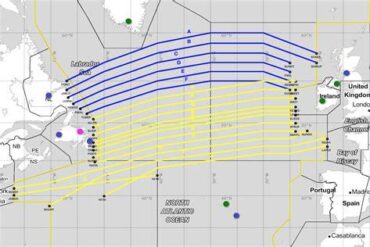
The North Atlantic (NAT) airspace connects Europe and North America, making it the busiest oceanic airspace globally. In 2012, around 460,000 flights crossed this region, with traffic steadily rising. Most parts of the NAT lack Direct Controller Pilot Communications (DCPC) and ATS Surveillance. To ensure safety, high standards for navigation performance and operating discipline are required. This article gives an overview of the NAT airspace, including its divisions and operating rules.
The North Atlantic Region
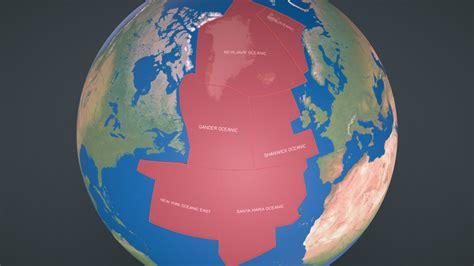
The North Atlantic Region covers nearly all non-domestic airspace over the Atlantic Ocean, stretching from about 20° north latitude to the North Pole, excluding New York Oceanic West airspace. It consists of seven Oceanic Control Areas (OCAs) / Flight Information Regions (FIRs):
-
Nuuk BGGL FIR (controlled by Gander south of 63°30″ N, and by Reykjavik north of that latitude)
-
Reykjavik OCA / BIRD FIR
-
Bodø Oceanic ENOB FIR / Bodø OCA (above FL195)
-
Gander OCA / CZQX FIR
-
Shanwick OCA / EGGX FIR
-
New York Oceanic East OCA / KZWY FIR
-
Santa Maria OCA / LPPO FIR
Additionally, domestic Controlled Terminal Areas (CTAs) and Terminal Maneuvering Areas (TMAs) exist within the NAT, including Reykjavik (Iceland) and Santa Maria (The Azores).
Flight Rules
Above the high seas, the lower limit for all NAT oceanic control areas is FL55, with no upper limit. Airspace at and above FL55 is classified as Class A controlled airspace, while below FL55 is Class G uncontrolled airspace. All flights operating at or above FL60 must follow Instrument Flight Rules (IFR), even in clear weather. Visual Flight Rules (VFR) clearance for climbing or descending in Visual Meteorological Conditions (VMC) will not be given.
Strategic Lateral Offset Procedures (SLOP)
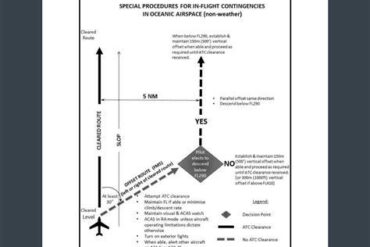
Strategic Lateral Offset Procedures (SLOP) are both authorized and encouraged within this airspace.
Separation
Separation in NAT airspace is procedural, relying on altitude, distance, and time. Vertical separation of 1,000 feet is maintained between FL60 and FL280, and flights above FL410 are separated by 2,000 feet. Lateral separation is based on distance, roughly one degree of latitude (60 nautical miles). Performance Based Communications and Surveillance (PBCS) tracks allow certified aircraft to operate on tracks separated by half a degree. Longitudinal separation relies on time intervals, with a standard separation of 10 minutes between aircraft following the same route. Adjustments are made for differences in aircraft speed. It’s crucial that timekeeping devices are accurate and synchronized to UTC time before entering NAT airspace to maintain appropriate separation.
Operation of Transponders
Transponders must be active at all times in the NAT region, set to squawk Code 2000. However, the last assigned ATC code should be retained for 30 minutes after entering NAT airspace unless instructed otherwise by ATC. An exception exists for specific routes where a change to Code 2000 should occur shortly after passing designated waypoints. Transponder codes issued by Reykjavik ACC must also be retained until instructed by ATC.
High Level Airspace (HLA)
Much of the North Atlantic airspace between FL285 and FL420 is classified as High Level Airspace (HLA). Prior to February 2016, this area was Minimum Navigation Performance Standards (MNPS) airspace. The transition to HLA reflects a shift to Performance Based Navigation (PBN). The HLA includes airspace controlled by Gander, Reykjavik, Bodø, Shanwick, Santa Maria, and part of New York Oceanic East. Approval processes ensure that aircraft meet defined NAT HLA standards and follow proper crew procedures and training.
Provisions for Aircraft Not Meeting HLA/MNPS Criteria
Aircraft that do not meet HLA navigation requirements can fly above FL420 or below FL285. Special routes, known as “Blue Spruce Routes,” are available for aircraft with only one Long Range Navigation System (LRNS) needing to cross the North Atlantic. These routes require state approval. Additionally, interim use is allowed for aircraft that have lost navigation capability but are typically approved for unrestricted NAT HLA operations.
Reduced Vertical Separation Minimum (RVSM) Airspace
Reduced Vertical Separation Minima (RVSM) applies from FL290 to FL410 in all NAT HLA. Non-RVSM certified aircraft will be cleared above or below RVSM airspace. Special approval may allow some MNPS approved aircraft that are not RVSM compliant to enter NAT HLA under specific circumstances.
Data Link Mandated Airspace
The first phase of the data link mandate for the NAT region started on February 7, 2013. All aircraft on specified tracks at FL360 to FL390 were required to use Controller Pilot Data Link Communications (CPDLC) and Automatic Dependent Surveillance – Contract (ADS-C). Subsequent phases expanded the mandated airspace to include additional altitude bands. Currently, aircraft must be equipped with FANS 1/A or equivalent to operate in this airspace. Certain flight categories may still be allowed to operate without the required equipment on a tactical basis. A corridor will also be available for non-equipped aircraft, requiring ADS-B equipment.