North Atlantic Operations – Organised Track System
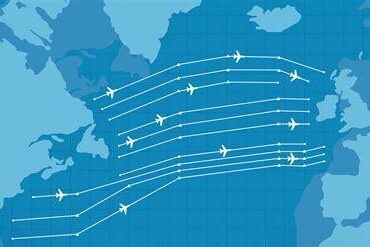
The North Atlantic (NAT) airspace connects Europe and North America, making it the busiest oceanic airspace worldwide. In 2012, around 460,000 flights crossed this region, and that number continues to rise. Unfortunately, Direct Controller Pilot Communications (DCPC) and ATS Surveillance are not available in most areas of the NAT. Thus, ensuring aircraft separation and safety relies on strict navigation performance and operational discipline. This article will provide an overview of the Organised Track System (OTS), the busiest segment of this airspace.
General Overview
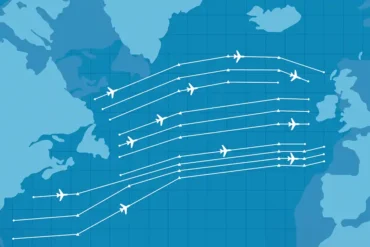
Air traffic over the North Atlantic mainly consists of two alternating flows: westbound flights from Europe in the morning and eastbound flights from North America in the evening. This pattern is influenced by time zone differences, airport noise restrictions, and passenger demand. Consequently, most traffic moves in one direction, with peak westbound flights crossing 30° west longitude between 1130 and 1900 UTC. Conversely, peak eastbound traffic crosses 30°W between 0100 and 0800 UTC. The large horizontal separation criteria in NAT airspace and a limited altitude band (FL310–400) for most commercial flights lead to congestion during peak hours. To best serve the majority of flights, a system of organised tracks is created to accommodate as many flights as possible along their optimal paths and altitudes.
Dynamic Nature of OTS
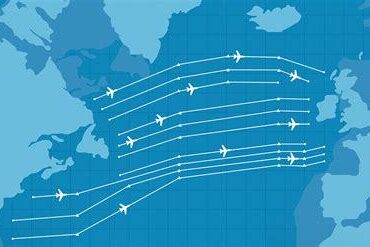
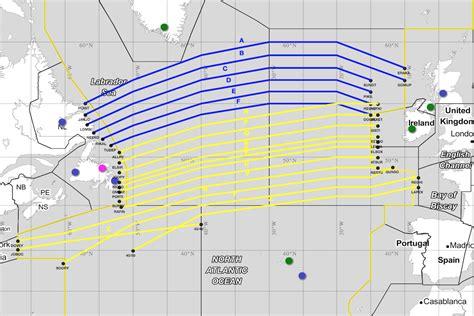
The ever-changing weather patterns in the NAT, including pressure systems and jet streams, cause eastbound and westbound minimum time tracks to be widely separated. These conditions can also lead to daily variations in track locations. As a result, two separate organised track structures are established daily: one for eastbound traffic and another for westbound traffic. While using OTS tracks is not mandatory, about half of NAT flights currently utilize them, with the rest flying random routes. Aircraft may fly clear of the OTS or join or leave an outer track. However, operators should be aware that ATC will attempt to accommodate random route traffic within the published altitude levels of the OTS, but significant changes to flight levels are likely during peak traffic times.
Construction of the OTS
The OTS is built based on basic minimum time tracks, taking into account airspace restrictions like danger areas and military reservations while considering airlines’ preferred routes as indicated in their Preferred Route Message (PRM). Gander OAC produces the night-time OTS for eastbound flights, while Shanwick OAC handles the daytime OTS for westbound flights, integrating requirements for tracks within the New York, Reykjavik, Bodø, and Santa Maria Oceanic Control Areas (OCAs). OTS planners coordinate with adjacent OACs and domestic ATC agencies to ensure the system’s viability and consider the needs of opposing traffic. Standard separation between adjacent tracks is at least one degree of latitude at significant points, although Reduced Lateral Separation Minimum (RLatSM) trials aim to reduce this to half a degree. If traffic volume justifies it, additional tracks may be added for specific traffic axes.
NAT Track Message
Once finalized, the agreed OTS is shared through the NAT Track Message, distributed via AFTN. The daytime (westbound) OTS is typically published at 2200 UTC, while the night-time (eastbound) OTS is published at 1400 UTC. This message details the coordinates of each track and the expected flight levels. Each NAT Track Message is identified by a 3-digit Track Message Identification (TMI) number based on the Julian calendar date. If there are changes to entry/exit points or flight level allocations, the entire NAT Track Message will be re-issued with an updated TMI number. The REMARKS section of the message is crucial, as it includes essential information for operators, such as flight planning restrictions and clearance delivery frequencies.
OTS Changeover Period
To ensure a smooth transition between the night-time and daytime OTS, a period of several hours is allocated for the changeover. This occurs from 0801 to 1129 UTC and from 1901 to 0059 UTC. During these periods, there are restrictions on flight planned routes and levels, and opposite-direction traffic must avoid the inbound OTS. Aircraft operating during this time should file requests in accordance with the Flight Level Allocation Scheme (FLAS) published in relevant aeronautical manuals. Clearances may need to be coordinated individually, and operators are advised to contact the initial OAC if flight levels are critical.