The F/A-18E/F Super Hornet is a versatile multirole fighter aircraft utilized by the United States Navy. A critical component of its combat effectiveness is its Infrared Search and Track (IRST) system, which enhances target detection, tracking, and engagement capabilities. Unlike traditional radar, which is susceptible to jamming, IRST systems provide passive detection of enemy aircraft and missiles, making them a crucial asset in modern aerial warfare.
ATFLIR Pod: Core of the IRST Capability
The Advanced Targeting Forward-Looking Infrared (ATFLIR) pod is the primary IRST system on the F/A-18E/F Super Hornet. Mounted on the aircraft’s left fuselage station, this pod provides all-weather, long-range infrared and television imaging, significantly enhancing target recognition in contested environments.
ATFLIR is particularly effective in beyond-visual-range (BVR) combat, allowing pilots to detect and identify threats without relying solely on radar. This capability is invaluable in electronic warfare scenarios, where enemy forces may attempt to jam radar signals. Notably, ATFLIR has proven essential in real-world combat, such as counter-Houthi operations, where it has been used to track and identify low-altitude, low-speed drones and loitering munitions.
IRST Integration in External Fuel Tanks: Benefits and Drawbacks
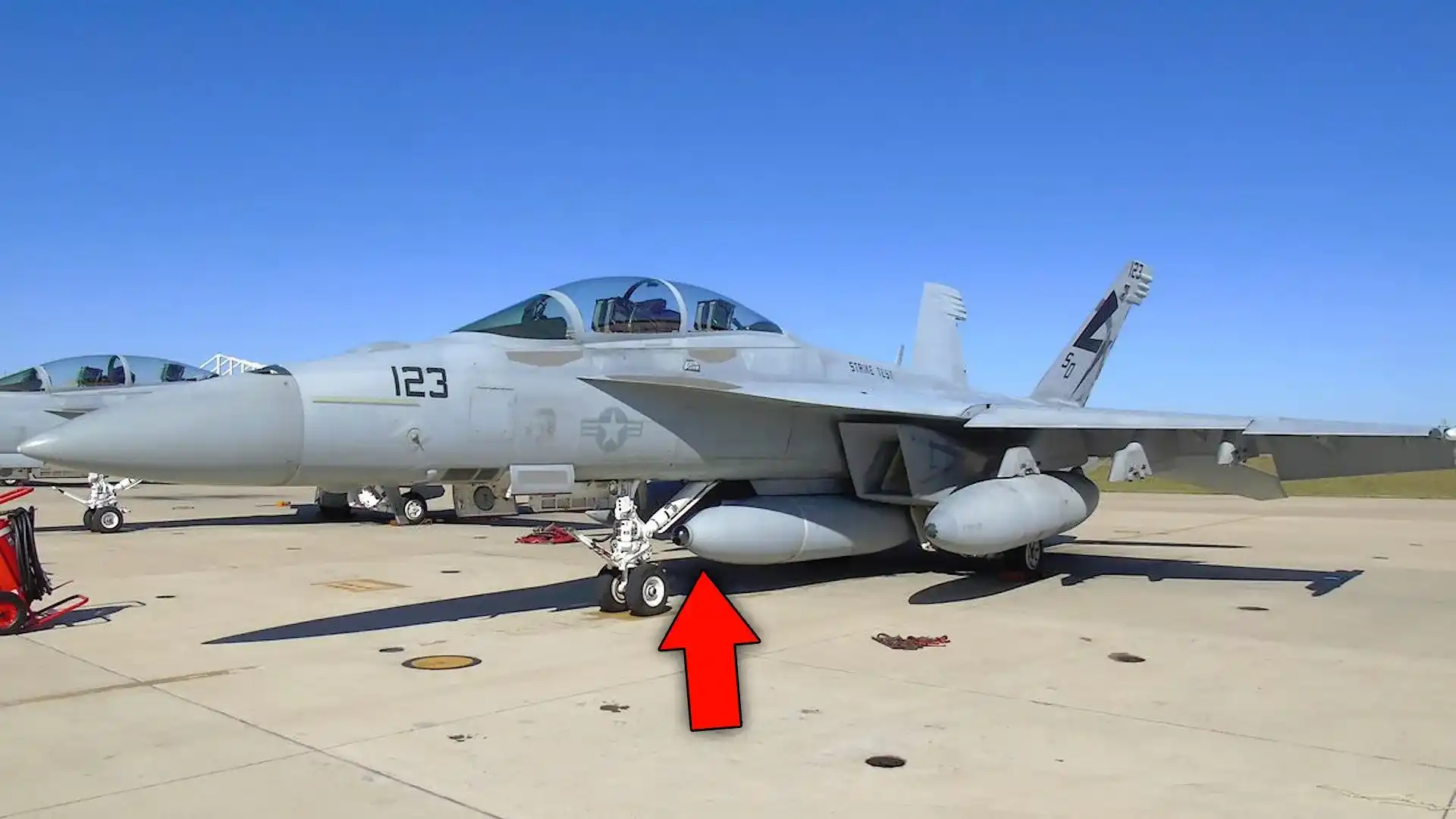
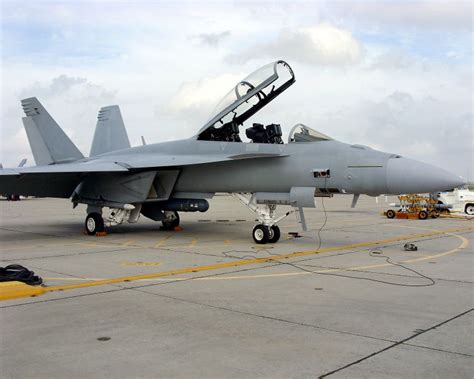
A notable attempt to expand the IRST capability involved integrating the system into the centerline external fuel tank. This approach aimed to provide a dual-purpose solution, combining infrared sensing with fuel storage. However, several drawbacks have limited its effectiveness:
- Reduced Fuel Capacity: Embedding the IRST sensor into the fuel tank decreases the overall fuel volume, subsequently reducing the aircraft’s combat range and endurance.
- Compromised Tactical Flexibility: Pilots often jettison external fuel tanks before entering aerial combat to enhance agility. However, with an integrated IRST system, jettisoning the tank would result in the loss of the IRST capability, creating a tactical dilemma.
Due to these constraints, the fuel tank IRST integration has not become the primary method for infrared target acquisition on the Super Hornet. Instead, the external pod-mounted IRST, such as ATFLIR, remains the preferred solution.
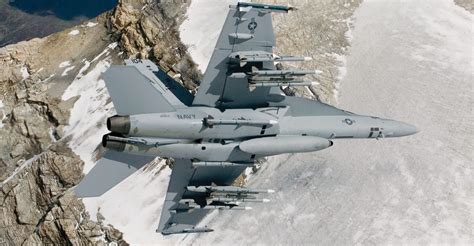
Evolving Tactics: IRST in Modern Air Combat
The United States Navy’s air combat doctrine has shifted from a strict beyond-visual-range (BVR) engagement strategy to a more balanced approach that incorporates both long-range and within-visual-range (WVR) combat. This shift has further emphasized the importance of IRST-equipped aircraft in various scenarios:
- Countering Low-Cost Threats: The growing prevalence of low-cost drones and anti-ship missiles necessitates a cost-effective response. The AIM-9X Sidewinder, with a range of approximately 35 kilometers, combined with IRST targeting, offers a highly efficient interception solution.
- High-End Combat Scenarios: Against near-peer adversaries such as China and Russia, IRST provides critical targeting support for long-range air-to-air missiles like the AIM-174. By detecting enemy airborne early warning and control (AEW&C) aircraft, IRST forces opposing forces to operate at greater distances, reducing their tactical effectiveness.
Comparing IRST Capabilities: F/A-18E vs. F-35
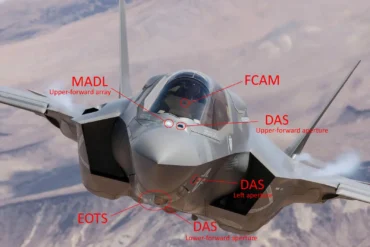
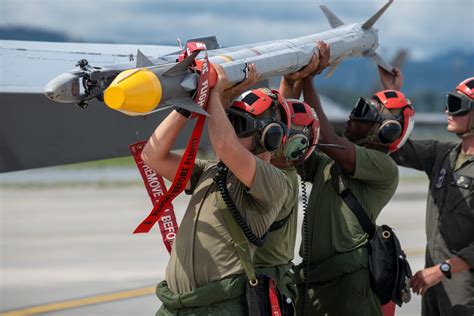
While the F-35 Lightning II is renowned for its stealth and sensor fusion, it lacks a dedicated IRST pod. Instead, its Distributed Aperture System (DAS) and Electro-Optical Targeting System (EOTS) serve similar functions but are primarily optimized for stealth operations. In contrast, the F/A-18E/F, especially in “Beast Mode”, can be equipped with:
- Up to 9 missiles (4 AIM-120 AMRAAM, 4 AIM-9X Sidewinder, and 1 centerline AIM-120)
- ATFLIR Pod for infrared targeting
- External IRST sensors for enhanced situational awareness
This configuration, often referred to as “Murder Hornet” mode, prioritizes firepower and multi-mission flexibility, making it a formidable option in non-stealth engagements.
F/A-18E/F Block III: Future IRST Enhancements
The Block III upgrade of the F/A-18E/F Super Hornet introduces several key improvements that further enhance IRST capabilities:
- Advanced Data Links: The integration of Tactical Targeting Network Technology (TTNT) improves real-time sensor sharing between aircraft.
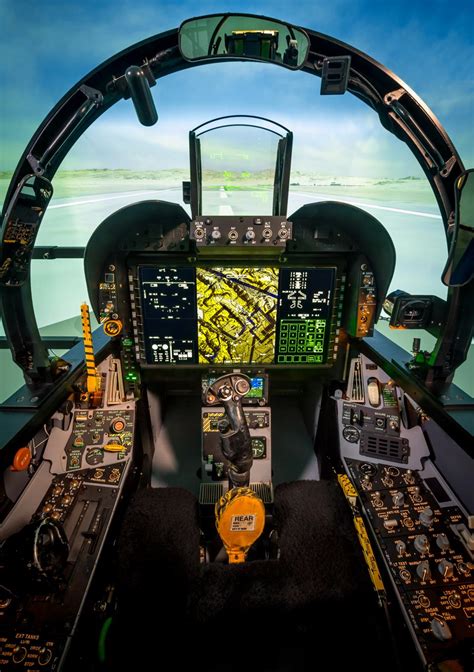
- Larger Touchscreen Displays: A new 11×19-inch touchscreen cockpit display enhances IRST imaging clarity, improving pilot decision-making.
- Distributed Target Processing-Network (DTP-N): This system fuses data from IRST, radar, and electronic warfare sensors, creating a comprehensive battlespace picture.
While specific details regarding IRST hardware upgrades in Block III remain classified, these improvements suggest a more refined IRST integration, potentially making the Super Hornet even more effective in high-threat environments.
Conclusion
The F/A-18E/F Super Hornet’s IRST capability is a critical element in modern air combat operations. Through the ATFLIR pod, IRST fuel tank experiments, and Block III enhancements, the U.S. Navy continues to refine infrared targeting technology. While challenges remain in optimizing IRST integration, its role in detecting stealth aircraft, countering drones, and supporting long-range missile engagements is undeniable. With evolving threats, IRST-equipped Super Hornets will remain a pivotal force in aerial warfare for years to come.
FAQ
1. How does the IRST system improve the F/A-18E/F Super Hornet’s combat effectiveness?
The Infrared Search and Track (IRST) system enables the F/A-18E/F Super Hornet to passively detect enemy aircraft and missiles without emitting radar signals. This capability is crucial for detecting stealth aircraft, countering electronic warfare tactics, and enhancing beyond-visual-range targeting.
2. Why was the IRST fuel tank integration not widely adopted?
Although integrating IRST sensors into the external fuel tank offered a potential dual-purpose solution, it posed significant drawbacks such as reducing fuel capacity and limiting tactical flexibility. Pilots often jettison external tanks before combat, making this approach impractical.
3. How does the F/A-18E/F’s IRST system compare to the F-35’s sensors?
The F/A-18E/F relies on ATFLIR pods and external IRST sensors, whereas the F-35 uses a Distributed Aperture System (DAS) and Electro-Optical Targeting System (EOTS). While the F-35’s sensors are optimized for stealth, the Super Hornet’s IRST configuration offers greater flexibility in high-intensity combat scenarios.