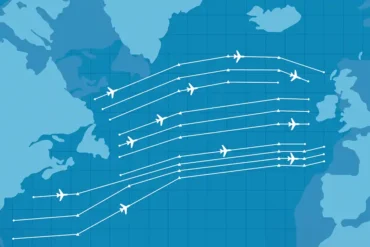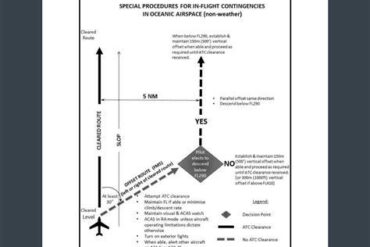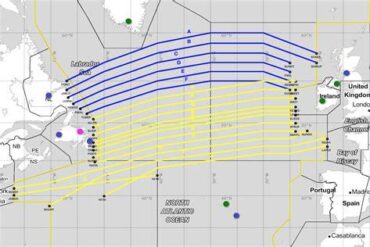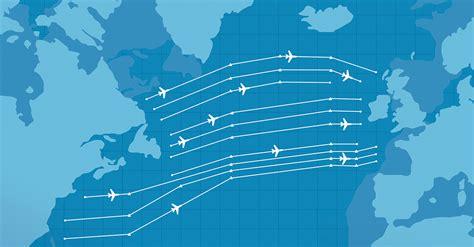
The North Atlantic (NAT) airspace is the busiest oceanic airspace globally, connecting Europe and North America. In 2012, around 460,000 flights crossed this region, and that number continues to rise. Due to the lack of Direct Controller Pilot Communications (DCPC) and ATS Surveillance in most areas, safety relies on strict navigation standards and operational discipline. This article outlines essential flight planning procedures for the North Atlantic.
Crews planning to use the Organised Track System (OTS) tracks need the current NAT Track Message to effectively plan their flights. Even if a flight does not follow an OTS track, knowing its location can be crucial during contingencies or diversions. Therefore, all crews flying at or above FL290 should obtain the latest track message before planning their routes and carry it during the flight.
During OTS validity hours, operators are encouraged to plan their flights along OTS routes. They may join or leave an outer track but can also choose random routes to avoid the OTS. However, ATC will try to accommodate random traffic crossing the OTS, but changes in flight level may be necessary during busy periods. Aircraft lacking the required equipment for the Data Link Mandate cannot join or cross OTS tracks. They may request continuous climb or descent through specified levels, depending on traffic conditions.
When OTS is inactive, operators can plan random routes, but restrictions apply an hour before each OTS period. Eastbound flights crossing 30°W less than one hour prior to a pending Westbound OTS must avoid the incoming OTS structure. Similarly, Westbound flights have the same requirement regarding the Eastbound OTS. All flights should ideally operate on great circle tracks joining significant waypoints. Eastbound or westbound flights should cross specified longitudes at whole or half degrees of latitude, while northbound or southbound flights should cross specified latitudes at whole degrees of longitude.
Entering NAT airspace requires using a designated Oceanic Entry Point (OEP), especially if it’s near a ten-degree meridian of longitude. In terms of altitude, planning between FL290 and FL410 mandates compliance with CPDLC and ADS-C requirements. Flights following an OTS track can select any published level, considering PBCS and DLM standards. Operators planning to fly within FL350-390 on the PBCS OTS must meet specific equipage and authorization criteria.
Random route flights should be planned at levels suitable for their direction of travel. Aircraft joining or leaving OTS tracks must be equipped with CPDLC/ADS-C for operating at FL350 to FL390. Additionally, pilots should review the NAT ATS Provider State AIPs for exceptions to standard flight level directions, as some levels may be reserved for opposing traffic flows. Current flight level allocations are published in the UK AIP and Transport Canada AIM, and pilots must consult these resources when planning random routes.
Operators can include step climbs in their flight plans, but pilots must request each level change from ATC. Approval depends on traffic conditions. Outside of OTS, achieving requested profiles is more likely. However, during peak OTS times, ATC may not accommodate every requested level change, so careful pre-flight fuel planning is essential. For level-critical flights, contacting the initial OAC before filing the flight plan is advisable to check the availability of specific flight levels.
Completing the ATC Flight Plan accurately is vital for oceanic operations, as errors can lead to delays in processing and clearances. Despite automated systems, many ATC Flight Plans for North Atlantic flights still contain mistakes. Guidance on completing the ICAO flight plan is available in Attachment 4 of Doc 007 – North Atlantic Operations and Airspace Manual. New or infrequent operators should refer to this document diligently.
For turbojet aircraft, planned speeds or Mach Numbers should be specified in Item 15 of the flight plan in a specific sequence: cruising True Airspeed (TAS) before oceanic entry, oceanic entry point, cruising Mach number, and planned Mach Number for an organized track. Each change of Mach Number must be specified by geographical coordinates or as a named waypoint. Non-turbojet aircraft should similarly specify TAS in Item 15.
If a flight plans to operate along an entire organized track, it should define the intended track in Item 15 using the abbreviation ‘NAT’ followed by the track code. Alternatives should be listed at the end of Item 18. ATC might offer clearances on planned tracks at different Flight Levels or via other OTS tracks if no reasonable alternatives are available. Random route aircraft wishing to join or leave an organized track must provide full route details in their flight plans without abbreviating the track letter.
In addition to standard estimates in Item 18, flights on random routes must provide accumulated estimated elapsed times for key points, including the last domestic reporting point, oceanic entry point, significant points described in Item 15, oceanic exit point, and the first reporting point on the domestic track. For flights along the entire length of a NAT organized track, estimates are also required for the track commencement point and FIR boundaries.
Operators are encouraged to indicate their complete RNP, RNAV, RVSM, CPDLC/ADS-C (FANS 1/A), ADS-B, and NAT HLA capabilities in the flight plan. This helps ensure that appropriately equipped flights benefit from the latest capacity and safety improvements in the NAT Region.