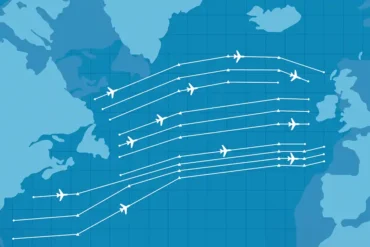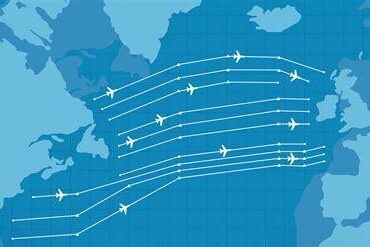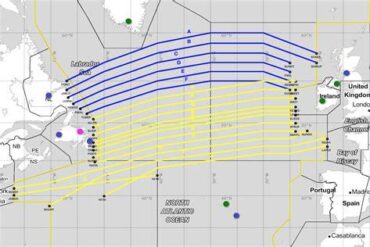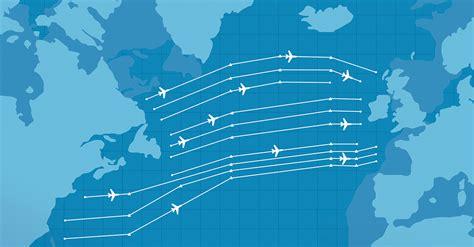
The North Atlantic (NAT) airspace is the busiest oceanic airspace globally, connecting Europe and North America. In 2012, around 460,000 flights crossed this region, and that number continues to rise. In most parts of the NAT, Direct Controller Pilot Communications (DCPC) and ATS Surveillance are not available. To ensure safety, aircraft must adhere to high standards of horizontal and vertical navigation performance as well as strict operating discipline. This article provides an overview of how to obtain and confirm an Oceanic Clearance for the NAT region.
All flights operating within NAT controlled airspace at or above FL60 must request General Oceanic Clearances. Pilots should reach out to the ATC unit responsible for their first Oceanic Control Area (OCA) following the procedures outlined in the appropriate Aeronautical Information Publications (AIPs). Although pilots often receive Oceanic Clearances before reaching the Oceanic entry point (OEP), these clearances apply only from the OEP onward. Any changes to route, altitude, or descent prior to entering oceanic airspace require a separate clearance from domestic controllers. If the oceanic entry point or flight level differs from what was initially requested, pilots must obtain the necessary domestic re-clearance to comply with their Oceanic Clearance upon entering oceanic airspace.
Pilots must also be vigilant at the oceanic exit point. If the cleared route does not match the planned route, they need to secure any revised clearance for their domestic path as they approach the exit. Given the high traffic volume in the NAT region, OAC planners strive to optimize airspace use. When requesting an oceanic clearance, pilots should inform the OAC of the maximum acceptable flight level at the boundary, ensuring that the assigned oceanic flight level is reached before entering oceanic airspace. Any required changes to their filed oceanic flight plan should be communicated as early as possible after takeoff.
If pilots do not receive their Oceanic Clearance before reaching the Shanwick OCA boundary, they must contact Domestic ATC for instructions to remain clear of Oceanic Airspace while awaiting clearance. This procedure differs from other NAT OCAs, where flights may enter while waiting for delayed Oceanic Clearances. Pilots should always aim to obtain their Oceanic Clearance before entering these regions. If they encounter difficulties, they should not hold for clearance unless instructed by ATC. Instead, they should maintain the flight level cleared by the current control authority until they receive the Oceanic Clearance.
To ensure timely processing, pilots are advised to request their Oceanic Clearance at least 40 minutes before their ETA at the Oceanic entry point. However, when entering the Reykjavik area from Scottish or Stavanger airfields, the request should be made 20 minutes before ETA. Specific procedures for obtaining oceanic clearance from each NAT OAC are available in State AIPs. Pilots can request Oceanic Clearances using published VHF frequencies, which are often listed in the AIP or on high-level charts.
For example, a typical request for oceanic clearance over Shanwick might sound like this: “Shanwick, KLM 467 estimating LIMRI at 1235z request Mach .81, FL360, able FL380. Second choice Track Echo.” At airports near oceanic boundaries, obtaining Oceanic Clearance before departure is essential. This applies to various airfields in Ireland, the UK, and Canada. The clearance request should include estimates for the OEP, expressed as Takeoff plus a specific number of minutes, along with altitude and speed.
Oceanic Clearances consist of three main elements: Route, Speed, and Level. These elements ensure lateral, longitudinal, and vertical separation. For flights on an Organised Track, Air Traffic Services will provide an abbreviated clearance. This includes the destination airfield, the cleared track, the flight level, and the Mach number. Conversely, for random routes, a full clearance will specify the clearance limit, the entire route from the oceanic entry point to the exit point, the flight level, and the Mach number.
Clearance readbacks vary depending on whether the aircraft is flying on an Organised Track or a random route. An abbreviated clearance can be confirmed using a short readback that includes the Track Message Identification (TMI) number. If the TMI is unavailable, a full route clearance will be issued, requiring a complete readback. For random route traffic, a full route readback is mandatory regardless of how the clearance was issued.
Errors related to Oceanic Clearances can arise from several issues, including ATC System Loop errors and Waypoint Insertion errors. ATC System Loop errors occur when there’s a misunderstanding between the pilot and the controller regarding the route, flight level, or Mach number. Such errors may stem from incorrect interpretations or coordination failures. These issues are typically detected through position reports and are usually corrected, though timely intervention isn’t guaranteed.
Waypoint Insertion errors happen when crews input incorrect waypoint data into their navigation systems. These errors often result from failing to verify the waypoints against the ATC cleared route or not cross-checking onboard navigation systems. As noted in the NAT Track Message, operators are reminded that the clearance may differ from the flight plan, emphasizing the importance of following the issued clearance closely. Incorrectly programming the navigation system with non-corresponding flight plan coordinates can lead to significant navigation errors.