ATC Clearance
Definition
ATC clearance is the authorization given to an aircraft to proceed under specific conditions set by an air traffic control unit. For convenience, this is often shortened to “clearance.” This term can be combined with words like “taxi,” “take-off,” “departure,” “en-route,” “approach,” or “landing” to specify the part of the flight it relates to.
Description and Purposes
Clearances are primarily issued to help manage and separate air traffic, based on known conditions that impact safety. These conditions include aircraft in the air, those on the maneuvering area, vehicles on the maneuvering area, and any temporary obstructions. Importantly, receiving an ATC clearance does not give pilots permission to ignore any regulations meant to ensure safe flight operations. The pilot-in-command remains responsible for adhering to all rules and regulations. If a pilot finds an ATC clearance unsuitable, they can request an amended clearance when possible.
Applicability
ATC clearances are only for controlled flights. If a flight plan indicates that the initial segment will be uncontrolled, the pilot must obtain a clearance from the relevant ATC unit before entering controlled airspace. If the flight plan states that the first part will be under ATC and the rest will be uncontrolled, the aircraft will typically receive clearance only up to where controlled airspace ends. For flights with intermediate stops, the first clearance limit is the initial destination, and new clearances will be issued for each leg of the journey. However, arrangements can be made for continuous clearance through intermediate stops. The requirement for ATC clearance depends on flight rules and airspace class; IFR flights need clearance in classes A, B, C, D, and E, while VFR flights require it only in classes B, C, and D.
Contents
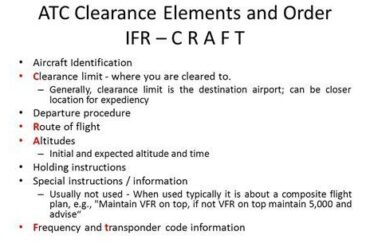
ATC clearances (except for departure and arrival) include several key items in a specific order: aircraft identification, clearance limit, route of flight, flight levels, and any necessary instructions (such as SSR transponder operation or approach maneuvers). The clearance limit is identified by a significant point, aerodrome, or controlled airspace boundary. When coordination has been made with the relevant ATC units, the clearance limit can be the destination aerodrome or an appropriate intermediate point. The route of flight should be detailed, and if conditions allow, the most direct routing should be offered.
Instructions related to flight levels should specify cruising levels, the points for climbs or descents, and necessary rates of climb or descent.
Readback
The flight crew must read back critical parts of ATC clearances and instructions communicated by voice. This includes route clearances, instructions to enter, land on, take off from, hold short of, cross, taxi, and backtrack on runways, as well as runway-in-use, altimeter settings, SSR codes, level instructions, and more. Other instructions, including conditional ones, must also be acknowledged clearly. The controller listens to ensure the clearance is correctly understood, and any discrepancies must be addressed immediately. Voice readbacks of CPDLC messages are not generally required unless specified.
Amendment of Clearance
When a clearance includes a requested change in route or level, the specifics of that change must be clearly stated. If traffic conditions prevent the requested change, the word “UNABLE” is used. If circumstances allow, an alternative route or level should be proposed. If an alternative is accepted, the amended clearance should describe the route until it rejoins the previous one or continue to the destination if the aircraft will not return to the previous route.