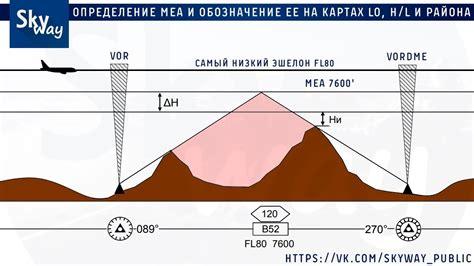
Minimum Obstacle Clearance Altitude (MOCA) is crucial in aviation. It represents the lowest altitude for a specific route segment that ensures safe clearance above obstacles. According to ICAO Doc 8168 PANS-OPS, the MOCA combines the higher of either the terrain or obstacle elevation with the minimum obstacle clearance (MOC). This altitude guarantees safety by providing necessary clearance over obstacles within designated areas. When determining these minimum altitudes, charting accuracies are considered. This involves adding both vertical and horizontal tolerances to the objects shown on the chart.
For IFR flights during the en-route phase, the standard MOC applied is 1000 feet (300 meters). However, in mountainous regions, the required obstacle clearance varies. For terrain elevations between 3000 feet and 5000 feet (900 meters to 1500 meters), the clearance is 1500 feet (450 meters). For elevations exceeding 5000 feet (1500 meters), the clearance increases to 2000 feet (600 meters).
For more details about constructing the obstacle segment, refer to ICAO Doc 8168, PANS-OPS, Volume I.
Additionally, EUROCONTROL provides guidance on Cold Temperature Corrections. The Cold Temperature Correction Tool, an Excel Workbook, assists airspace designers and ATS authorities in assessing how to best incorporate temperature corrections into airspace design. This tool identifies optimal temperature ranges for efficient use of airspace. It includes three spreadsheets that allow users to calculate the necessary correction values based on specific parameters. It also helps evaluate the impact of cold temperatures on minimum vectoring altitudes and assess corrections for temperature banding.