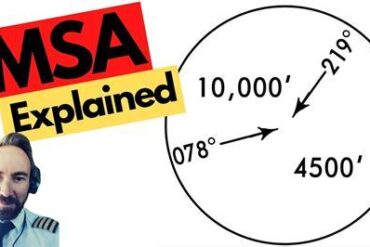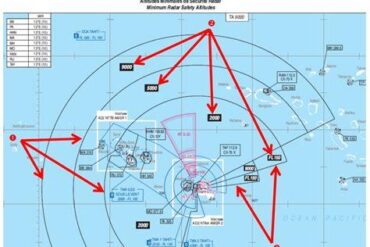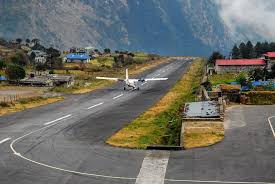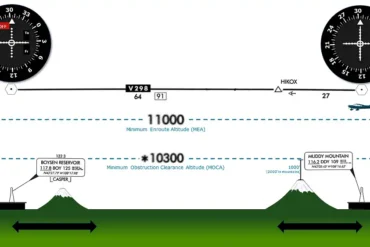
Minimum Safe Altitude (MSA) refers to the lowest altitude a pilot can fly without risking collision with terrain or obstacles. Although the International Civil Aviation Organization (ICAO) does not provide a specific definition, MSA is an important concept in aviation safety.
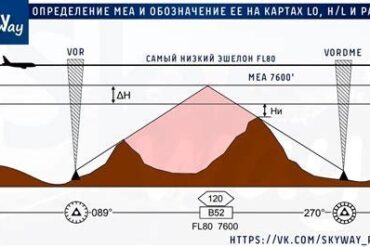
To determine minimum altitudes, pilots consider the highest terrain or obstacle in a designated area. They also include a safety buffer and additional margin to account for any errors. In controlled airspace, these minimum altitudes may be published in the state’s Aeronautical Information Publications (AIPs).
Additionally, the term “minimum safe altitude” relates to the Minimum Safe Altitude Warning (MSAW) function within air traffic control (ATC) systems. It’s essential to note that while MSA can refer to minimum safe altitude, it is also commonly used to mean Minimum Sector Altitude. Pilots should clarify which definition is being used when encountering the acronym MSA.