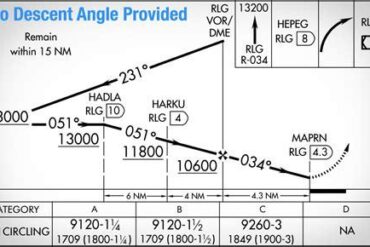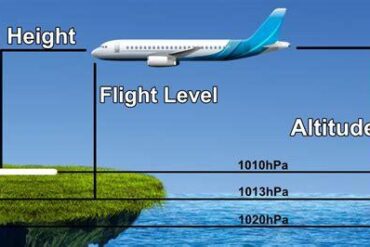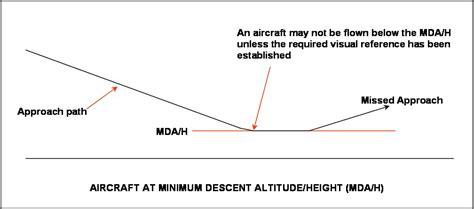
The Minimum Descent Altitude (MDA) or Minimum Descent Height (MDH) is a key term in aviation. It refers to a specific altitude or height during a Non-Precision Approach or Circling Approach. Pilots must not descend below this altitude without having the required visual reference. According to ICAO Annex 6, MDA is based on mean sea level, while MDH relates to the aerodrome elevation. If the threshold elevation is more than 2 meters (7 feet) below the aerodrome elevation, MDH is referenced to that threshold. For circling approaches, the MDH is always tied to the aerodrome elevation.
The term “required visual reference” indicates the area pilots should see for a sufficient time. This allows them to assess the aircraft’s position and how it is changing in relation to the desired flight path. For circling approaches, this visual reference is the runway environment. When discussing both MDA and MDH, they can be collectively referred to as “minimum descent altitude/height” and abbreviated as “MDA/H.”
It’s important to note that MDA/H is different from Decision Altitude/Height. With MDA/H, an aircraft must maintain its altitude until the required visual reference is established. Typically, a plane will hold at the MDA/H until it reaches a predetermined missed approach point. If the visual reference isn’t met by then, the pilot will execute a Missed Approach.
The MDA/H cannot be lower than the system minimum for the specific type of approach. Here are some examples of system minima for various facilities:
-
ILS (no glide path – LLZ): 250 ft
-
VOR: 300 ft
-
VOR/DME: 250 ft
-
NDB: 300 ft
Operators must add to the MDA/H based on the aircraft’s performance. This ensures that if a missed approach occurs at this altitude, the aircraft does not descend below the MDA/H. For further details on calculating MDA/H, refer to the Aerodrome Operating Minima (AOM).