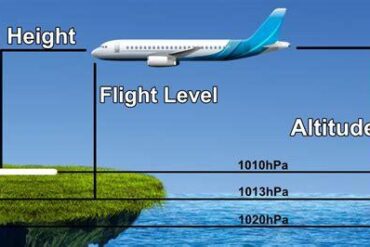
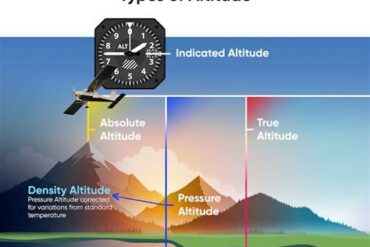
Altitude refers to how high an object is above mean sea level. It’s simply the vertical distance measured from this baseline. Flight Level (FL) is a specific atmospheric pressure surface, tied to a pressure datum of 1013.2 hPa. These levels are separated by specific pressure intervals. Flight levels provide an indication of pressure rather than altitude itself. Above a certain point, known as the transition level—usually around 4,000 feet—flight levels are used to indicate altitude. Below this level, measurements are given in feet. For example, FL250 means an altitude of 25,000 feet above mean sea level when the sea-level pressure is at 1013.2 mb.
Elevation or height is the vertical distance from a chosen reference point. This could be a level, a point, or an object. The main unit for measuring altitude and height is the meter, but in aviation, feet are more commonly used. Some countries use metric altitudes and flight levels. A partial list of measurement units can be found in ICAO Annex 5 and its Supplement. If there’s any uncertainty, it’s best to check the Aeronautical Information Publication (AIP) for the relevant country.