In the world of aviation, precision is critical. Pilots must be able to make life-saving decisions quickly, especially when flying under low-visibility conditions. Two key concepts in this process are Decision Altitude (DA) and Decision Height (DH). While these terms might seem interchangeable at first glance, they are, in fact, quite different, with each playing a vital role depending on the type of approach. Understanding these distinctions can help pilots ensure safety and efficiency when operating in challenging weather conditions.
What is Decision Altitude (DA)?
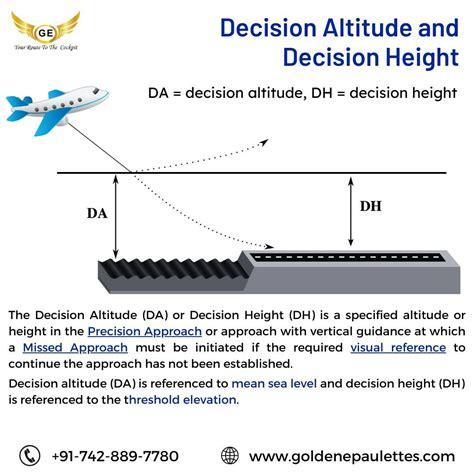
Decision Altitude (DA) is a specified altitude above Mean Sea Level (MSL), primarily used in Category I (CAT I) Instrument Landing System (ILS) approaches. The primary purpose of DA is to guide the pilot to a critical decision point where they must either continue the approach or initiate a go-around. In essence, it represents the altitude at which a pilot needs to have visual contact with the runway or the runway environment to safely proceed with the landing.
For example, during a standard CAT I ILS approach, the DA will typically be expressed as an MSL value (e.g., 6,085 feet). This means, as the aircraft descends along the ILS glideslope, the pilot reaches 6,085 feet MSL and must make a decision based on the visibility and runway environment. At this point, if the runway is not visible or the necessary conditions for landing are not met, the pilot will execute a go-around.
The DA is crucial in many operational scenarios because it directly influences the safety of an approach. A higher DA may be used when obstacles or terrain near the airport might compromise the approach path, while a lower DA may be employed when the conditions allow for safer, more precise landings.
What is Decision Height (DH)?
In contrast, Decision Height (DH) is defined as the height above the touchdown zone elevation (TDZE). It is used specifically in Category II (CAT II) and Category III (CAT III) approaches, which rely on more advanced instrumentation, such as a radar altimeter. The DH is essential for pilots flying precision approaches at lower altitudes, typically in low-visibility conditions.
Unlike DA, which is based on altitude, the DH is based on the actual height above the runway’s TDZE. This means that pilots flying a CAT II or III approach use a radio altimeter to measure their height above the ground, rather than relying on the pressure altitude provided by traditional altimeters. A typical DH for CAT II/III approaches is set to be less than 200 feet above the TDZE, which provides more precise control over the aircraft’s descent path in low-visibility scenarios.
For instance, if an ILS approach for a CAT III procedure is being flown, the DH might be set at 200 feet above the TDZE. At this point, the radar altimeter will trigger the decision-making process, telling the pilot whether to continue or initiate a go-around. This level of precision is critical, especially when landing in weather conditions with very poor visibility.
Key Differences Between DA and DH
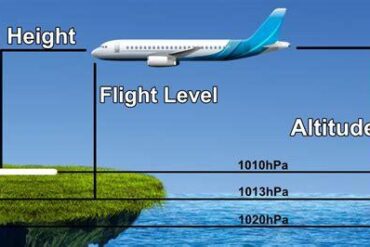
While both DA and DH are associated with critical decision points during an approach, their differences lie in the reference system used to define them.
- DA is based on Mean Sea Level (MSL), meaning it is referenced from the altitude above sea level. This makes it applicable for most CAT I approaches.
- DH is based on the touchdown zone elevation (TDZE), referring to the height above the runway’s threshold, and is used for CAT II/III approaches that require the use of radar altimeters.
When Should Pilots Use DA or DH?
The decision to use DA or DH depends on the type of approach being flown and the equipment available on the aircraft. In CAT I approaches, which are the most common for general aviation, pilots will typically use DA. These approaches are often conducted under less severe weather conditions where visibility may still allow for visual contact with the runway at higher altitudes.
However, in CAT II and CAT III approaches, which are designed for extremely low-visibility scenarios (e.g., fog, heavy rain, or low cloud ceilings), DH is used, with the aircraft’s radar altimeter measuring the height directly above the runway.
It’s essential to note that pilots must ensure they have the appropriate equipment for these advanced approaches. For CAT II/III operations, aircraft must be equipped with a radar altimeter, and pilots must be trained to operate under such conditions. Furthermore, CAT II/III approaches are generally not available at all airports, as they require specific infrastructure, such as runway lighting systems and precision guidance systems.
Why Does the Distinction Between DA and DH Matter?
The distinction between DA and DH is more than just a matter of terminology; it is essential for ensuring flight safety in low-visibility conditions. Pilots must be aware of which minimums they are operating under and ensure they follow the correct procedure for their approach.
For example, consider a situation where a pilot is conducting a CAT I approach to an airport with challenging terrain near the runway. If the pilot mistakenly relies on the DH, which is referenced to the touchdown zone instead of DA, they might misinterpret their altitude, putting the aircraft at risk of descending too low, too soon, potentially causing a Controlled Flight Into Terrain (CFIT) accident.
Moreover, the DA/DH distinction is vital for effective communication during the approach phase. Using incorrect terminology, such as calling a DH as a DA, can lead to confusion, particularly in a multi-pilot or crew environment. Using the correct phraseology ensures that everyone involved in the flight operation understands the critical decision point and responds accordingly.
Conclusion
In summary, understanding the differences between Decision Altitude (DA) and Decision Height (DH) is vital for pilots to navigate low-visibility approaches with precision and confidence. While both are integral to decision-making during approaches, DA is used for Category I ILS approaches and is based on MSL, while DH is used for Category II and III approaches and is based on the height above the touchdown zone elevation (TDZE). By adhering to the correct procedures, pilots can ensure that they make the right decisions at critical moments during their flight operations, ensuring safety and compliance with aviation regulations.
With this knowledge, pilots can effectively handle approaches in any visibility condition, safeguarding themselves, their passengers, and the aircraft.