Definition of Vmcg
Vmcg stands for Minimum Control Speed on the Ground. It is the lowest calibrated airspeed during a takeoff run at which a pilot can maintain directional control if the critical engine fails suddenly. Importantly, Vmcg must not exceed V1, the maximum speed for a rejected takeoff.
Criteria for Vmcg
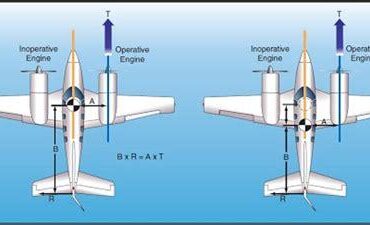
Vmcg is a crucial design certification speed established by aircraft manufacturers during the certification process. It represents the minimum speed at which directional control can be maintained using only the rudder when the critical engine becomes inoperative. This control is limited to a force of 150 pounds, and the pilot must keep the wings level enough to safely continue the takeoff using normal piloting skills. When the airplane accelerates along the runway centerline, it should not deviate more than 30 feet laterally from this centerline after the critical engine fails. Manufacturers can specify different deviation values as long as they are published in the aircraft’s flight and performance manuals. Smaller deviation values may be especially useful for operations from narrow runways.
Conditions for Certification Tests
Certification tests for Vmcg are conducted under specific conditions:
-
A bare and dry runway
-
Calm winds with no crosswind
-
Nose wheel steering disconnected to mimic a slippery runway
Vmcg is determined for each takeoff configuration or, at the manufacturer’s discretion, in the most critical takeoff configuration. The critical engine must fail suddenly during these tests. Additionally, the following criteria must be met:
-
Maximum available thrust on the operating engines
-
The most unfavorable center of gravity
-
The airplane trimmed for takeoff
-
The most unfavorable weight within the range of takeoff weights.
The Relationship Between Vmcg and V1
V1 is defined as the maximum speed at which a pilot can initiate a rejected takeoff in an emergency and is also the minimum speed to continue a takeoff after an engine failure. If an aircraft has not reached Vmcg during takeoff acceleration, it cannot maintain control if the critical engine fails, meaning that V1 cannot be less than Vmcg.
Vmcg and Derated Thrust
Vmcg is influenced by the available thrust and varies with pressure altitude and temperature. Higher altitudes or temperatures above the engine’s flat-rated temperature reduce thrust, which in turn lowers Vmcg. Additionally, derating engine thrust affects directional control. To maintain control with an inoperative engine, the rudder must counteract adverse yaw. The rudder’s effectiveness depends on its size, deflection capability, and airflow speed. When engines can be derated for takeoff, this reduction in thrust leads to less yaw if an engine fails. Since the rudder’s size and deflection remain constant, less airspeed is needed to generate the force required to counteract yaw, resulting in a lower Vmcg and potentially a lower V1.