Modern aviation technology distinguishes itself through intricate design philosophies that cater to specific flight dynamics. Helicopters, renowned for their vertical takeoff and landing (VTOL) capabilities, operate under complex aerodynamic principles fundamentally different from fixed-wing airplanes. These differences manifest clearly in their control systems: helicopters often feature two distinct control sticks, while airplanes function efficiently with just one primary control column. Understanding why this disparity exists requires analyzing the intrinsic mechanical and operational frameworks that govern both aircraft types.
The Complexity of Helicopter Flight Dynamics
Unlike airplanes that depend on forward thrust and lift generated through wings, helicopters rely primarily on their main rotor system for lift and propulsion. This fundamental design choice introduces inherent instability. Helicopters must constantly manage their rotor blade angles, rotor disk orientation, and tail rotor inputs, all requiring continuous pilot adjustments. Consequently, the need for multiple control inputs becomes essential to sustain stable flight.
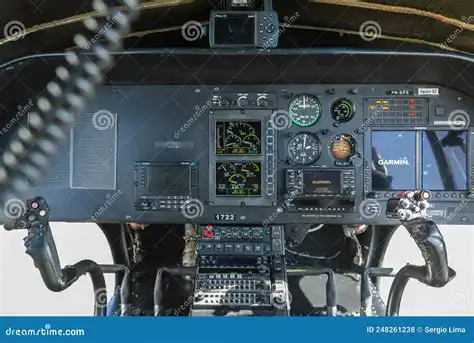
The two main flight control sticks in helicopters are:
- Collective Stick: This adjusts the collective pitch of all the main rotor blades simultaneously. Increasing collective pitch causes blades to generate more lift, enabling the helicopter to ascend. Reducing the pitch leads to descent. Essentially, the collective governs vertical motion.
- Cyclic Stick: The cyclic tilts the rotor disk itself, enabling the helicopter to move forward, backward, or laterally. By pushing or pulling the cyclic in a direction, the pilot adjusts the plane of rotation, altering thrust vectoring to control directional movement.
Combined, these two sticks offer precise, independent management of vertical and horizontal positioning—a necessity for helicopters that hover and maneuver within confined environments.
Why Airplanes Manage with Just One Control Column
In contrast, fixed-wing airplanes are inherently more aerodynamically stable. Airplanes generate lift via fixed wings and rely on a simpler flight control structure. Their primary control stick or yoke integrates pitch and roll commands seamlessly:
- Pitch Control: Pulling or pushing the control stick adjusts the elevators, influencing nose-up or nose-down attitude.
- Roll Control: Moving the stick laterally actuates the ailerons, enabling the aircraft to roll left or right.
Yaw is managed separately using rudder pedals controlling the aircraft’s vertical axis, but critically, this doesn’t require an additional stick. The airplane’s simplified aerodynamics allow for consolidated controls, making a single-stick setup more practical and sufficient.
The Role of Two Pilots and Redundancy in Helicopters
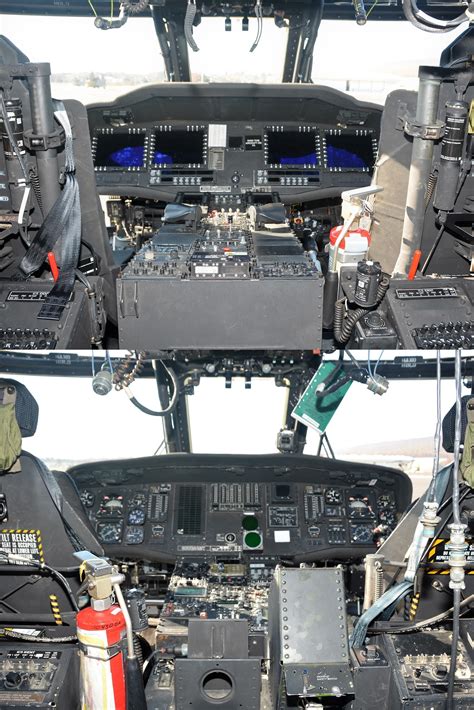
Larger helicopters, like the iconic Sikorsky UH-60 Blackhawk, feature dual control sticks not just for individual operational needs but also to facilitate two-pilot crew configurations. This setup offers several advantages:
- Workload Distribution: Helicopter piloting demands continuous adjustments. Splitting responsibilities between two pilots enhances safety and efficiency.
- Redundancy and Safety: In emergencies, if one pilot is incapacitated, the other can immediately assume control.
- Compliance with Regulations: Aviation safety standards often mandate two-pilot operations for specific missions or aircraft classes.
This redundancy principle, while present in some large fixed-wing aircraft, is more critical for helicopters due to their complex control requirements during hovering, maneuvering, and vertical operations.
Technological Evolution: Simplifying Helicopter Controls
Helicopter technology is rapidly evolving. Stability Augmentation Systems (SAS) and Automated Flight Control Systems (AFCS) are reducing pilot workload through automated adjustments that previously required manual input. These systems use real-time sensor data and computational power to maintain flight stability without constant cyclic or collective corrections.
Examples of technological advancements include:
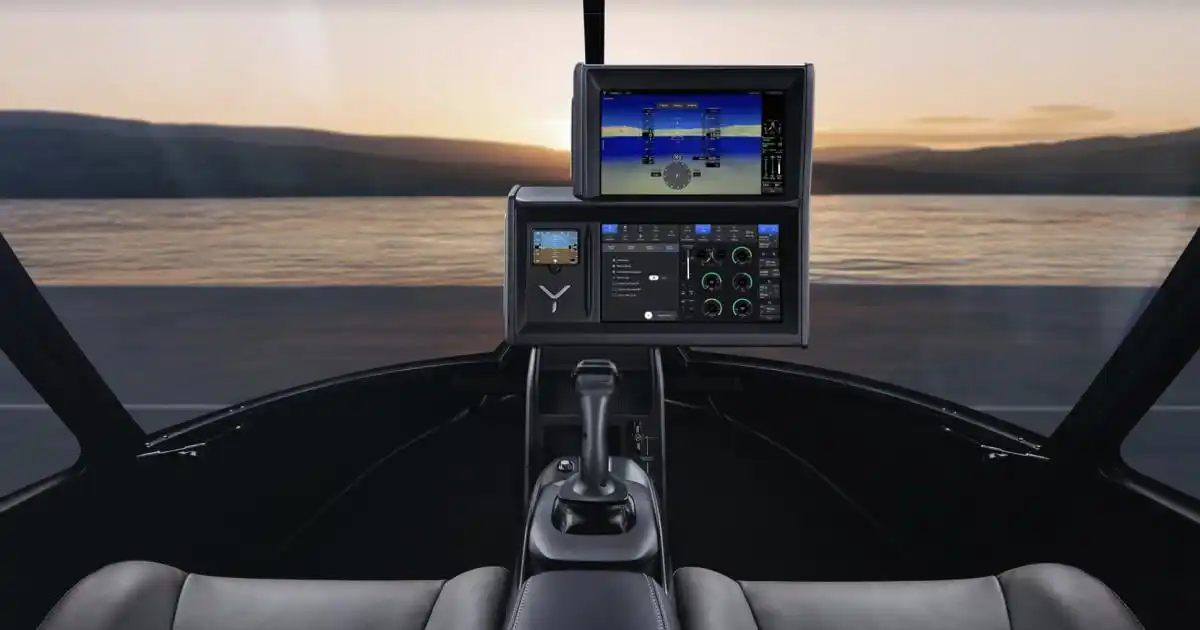
- Skyryse Flight System: Combining fly-by-wire systems with its proprietary SkyOS, this system integrates both collective and cyclic controls into a single stick. Yaw is controlled by twisting the stick, while a thumb-operated lever manages ascent and descent.
- Airbus Human Machine Interface (HMI): This futuristic interface enhances pilot interaction with aircraft systems. The HMI streamlines operations, allowing better communication between human inputs and machine responses, adjusting rotor behavior based on flight conditions and performance needs.
These innovations point towards a future where dual sticks might merge into a consolidated, intuitive control interface, radically altering helicopter pilot training and operational methodologies.
From Bell Boeing V-22 to Future AI-Driven Systems
The development of tiltrotor aircraft like the Bell Boeing V-22 Osprey highlights this trend towards multi-role, adaptable aircraft with advanced control systems. Although operating on principles distinct from traditional helicopters, the V-22 incorporates helicopter-style vertical takeoff with airplane-like cruising efficiency, further complicating its control architecture.
Looking forward, artificial intelligence (AI) promises even more transformative changes in helicopter flight management. AI-driven systems will likely integrate:
- Obstacle Recognition
- Real-time Flight Path Optimization
- Autonomous Navigation
- Predictive Maintenance and Diagnostics
These systems will not just assist but potentially overtake manual control tasks, allowing helicopters to function with minimal human input while maximizing operational safety and efficiency.
Conclusion: Control Systems Reflect Flight Complexity
Ultimately, the reason helicopters require two control sticks lies in their unique flight dynamics. Hovering, vertical flight, and omnidirectional control demand real-time management of lift and directional thrust, necessitating separate yet complementary control mechanisms. By contrast, airplanes leverage aerodynamic stability and rely on single-stick input complemented by rudder pedals, simplifying pilot workload considerably.
The future of rotorcraft flight control, however, is changing. With rapid advancements in fly-by-wire technology, integrated control interfaces, and AI-powered assistance, tomorrow’s helicopters may no longer require dual-stick systems. Yet, understanding the existing dual-control configuration offers crucial insight into the complexities of vertical flight and the innovation driving aviation’s next frontier.