Definition of Vmca
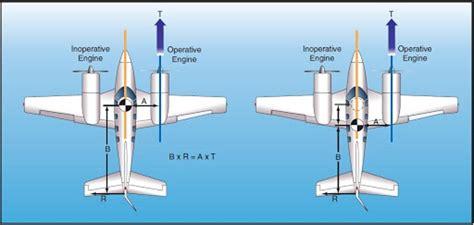
Vmca is the minimum speed in the air needed to maintain directional control when one engine fails in a multi-engine aircraft. This speed is crucial during takeoff, with the operating engines at full power and a bank angle of up to 5 degrees towards the functioning engine(s).
Discussion
When an engine fails in flight, it creates an imbalance known as asymmetric thrust. This causes the aircraft to yaw, or turn, toward the inoperative engine. Pilots use the rudder to counteract this yaw and the ailerons to manage any roll. There exists a specific speed, known as Vmca, at which full rudder deflection allows the aircraft to maintain a steady heading with wings level. If the aircraft is banked toward the live engine(s), this minimum speed increases. Regulations define Vmca as the speed corresponding to full rudder deflection combined with a 5-degree bank angle.
At speeds below Vmca, the rudder’s side force generated is insufficient to counteract the asymmetric thrust, making it impossible to maintain heading if the critical engine is failed and the other engine(s) are at maximum thrust. Engineers calculate Vmca while designing the aircraft’s vertical tail size. A larger tail reduces Vmca but adds weight and production costs, while a smaller tail can increase Vmca.
Criteria for Vmca
Vmca is determined by the manufacturer and is published in the Aircraft Flight Manual (AFM). This speed is calculated during the aircraft design phase and confirmed through certification test flights. Factors influencing Vmca include:
-
Maximum allowable power on all operating engines
-
The critical engine windmilling
-
Full rudder deflection or a specified pedal force
-
A 5-degree bank away from the failed engine
-
Flaps in the takeoff position
-
Landing gear retracted
-
The most unfavorable center of gravity (full aft)
Vmca and Derated Thrust Relationship
To keep control with an inoperative engine, the rudder must be pushed to counteract adverse yaw. The rudder’s effectiveness depends on its size, how much it can be deflected, and the airflow speed over it. In aircraft where engines can be derated during takeoff, reduced thrust leads to less yaw if an engine fails. Since the rudder’s size and deflection capabilities remain unchanged, the force needed to counter yaw can be generated at lower airspeeds than during full thrust takeoffs, resulting in a lower Vmca.