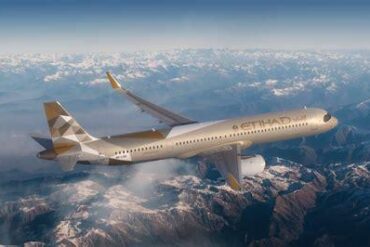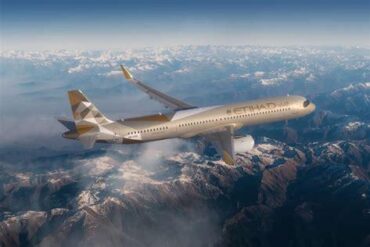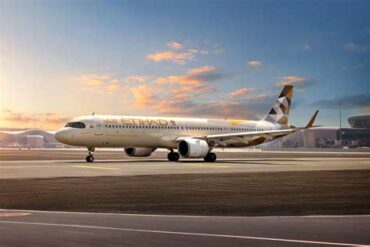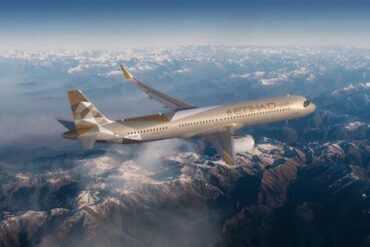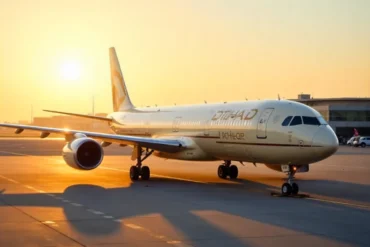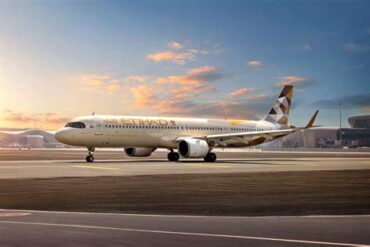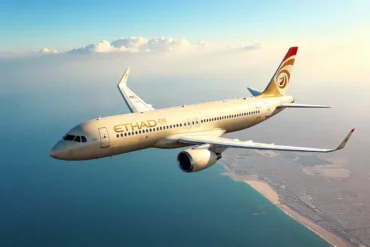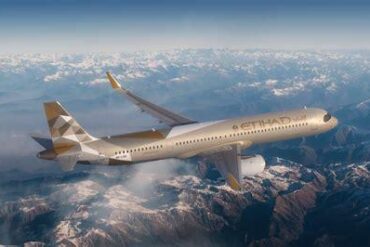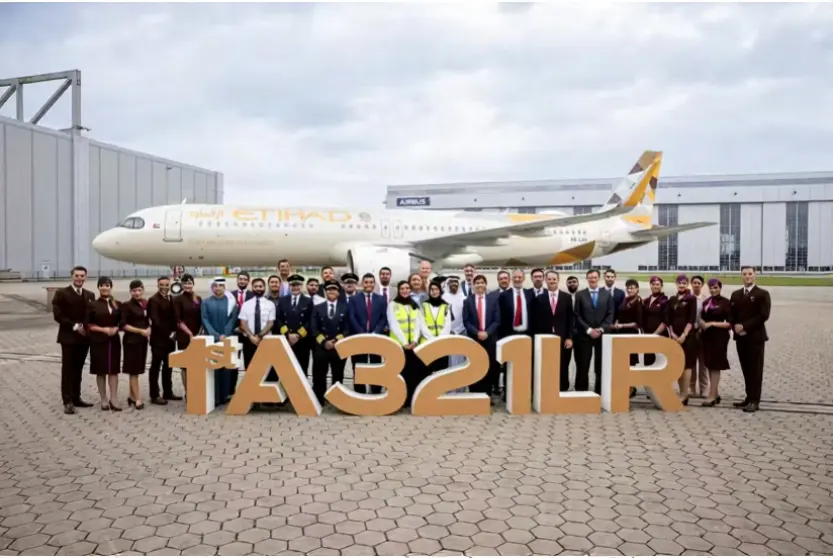
Etihad Airways has officially taken delivery of its first Airbus A321LR, a strategic milestone that reshapes the global premium air travel landscape. With this new addition, Etihad becomes the first airline in the world to bring widebody-style First Class luxury to short and medium-haul routes, redefining what passengers can expect from single-aisle jet service.
A New Era of Single-Aisle Sophistication
Etihad’s introduction of the Airbus A321LR is not merely a fleet expansion—it’s a deliberate disruption. Traditionally, narrowbody aircraft were confined to basic layouts and modest amenities. Etihad’s A321LR, however, delivers an experience that rivals many long-haul widebody services. For the first time, travelers on routes under 4,000 nautical miles can enjoy the airline’s flagship First Class Suites, complete with sliding privacy doors, lie-flat beds, and elegant interior finishes designed to replicate the feel of an opulent lounge.
Each of the First Class Suites is outfitted with a 20-inch 4K screen, Bluetooth connectivity, wireless charging, and ample personal space, even allowing another guest to join during the flight. Positioned next to windows, the suites blend privacy and panoramic views, creating a boutique, cocooned experience unheard of on single-aisle jets.
Business Class with Private Jet-Level Comfort
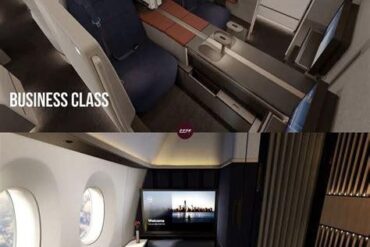
Etihad’s Business Class cabin on the A321LR is equally groundbreaking. Featuring 14 seats in a 1-1 herringbone layout, it ensures direct aisle access and window views for every passenger. Each seat is fully lie-flat, ergonomically contoured, and designed to cocoon the traveler in both privacy and style.
Passengers enjoy a 17.3-inch Ultra HD screen, Bluetooth audio, and wireless device charging, all integrated into a smart, minimalistic seat design. The suite-like setup draws inspiration from private jet interiors, offering unmatched comfort and immersion on flights typically seen as short and utilitarian.
Economy Class with an Upscale Touch
Even in Economy Class, Etihad breaks conventions. The A321LR houses 144 next-generation economy seats, each equipped with a 13.3-inch 4K touchscreen, USB charging ports, and Bluetooth headphone support. The redesigned cabin also boasts oversized overhead bins, allowing passengers to stow more carry-on items with ease.
In-flight entertainment has been transformed into a comprehensive experience, featuring over 1,000 hours of movies, TV series, music, and interactive games. With these upgrades, regional travelers receive a rich, immersive journey no matter their ticket class.
Seamless, High-Speed Connectivity at 30,000 Feet
A major advancement aboard the A321LR is its cutting-edge Wi-Fi powered by Viasat, providing high-speed internet access throughout the flight. Capable of delivering speeds in the hundreds of Mbps, the system allows seamless video streaming, online conferencing, and real-time browsing, transforming each seat into a fully connected workspace or entertainment center.
Etihad’s gate-to-gate connectivity—available where regulations permit—ensures passengers are never disconnected, whether flying for business or leisure. By September 2025, the airline expects full Wi-Fi coverage across its Asian routes, underscoring its commitment to technology-driven excellence.
A Core Driver of Etihad’s Strategic Expansion
The A321LR is not just about luxury; it’s a key enabler of Etihad’s growth strategy under its “Journey 2030” vision. With a target of increasing annual passenger capacity to 38 million, this aircraft provides the operational flexibility and fuel efficiency needed to reach that goal. It enables the airline to right-size its fleet while preserving its commitment to premium service.
The first A321LR will begin commercial operations on August 1, 2025, with inaugural service between Abu Dhabi and Phuket. This route launch is part of a broader initiative in which Etihad has unveiled or launched 27 new routes within a year. The aircraft’s 4,000 nautical mile range allows the airline to introduce point-to-point connections to underserved or emerging markets while delivering a consistent premium experience.
Planned destinations for the A321LR include:
- Bangkok, Chiang Mai, Krabi (Thailand)
- Kolkata, Medan (South Asia)
- Copenhagen, Düsseldorf, Krakow, Milan, Paris, Zurich (Europe)
- Phnom Penh (Southeast Asia)
- Tunis, Algiers (North Africa)
This mix of destinations reflects Etihad’s intent to extend its brand into a diverse set of travel corridors while maintaining the efficiency of narrowbody operations.
Fuel Efficiency and Operational Versatility
One of the core reasons behind Etihad’s pivot toward the A321LR is its remarkable fuel efficiency. Built to perform transcontinental missions with a significantly lower fuel burn than widebodies, the A321LR gives Etihad a cost-effective tool to optimize yield on medium-density routes. This not only contributes to sustainability targets but also enhances route viability, allowing for higher frequency service without compromising profitability.
The aircraft’s CFM LEAP-1A engines are among the most fuel-efficient in their class, and the overall design of the A321LR includes aerodynamic refinements, lighter materials, and cutting-edge avionics. All these attributes contribute to lower CO₂ emissions and reduced noise footprints.
Supporting the Journey 2030 Vision
Etihad’s strategic acquisition of the A321LR aligns directly with its Journey 2030 blueprint, a forward-looking plan to make Abu Dhabi a global aviation powerhouse. Central to this vision is fleet diversification, fuel efficiency, and enhanced customer experience—all of which are embodied in the A321LR.
Throughout 2025, nine additional A321LR aircraft will be added to the Etihad fleet. These new aircraft will be carefully deployed on routes that have shown strong demand but do not yet justify widebody service, allowing Etihad to optimize its network dynamically while delivering consistent luxury.
In doing so, the airline positions itself not just as a connector of destinations but as a curator of elevated air travel experiences, merging efficiency with indulgence.
Redefining Expectations for Regional Air Travel
Etihad’s A321LR does more than introduce a new aircraft model—it shifts the paradigm of regional aviation. Historically, short and medium-haul flights were utilitarian in nature, focused more on capacity and speed than comfort. By deploying First Class cabins with widebody-style amenities on such routes, Etihad breaks this mold and creates an entirely new product category.
This evolution challenges other premium carriers to reimagine the role of narrowbody aircraft. It opens the door to luxury regional travel, where passengers are no longer expected to compromise comfort based on route length. For business travelers, this means greater flexibility with no trade-off in amenities. For leisure passengers, it offers an aspirational travel experience previously out of reach on shorter journeys.
Looking Ahead
As Etihad continues to reshape its fleet and expand its global footprint, the Airbus A321LR stands as both a symbol and a tool for the airline’s broader ambitions. With luxury, efficiency, and innovation packed into a single-aisle frame, the aircraft reflects a company determined to lead—not just participate—in the evolution of commercial aviation.
By pioneering First Class travel on narrowbody aircraft, and aligning this strategy with high-growth markets and sustainability goals, Etihad is not simply adding new aircraft—it is engineering the future of air travel.
Passengers flying with Etihad in the months and years ahead will come to recognize a new standard—not defined by aircraft size, but by experience quality. The Airbus A321LR is more than a jet; it’s a vision in flight.