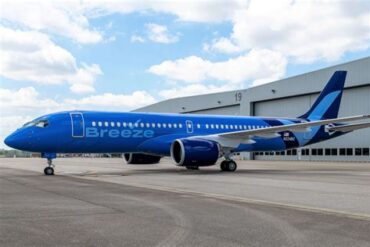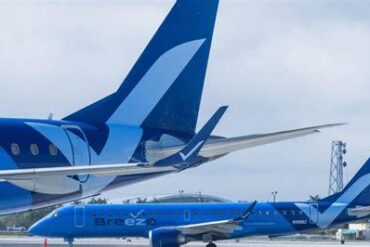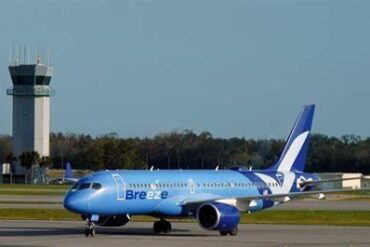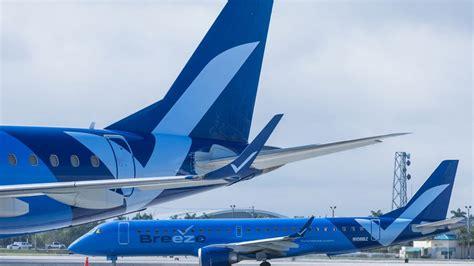
Breeze Airways is doubling down on Florida in 2026, unveiling one of the most ambitious expansions in its young history with 38 new routes connected to the Sunshine State. The fast-growing carrier continues to strengthen its presence across major and secondary airports, transforming Florida into the centerpiece of its network strategy. According to schedule data, nearly half of all Breeze flights during July and August 2026 will involve Florida, underscoring the state’s importance to the airline’s long-term growth plans.
Traffic to, from, and within Florida has surged by 51% year over year, outpacing the growth of Breeze’s overall network. While only six Florida-related routes have disappeared during the same period, the carrier has added 36 domestic services and two international connections, creating a significantly larger footprint across the state. The expansion reflects a broader strategy of targeting underserved markets and taking advantage of opportunities left behind by competitors.
Florida has become a natural growth engine for Breeze Airways. Strong leisure demand, expanding populations, and year-round tourism have combined to create an environment where nonstop routes can flourish. The airline’s approach of linking medium-sized cities with popular destinations has proven increasingly effective, allowing travelers to bypass major hubs while enjoying lower fares and more direct options.
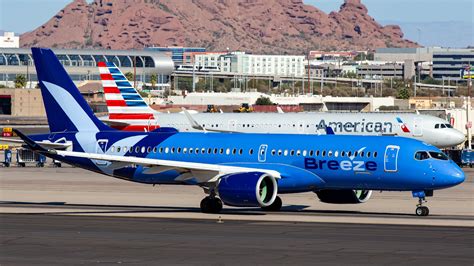
Fort Lauderdale Emerges as a Key Hub in Breeze Airways’ Expansion
Among all Florida airports, Fort Lauderdale-Hollywood International Airport (FLL) has become one of the biggest beneficiaries of the airline’s expansion plans. Breeze only entered the airport in late 2025, yet it is already expected to become the carrier’s ninth busiest station during the summer of 2026.
Fourteen of the new domestic routes involve Fort Lauderdale, demonstrating how rapidly the airport has risen in importance. New services include destinations such as Birmingham, Charleston, Greenville-Spartanburg, Jacksonville, Salisbury, Tallahassee, Tampa, and Wilkes-Barre/Scranton. Some of these routes overlap with competitors including Allegiant Air, JetBlue, and Southwest Airlines, while others revive markets that previously lost nonstop service.
Several routes represent entirely new opportunities. Services to Salisbury and Wilkes-Barre/Scranton are particularly notable because they establish nonstop links that had never existed before. Such markets align with Breeze’s philosophy of connecting smaller cities with popular leisure destinations without forcing passengers to transit through congested hubs.
July 2026 Marks Another Major Wave of New Routes
The rollout of new Florida services has occurred in phases. Fifteen routes debuted during 2025, while another nine entered service during the first half of 2026. A further twelve routes are scheduled to launch during July 2026, highlighting the airline’s confidence in summer demand.
Interestingly, roughly half of the July additions previously belonged to Spirit Airlines before the carrier’s operations disappeared from those markets. These ready-made opportunities have enabled Breeze to enter routes with existing demand and customer familiarity, reducing some of the risks associated with launching entirely new city pairs.
Orlando International Airport will gain service to Atlantic City, while Tampa International Airport will receive flights to Atlantic City and Columbus. Tallahassee will also secure a new connection to Raleigh-Durham, further enhancing access between Florida and growing southeastern markets.
International Growth Brings Nassau and Punta Cana Into the Network
Domestic growth is only part of the story. Breeze Airways has also expanded internationally with two new routes from Tampa International Airport. Service to Nassau in the Bahamas began in June 2026, operating between two and four times weekly. Flights to Punta Cana in the Dominican Republic are scheduled to commence in July with twice-weekly operations.
The Punta Cana route arrives at an interesting moment. JetBlue exited the market in June 2026, while Frontier Airlines plans to discontinue its own service in August. Breeze therefore enters with limited competition and the opportunity to capture strong leisure demand to one of the Caribbean’s most popular destinations.
The Nassau route is particularly significant because it represents the airline’s shortest international service, spanning just 324 nautical miles. Historically, the market had been served by regional aircraft operated by American Airlines and Delta Air Lines until 2006. After years without nonstop flights, Silver Airways briefly revived the route before ending operations. Breeze has now taken over, becoming the first airline in two decades to deploy jet aircraft between Tampa and Nassau.
Raleigh-Durham to Key West Demonstrates the Power of New Nonstop Service
One of Breeze’s success stories illustrates why its strategy is gaining momentum. The airline launched nonstop flights between Raleigh-Durham International Airport and Key West in October 2025, creating a route that previously lacked direct service.
Before the launch, travelers depended on connecting itineraries, with most passengers flying through Charlotte or Miami on American Airlines. During the six months before nonstop flights became available, approximately 8,886 round-trip passengers traveled indirectly between the cities.
After Breeze entered the market, traffic climbed dramatically. Passenger numbers rose to more than 12,600 round trips during the following six months, representing 42% annual growth. Equally important, average fares fell from $232 to $183 each way, stimulating additional demand and making travel more affordable.
Breeze carried over 6,000 passengers during the period, while American Airlines saw its market share decline substantially. The results demonstrated how direct flights and lower fares can unlock entirely new demand rather than simply redistribute existing passengers.
Florida Becomes the Foundation of Breeze Airways’ Future
Breeze Airways’ aggressive expansion demonstrates how quickly the carrier has evolved from a startup into a serious player within the U.S. aviation market. By adding 38 new Florida routes, the airline is creating a network that stretches across 33 airports and connects travelers to destinations that often lacked convenient nonstop options.
With Fort Lauderdale rapidly emerging as a major base, international service expanding from Tampa, and proven success in underserved markets, Florida has become far more than a seasonal destination within the airline’s network. It is increasingly the foundation upon which Breeze Airways is building its future growth.