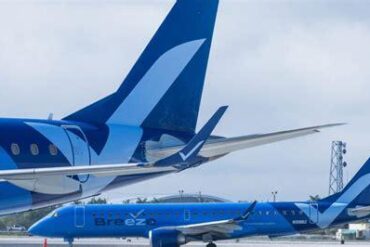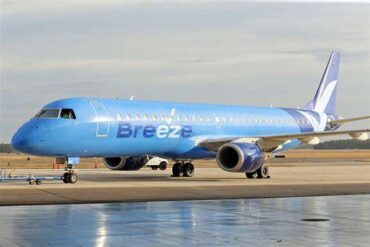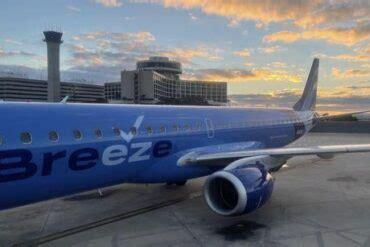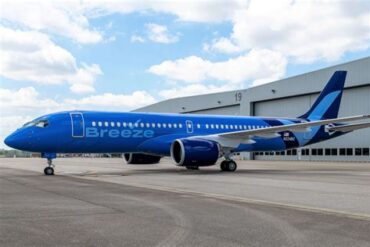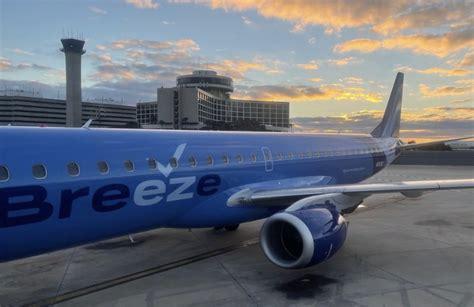
Breeze Airways is pressing forward with one of the most aggressive network expansions in the U.S. leisure and secondary-city market, unveiling 12 brand-new routes and adding four cities to its fast-evolving route map. The announcement underscores Breeze’s core strategy: identifying overlooked demand, stimulating new traffic, and avoiding direct competition wherever possible. This latest move further cements the airline’s reputation as one of the most analytically driven newcomers in North American aviation.
The expansion introduces Atlantic City, Brownsville, Nassau, and San Antonio as new or returning destinations, while also marking another milestone in Breeze’s growing international footprint. With these additions, Breeze continues to blur the line between traditional low-cost flying and point-to-point market creation, focusing on city pairs that larger hub-and-spoke carriers consistently ignore.
Unlike splashy expansions built around major hubs, Breeze’s approach is deliberately surgical. Each route reflects careful scrutiny of historical passenger data, leakage to nearby airports, and the airline’s ability to profit with right-sized aircraft and limited frequencies. The result is a network that looks unconventional on paper, yet increasingly logical in execution.
A Strategic Leap into New Cities and International Markets
Breeze’s addition of four cities tells a story of calculated ambition. Atlantic City and Brownsville are entirely new to the airline, while San Antonio returns to the network after a prior exit. Nassau, the capital of the Bahamas, represents Breeze’s latest international step following earlier launches to Cancún and Punta Cana.
This international growth is notable not for its scale, but for its intent. Breeze is clearly targeting short-haul leisure routes where price sensitivity, vacation demand, and limited nonstop options intersect. The Nassau launch also revives momentum after plans to serve Montego Bay were halted due to Jamaica’s hurricane disruption. That route remains a strong candidate for future re-entry.
By focusing on leisure-heavy destinations with constrained nonstop service, Breeze avoids the yield pressure that dominates trunk routes while still benefiting from high seasonal demand. The strategy mirrors successful models seen among European low-cost carriers, where market creation often matters more than stealing passengers from incumbents.
Inside the 12 New Routes: Market Creation Over Market Share
All 12 newly announced routes are firsts for Breeze, and only one faces direct head-to-head competition. This is entirely by design. Breeze thrives in markets where it can create demand rather than fight for it, and U.S. Department of Transportation data reinforces why these routes were chosen.
Five of the new routes have never been served before, including Charleston–Atlantic City and Raleigh/Durham–Atlantic City. In these cases, historical data shows effectively zero recorded airline passengers, not because demand didn’t exist, but because Atlantic City lacks hub connectivity. Travelers likely drove to Philadelphia or connected through distant hubs, creating invisible leakage that Breeze now hopes to recapture.
Even in routes previously served by other airlines, Breeze benefits from timing. Several markets were abandoned years ago by carriers such as Frontier, Spirit, or regional operators, often due to aircraft size mismatches rather than weak underlying demand. Breeze’s twice-weekly model allows it to re-enter these markets with far lower risk.
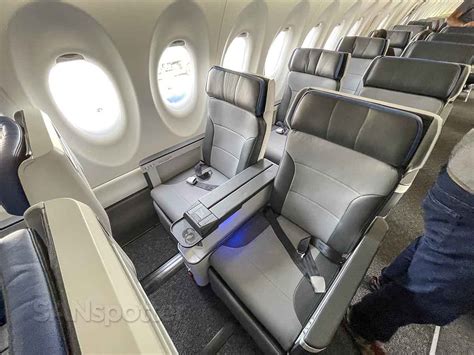
Aircraft selection plays a critical role here. The Airbus A220-300, with its lower trip costs and right-sized capacity, enables Breeze to profit where larger narrowbodies struggled. This flexibility is the backbone of the airline’s network logic.
Brownsville Returns to Florida—This Time with a Different Formula
One of the most closely watched additions is Orlando–Brownsville, a route Breeze inherits conceptually from Avelo Airlines. Brownsville, located at the southern tip of Texas near the Mexican border, had no nonstop Florida service until 2023. When Avelo entered the market, demand exploded almost overnight.
U.S. DOT figures show that indirect traffic ballooned from 4,563 passengers to 17,645 round-trip travelers in just one year, proving that the market existed but needed stimulation. However, Avelo’s use of Boeing 737-800s ultimately proved too much capacity. Load factors collapsed from over 80% to just 52.3% in 2024, sealing the route’s fate.
Breeze approaches the same market with a very different toolkit. Smaller A220s, tighter frequency control, and a demand boost tied to SpaceX-related travel between Florida and South Texas all improve the odds. Even flight numbers have been customized to reflect the SpaceX connection, a subtle signal of Breeze’s attention to narrative-driven demand.

Louisville–Los Angeles: The Standout Route in the Expansion
Among all 12 routes, Louisville–Los Angeles stands apart. With 107 passengers daily each way, it is statistically the strongest unserved market Breeze has added. In fact, DOT data ranked it as Louisville’s largest unserved domestic city pair, ahead of Austin, Seattle, and San Diego.
The route has historical precedent. Spirit Airlines operated it until 2025, while American Airlines flew it briefly between 2019 and 2020. Breeze now reintroduces the nonstop link with a leaner structure, targeting travelers who previously endured connections or long drives to alternative airports.
This route also hints at Breeze’s long-term potential. When stage lengths are limited to 850 nautical miles, several high-PDEW opportunities remain untapped, including New Orleans and Savannah. As Breeze deepens its presence in cities like San Antonio and Louisville, these logical extensions become increasingly viable.
What the Expansion Signals for Breeze’s Future Network
This announcement is not a one-off growth spurt; it is a blueprint. Breeze continues to demonstrate that low-frequency, data-driven route launches can succeed where traditional models fail. By prioritizing underserved city pairs, leveraging efficient aircraft, and embracing market stimulation, the airline is steadily reshaping expectations around U.S. domestic and near-international travel.
More routes are expected to follow, particularly as Breeze refines performance data from these new additions. If early indicators hold, this expansion will further validate Breeze’s belief that the most profitable opportunities in aviation are often hiding in plain sight—between cities no one else bothered to connect.