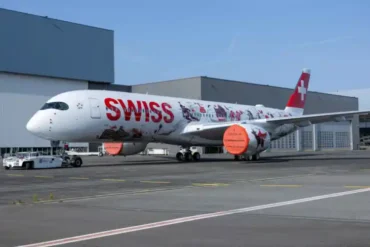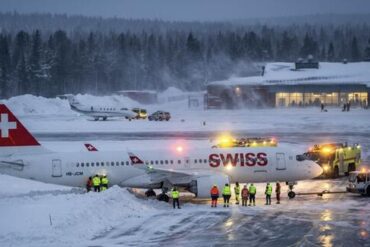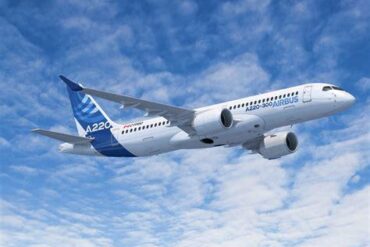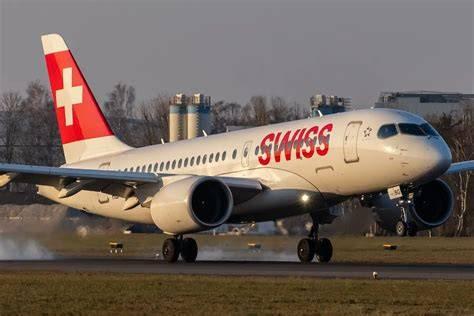
SWISS is preparing to retire its entire Airbus A220-100 fleet by the end of 2027, marking the end of a historic chapter for an aircraft that introduced the Bombardier CSeries program to commercial aviation. The airline was the launch customer of the aircraft type, but operational realities surrounding engine availability, maintenance resources, and fleet efficiency have pushed it toward a different strategy.
The decision does not represent a rejection of the Airbus A220 family. Instead, SWISS is concentrating its resources on the larger A220-300, which offers greater passenger capacity while sharing much of the same technology and maintenance infrastructure. The move highlights how airlines increasingly prioritize fleet simplicity and reliability over maintaining smaller sub-fleets, even when those aircraft are relatively young.
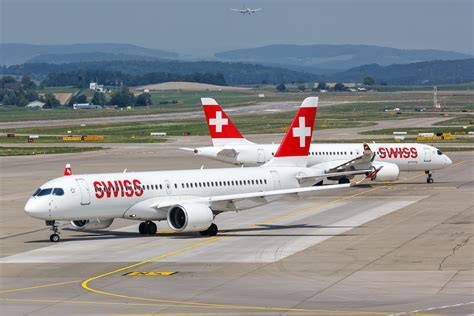
SWISS Sets Final Timeline for A220-100 Retirement
SWISS originally operated nine Airbus A220-100 aircraft, but the fleet has already been significantly reduced. Four aircraft remain active, three have been placed into storage, and two have entered the dismantling process. The airline expects the remaining aircraft to leave service by the end of 2027, after which SWISS will operate only the larger A220-300 variant within its narrowbody regional fleet.
The two aircraft already being dismantled are among the youngest members of the fleet. Stored at Toulouse-Francazal, these aircraft were determined to have greater value as sources of spare parts rather than returning to passenger operations. Their Pratt & Whitney PW1500G engines and other components can support the larger A220-300 fleet, improving aircraft availability at a time when airlines continue to face supply chain challenges.
This approach reflects a significant shift from earlier expectations. When SWISS first began removing some A220-100s from service, the airline had not ruled out returning stored aircraft once engine problems improved. However, the decision to retire the entire sub-fleet confirms that the airline has chosen long-term consolidation rather than rebuilding a smaller and more complex operation.
Engine Problems Changed the A220 Fleet Strategy
The main factor behind SWISS’s decision is the ongoing reliability challenge affecting the Pratt & Whitney geared turbofan engine that powers the A220 family. Engine inspections, repairs, and component replacements have created extended aircraft downtime across the global A220 fleet.
For SWISS, the impact became increasingly difficult to manage. The airline reported that several A220 aircraft were unavailable at any given time while engines underwent inspections and maintenance procedures. With limited engines and technical resources available, the airline faced a strategic choice: distribute resources across both A220 variants or focus on the aircraft capable of carrying more passengers.
The A220-300 ultimately became the preferred solution. With 145 seats in SWISS configuration, it provides approximately 20 more seats than the A220-100, which carries 125 passengers. While the difference may appear modest, those additional seats create a meaningful advantage when multiplied across an entire fleet and hundreds of daily flights.
Why the Airbus A220-300 Became the Preferred Aircraft
The economics behind SWISS’s decision are closely linked to fleet efficiency. Both the A220-100 and A220-300 share the same aircraft family design, similar cockpit systems, and the same engine platform. However, the larger aircraft generates more passenger capacity from nearly identical operational requirements.
SWISS operates 21 Airbus A220-300 aircraft compared with only nine A220-100s originally acquired. Maintaining two different variants requires additional scheduling complexity, spare parts planning, pilot training considerations, and maintenance support. As the A220-100 fleet became smaller, those challenges became harder to justify.
By redirecting available engines and components toward the A220-300, SWISS can maximize the number of available seats while improving operational reliability. The strategy allows the airline to maintain the benefits of the A220 family without supporting a shrinking aircraft group that provides less capacity.
The retirement decision also reflects a wider industry trend. Airlines increasingly prefer aircraft families with fewer variants because simplified fleets reduce costs and improve resilience. A smaller fleet type can become inefficient when spare parts, engineering support, and maintenance capabilities are spread too thinly.
The Aircraft That Introduced the A220 Era
Although its operational life with SWISS will end earlier than expected, the A220-100 holds a unique place in aviation history. The aircraft began life as the Bombardier CSeries, a program designed to challenge traditional regional aircraft with advanced technology, lower fuel consumption, and improved passenger comfort.
In 2009, SWISS and Lufthansa Group committed to the CSeries program, becoming its launch customer. The airline planned to replace its aging Avro RJ100 fleet with a new generation aircraft that promised significantly better efficiency and environmental performance.
The CS100, which later became the Airbus A220-100 after Airbus acquired a majority stake in the program, delivered on many of those promises. Compared with older regional aircraft, it offered improved fuel efficiency, quieter operations, and a more comfortable cabin experience. These qualities were particularly valuable for airports with strict noise requirements, including Zurich Airport and London City Airport.
The historic moment arrived on July 15, 2016, when SWISS operated flight LX638 from Zurich to Paris Charles de Gaulle using aircraft HB-JBA. This became the first commercial flight of any Bombardier CSeries aircraft, officially launching a new era of small narrowbody aviation.
A Short Career With a Lasting Impact
The A220-100’s retirement after roughly a decade of service may appear surprising, but its contribution to aviation remains significant. The aircraft helped introduce a new generation of efficient regional jets and played a major role in establishing the A220 family as a competitive force in the commercial aircraft market.
SWISS originally planned a larger and more balanced CSeries fleet, but the final structure evolved into nine A220-100s and 21 A220-300s. The smaller aircraft successfully completed its original mission by replacing older regional aircraft and proving the capabilities of the new platform.
The aircraft’s early departure is therefore not a sign of failure. Instead, it demonstrates how quickly airline strategies can change when external challenges, such as engine shortages, reshape operational priorities.
The Airbus A220-100 introduced the world to a new aircraft family, but the A220-300 has become the model that better matches SWISS’s current needs. By retiring the smaller variant, SWISS is choosing a simpler and more efficient fleet structure while preserving the technology that transformed its short-haul operations.
The final retirement of the A220-100 will close an important chapter, but the legacy of the aircraft will continue through the A220-300 fleet and the broader success of the A220 program worldwide.