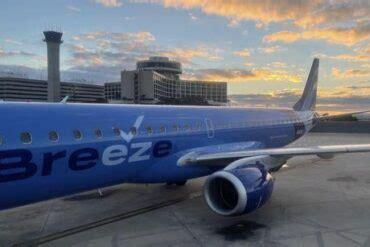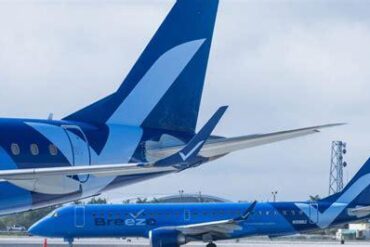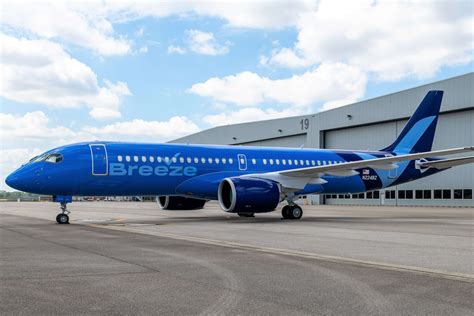
The peak summer travel season is set to become even busier for Breeze Airways, with the fast-growing carrier unveiling 19 new routes scheduled to begin in July. The expansion represents another major milestone for the airline as it continues building a network centered on underserved city pairs, secondary airports, and limited-competition markets throughout the United States.
According to schedule data submitted to OAG, Breeze expects to operate 266 daily flight movements during July, marking a 44% increase compared with the same month last year. The airline is also planning roughly 20% more services than in the current month, highlighting an aggressive growth strategy timed to capitalize on strong seasonal demand.
While the percentage gains are amplified by Breeze’s relatively young network, the scale of the expansion demonstrates the carrier’s confidence in point-to-point routes that traditional airlines have often overlooked.
Florida Becomes the Centerpiece of Breeze Airways’ July Growth
Florida remains one of the airline’s most important strategic markets, accounting for approximately 27% of all Breeze flights during July. The state’s importance is reflected by the fact that 13 of the 19 newly introduced routes either originate, terminate, or operate within Florida, significantly expanding connectivity across the region.
The airline’s Florida schedule will grow even faster than its overall network, with services to, from, and within the Sunshine State increasing by roughly 61% compared with July of the previous year.
A major focus of the expansion is Fort Lauderdale-Hollywood International Airport (FLL), which will gain eight new Breeze destinations. These include Birmingham (BHM), Charleston (CHS), Greenville-Spartanburg (GSP), Jacksonville (JAX), Salisbury (SBY), Tallahassee (TLH), Tampa (TPA), and Wilkes-Barre/Scranton (AVP).
Several of these markets will be operated exclusively by Breeze, while others will compete against airlines such as JetBlue, Southwest, Allegiant, and Frontier depending on the route.
New Airports Join the Breeze Airways Network
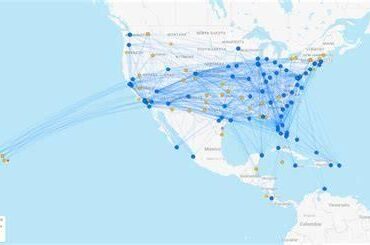
Beyond adding routes, Breeze is also extending its airport footprint. In July, the carrier will begin serving Tallahassee Regional Airport (TLH) and Birmingham-Shuttlesworth International Airport (BHM) for the first time, increasing its network to 84 airports.
The addition of these destinations supports Breeze’s long-standing strategy of connecting communities that have historically experienced limited nonstop service. Rather than concentrating solely on major airline hubs, the company continues targeting markets where passengers previously relied on connections or lengthy drives.
Fort Lauderdale Emerges as a Major Expansion Hub
Among the most significant additions is the strengthening of Fort Lauderdale’s role within the Breeze network. The carrier plans to operate 13 weekly flights between Fort Lauderdale and Tampa, making it one of the airline’s highest-frequency routes systemwide.
Other notable Florida additions include Orlando to Atlantic City, Raleigh-Durham to Tallahassee, and Tampa to Atlantic City, Columbus, and Punta Cana.
Some of these routes replace markets recently abandoned by competitors. For example, nonstop service between Orlando and Atlantic City and between Tampa and Atlantic City had previously been operated by Spirit Airlines, creating an opportunity for Breeze to enter with fresh capacity.
Meanwhile, Breeze’s new Tampa–Punta Cana service arrives as JetBlue prepares to exit that international market, leaving Breeze to compete primarily with Frontier.
Six Additional Domestic Routes Expand Regional Connectivity
Outside Florida, Breeze will also introduce six twice-weekly domestic routes aimed at strengthening links between midsized metropolitan areas.
The additions include:
- Akron/Canton – Portland
- Cincinnati – Greenville/Spartanburg
- Cincinnati – Portland
- Columbus – Savannah
- Pittsburgh – Myrtle Beach
- Raleigh-Durham – Birmingham
Most of these routes will launch without nonstop competition. Only Pittsburgh to Myrtle Beach currently faces direct rivals, where Breeze will compete against Allegiant and Southwest after Spirit’s earlier withdrawal.
The emphasis on low-frequency but carefully selected city pairs allows the airline to test demand while maintaining scheduling flexibility.
Limited Competition Shapes Breeze’s Expansion Strategy
Perhaps the most remarkable aspect of the July rollout is the competitive landscape. Thirteen of the nineteen new routes—approximately 68%—will have no direct airline competition, giving Breeze a significant opportunity to establish itself before rivals enter the market.
Many of these routes once existed years ago but disappeared following network restructurings by legacy airlines. Examples include Cincinnati to Portland, last served by Delta before the closure of its Cincinnati hub, and Raleigh-Durham to Birmingham, whose previous nonstop service ended in 2008.
Several markets are entirely new. Routes such as Portland to Akron/Canton, Fort Lauderdale to Salisbury, Fort Lauderdale to Wilkes-Barre/Scranton, and Raleigh-Durham to Tallahassee previously lacked nonstop options altogether.
Transportation data suggests that some generated relatively modest connecting passenger volumes before receiving direct flights. Breeze appears to be betting that affordable fares, nonstop convenience, and modern aircraft will stimulate entirely new travel demand rather than simply divert existing passengers.
With 19 additional routes, two new airports, and a substantial increase in flight activity, Breeze Airways is reinforcing its position as one of America’s most ambitious expanding airlines while continuing to reshape connectivity in underserved regional markets.