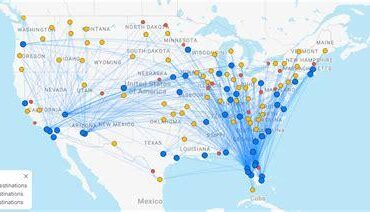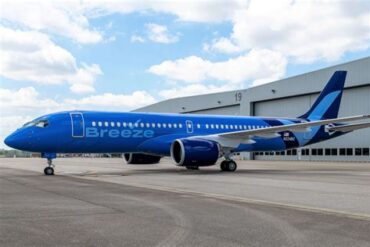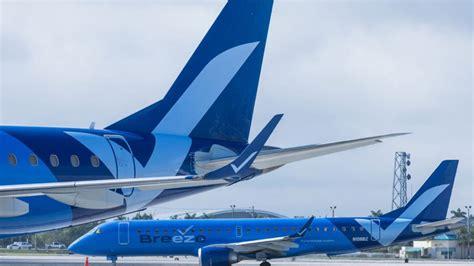
Breeze Airways is once again reshaping its fast-growing domestic network, cutting nine routes across the United States while continuing an aggressive expansion strategy focused on underserved city pairs and secondary airports. The carrier, founded by aviation entrepreneur David Neeleman, has built its reputation on launching nonstop flights where larger airlines often see limited opportunity. Yet the latest schedule adjustments reveal the difficult balancing act facing a young airline trying to grow rapidly while maintaining sustainable demand.
Since launching passenger operations in 2021, Breeze Airways has transported more than 15 million passengers across the United States. The airline’s footprint expanded quickly thanks to low-frequency point-to-point routes linking mid-sized cities that previously lacked nonstop service. However, not every market delivered the performance needed to remain viable long term.
Industry schedule data comparing the carrier’s second and third quarter 2025 network against the same period in 2026 confirms that nine routes have disappeared from Breeze’s system. While that may sound dramatic, the broader picture is far more nuanced. During the same timeframe, Breeze also introduced or restored dozens of additional airport pairs, reinforcing its strategy of constant experimentation.
The airline’s business model depends heavily on identifying overlooked travel demand before competitors move into the market. Some routes become long-term successes. Others quietly disappear after a year or two of operation when passenger demand, aircraft utilization, or operational economics fail to align.
The latest cuts demonstrate how dynamic that process has become for one of America’s newest hybrid low-cost carriers.
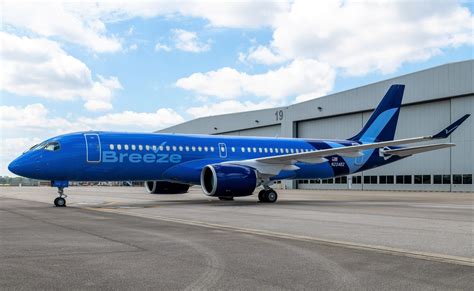
Breeze Airways Removes Nine Domestic Routes From Its Network
The eliminated routes cover a wide geographic spread and include several transcontinental services that connected smaller metropolitan areas with major leisure and business destinations.
The discontinued routes include:
- Raleigh/Durham to Los Angeles
- Greenville/Spartanburg to Westchester
- Akron/Canton to Los Angeles
- Huntsville to Los Angeles
- Norfolk to Syracuse
- Tampa to Orange County
- Stewart to Vero Beach
- Orlando to Plattsburgh
- Louisville to New Orleans
Some routes ended as early as spring 2025, while others survived into early 2026 before being removed from Breeze’s schedules.
One particularly notable cancellation was the Louisville-to-New Orleans service. The route launched during Breeze’s early expansion phase in July 2021 and represented the kind of underserved leisure-oriented market the airline originally targeted. Spanning nearly 1,000 kilometers each way, the route connected two culturally vibrant cities without requiring passengers to connect through congested hub airports.
Despite its early symbolic importance within Breeze’s network, the route ultimately disappeared after operations ended in April 2025.
The airline’s willingness to rapidly test and abandon markets remains one of its defining characteristics. Unlike legacy airlines that often preserve weaker routes for competitive or strategic reasons, Breeze appears far more willing to redeploy aircraft toward stronger-performing opportunities.
Tampa To Orange County Became Operationally Challenging
Among the most interesting route cuts was Breeze’s nonstop service between Tampa and Orange County’s John Wayne Airport in Southern California.
John Wayne Airport presents operational challenges unlike most airports in the United States. Strict slot limitations, passenger caps, and one of the shortest major commercial runways in the country create a difficult environment for airlines operating longer-range services. At only 5,700 feet, the runway limits aircraft performance, especially on transcontinental flights requiring higher fuel loads.
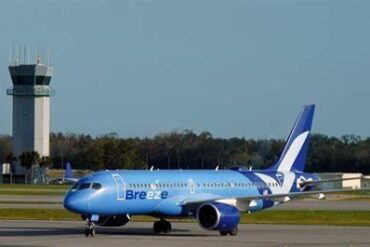
Breeze launched the Tampa-to-Orange County route in May 2024 using its Airbus A220-300 fleet. While the aircraft is highly efficient and capable of operating thinner long-haul domestic routes, the service itself faced structural disadvantages.
The schedule reflected how tightly Breeze was utilizing its aircraft. The A220 serving the route was not based in Tampa. Instead, it originated in Hartford before operating multiple sectors throughout the day. That created exceptionally long operational cycles with high block-hour utilization despite relatively few daily flights.
In practical terms, the aircraft spent large portions of the day airborne while generating revenue from only a limited number of sectors. For a growing airline still optimizing fleet deployment, such inefficiencies can quickly make marginal routes unattractive.
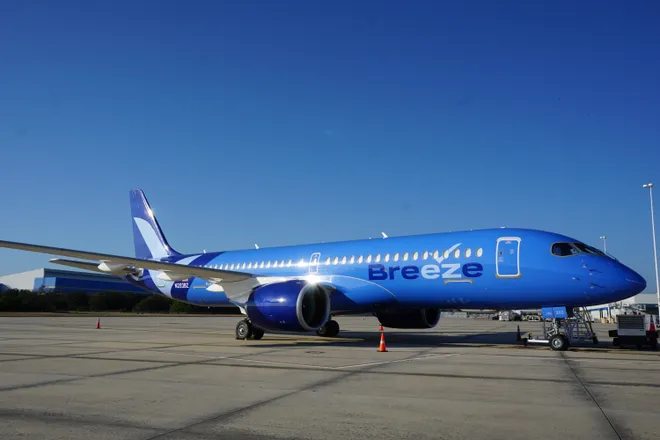
Raleigh-Durham To Los Angeles Faced Fierce Competition
The discontinuation of Breeze’s Raleigh/Durham-to-Los Angeles route may appear surprising given the sheer size of the market.
Raleigh/Durham has emerged as one of Breeze’s most important focus cities, and passenger demand between North Carolina and Southern California remains substantial. Federal transportation data shows nearly 292,000 passengers traveled nonstop between Raleigh/Durham and Los Angeles in 2025 alone.
When all Los Angeles-area airports are included, annual passenger traffic exceeded 395,000 travelers.
Yet market size alone does not guarantee profitability.
Breeze entered the route in May 2023 as a smaller challenger competing directly against major network carriers including Delta Air Lines and American Airlines. Both airlines already possessed strong customer loyalty, extensive connecting networks, premium cabin demand, and higher flight frequencies.
Although Breeze reportedly achieved an impressive seat load factor exceeding 82% during the route’s final year, its overall market share remained below 8%. The airline’s low-frequency model made it difficult to compete for business travelers seeking flexible departure times and broader loyalty benefits.
This highlights a critical reality in aviation economics: high load factors do not automatically translate into profitable operations. Airlines must also consider yields, operating costs, aircraft utilization, crew logistics, and competitive pricing pressure.
In many cases, a route can appear healthy from a passenger perspective while remaining financially unsustainable behind the scenes.
Breeze Airways Continues Expanding Despite Route Cuts
The latest network adjustments should not be interpreted as a retreat. Instead, they reinforce Breeze Airways’ broader strategy of constant recalibration.
Compared with several ultra-low-cost competitors, Breeze remains aggressively expansion-focused. The airline continues launching new airport pairs at a pace few US carriers can match. Its use of the Airbus A220 has enabled the company to operate thinner long-distance routes with lower operating costs and improved passenger comfort compared with older narrowbody aircraft.
At the same time, the carrier continues refining which markets truly support sustainable year-round demand.
That flexibility may ultimately become one of Breeze’s greatest strengths. By avoiding long-term attachment to underperforming routes, the airline can quickly redirect aircraft toward markets where competition is lighter and demand is more predictable.
For passengers, the changes serve as another reminder that Breeze operates differently from traditional airlines. Its route map remains fluid, experimental, and highly responsive to real-world booking trends.
As the airline enters its next growth phase, additional adjustments — both expansions and cuts — are almost certain to continue reshaping its national network.