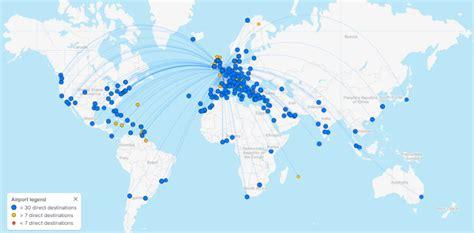
British Airways is undertaking one of its most notable network restructures in recent years, cutting 19 international routes across its long-haul and short-haul operations while simultaneously strengthening its dominance at London Heathrow. The changes, identified through a comparison of schedules between January 2025–May 2026 and the currently published June 2026–March 2027 timetable, reveal a carrier reshaping its global footprint around profitability, slot efficiency, and premium-demand markets.
As Europe’s sixth-largest airline by flights and the United Kingdom’s leading long-haul operator, British Airways faces mounting pressure from low-cost rivals, rising operational costs, fleet utilization constraints, and shifting passenger demand. The latest route removals are not random cuts. They reflect a calculated transition away from fragmented operations at London Gatwick and secondary European airports toward a more concentrated Heathrow-centric strategy.
The changes affect both leisure and business markets, including routes to the Middle East, the Caribbean, North America, Southern Europe, and Scandinavia-linked regional operations. Some routes have disappeared entirely, while others are being consolidated into Heathrow services with higher frequencies and stronger premium revenue potential.
By reducing duplication and concentrating aircraft where margins are strongest, British Airways is effectively redrawing its international network for a post-pandemic aviation environment increasingly defined by yield rather than sheer scale.
British Airways Ends Seven Long-Haul International Routes
The most significant cuts involve seven long-haul services, with Heathrow losing two routes and Gatwick losing five. The airline has permanently removed Heathrow flights to Jeddah and Kuwait, both of which carried strategic importance in the Gulf region.
The suspension of the Heathrow–Jeddah route is particularly striking because the Saudi Arabian destination only returned in November 2024 after several years away from the network. British Airways cited regional instability in the Middle East as a contributing factor, but broader commercial realities likely played a larger role. Riyadh remains a stronger premium market with higher corporate demand and government-related travel, making it a far more lucrative destination for scarce Heathrow slots.
Kuwait’s removal is even more symbolic. British Airways had served the Gulf state for more than six decades, making the withdrawal one of the airline’s most historically significant network exits in recent memory. The decision reflects changing competitive dynamics in the region, where Gulf carriers continue to dominate with superior connectivity and aggressive capacity growth.
Meanwhile, Gatwick has absorbed the heaviest long-haul reductions. British Airways has discontinued flights from the airport to:
- Aruba
- Cape Town
- Las Vegas
- New York JFK
- San Jose, Costa Rica
These eliminations do not necessarily indicate weak demand in every market. In several cases, British Airways is consolidating operations at Heathrow instead of abandoning the destinations entirely. San Jose, Costa Rica, for example, will continue from Heathrow for the first time, signaling confidence in the market but not in Gatwick as the operating base.
The cuts to New York JFK and Las Vegas illustrate a broader strategic shift. Rather than splitting traffic between Heathrow and Gatwick, British Airways is concentrating premium-heavy transatlantic demand at Heathrow, where corporate contracts, alliance connectivity, and high-yield passengers generate significantly stronger returns.
This consolidation also helps explain why British Airways will operate a record 50 daily services between London and the United States during the peak summer season.
Heathrow Becomes the Center of British Airways’ Global Network
The restructuring demonstrates that Heathrow is no longer simply British Airways’ primary hub. It is increasingly becoming the airline’s exclusive strategic priority for long-haul expansion.
Gatwick, while still important for leisure traffic, does not offer the same profitability advantages. Heathrow delivers stronger premium cabin demand, superior alliance feed through the oneworld network, and greater appeal to business travelers willing to pay higher fares.
The upcoming transfer of Tampa flights from Gatwick to Heathrow further reinforces this strategy. The Florida route will become Heathrow’s second Tampa service, despite concerns over load factors in the market. Virgin Atlantic previously identified Heathrow–Tampa as one of its weakest-performing U.S. routes by seat occupancy, yet British Airways appears willing to test whether Heathrow’s broader connectivity can improve performance.
The airline is effectively betting that concentration creates efficiency. Rather than operating diluted frequencies from multiple London airports, British Airways now prefers deeper Heathrow schedules capable of maximizing aircraft utilization and premium revenue.
Eleven Short-Haul Routes Also Disappear
Beyond long-haul operations, British Airways has also removed 11 short-haul international routes linked to London airports. The cuts affect Heathrow, Gatwick, London City, and Stansted operations.
The Heathrow reductions include flights to:
- Cologne
- Grenoble
- Istanbul Sabiha Gökçen
- Izmir
- Kalamata
- Riga
- Stuttgart
Several of these destinations had only recently returned after pandemic-era suspensions, revealing how unstable short-haul recovery economics remain across Europe.
The disappearance of Kalamata from Heathrow initially appeared to mark a complete exit from the Greek leisure destination. Instead, British Airways transferred the operation to its lower-cost subsidiary BA Euroflyer at Gatwick. The move highlights how the airline is using different operating units to match specific market conditions.
BA Euroflyer’s lower-cost structure allows British Airways to maintain seasonal Mediterranean routes without exposing Heathrow’s premium-focused operation to weaker margins.
The highly irregular Kalamata schedule also reflects Gatwick’s continuing slot pressures and aircraft availability limitations. Unlike Heathrow’s structured long-haul banking system, Gatwick operations often require flexible rotations to maximize utilization across leisure-heavy routes.

London City and Regional Flying Continue to Shrink
British Airways’ regional and London City operations are also becoming increasingly selective. Routes from London City to Frankfurt and Prague have disappeared, while Stansted’s Amsterdam service has also been removed.
These reductions demonstrate how business travel patterns continue to evolve after the pandemic. London City Airport historically relied heavily on financial-sector travelers demanding frequent short-haul connections. Hybrid work patterns and reduced same-day corporate travel have permanently altered demand across many traditional business routes.
Outside London, only one international route has disappeared entirely: Edinburgh to Olbia. Operated by CityFlyer using Embraer E190 aircraft during weekends, the Sardinia route struggled after low-cost carrier competition intensified.
easyJet’s launch of Edinburgh–Olbia services likely accelerated British Airways’ decision to withdraw. The route had depended heavily on seasonal leisure traffic, an area where low-cost airlines typically maintain a substantial pricing advantage.
British Airways Is Prioritizing Profitability Over Network Size
The latest cuts reveal a broader reality shaping modern airline strategy. Growth alone is no longer the objective. Airlines increasingly prioritize routes capable of generating premium revenue, maximizing slot value, and supporting alliance connectivity.
British Airways is not retreating from international aviation. Instead, it is refining where and how it competes.
The airline remains heavily committed to North America, premium Gulf markets, and strategically valuable long-haul corridors. At the same time, secondary leisure routes and weaker short-haul operations are becoming harder to justify in an environment defined by high fuel prices, aircraft shortages, labor costs, and fierce low-cost competition.
For passengers, the result is a British Airways network that may appear smaller on paper but is becoming more concentrated around the markets the airline believes will deliver the strongest long-term returns.