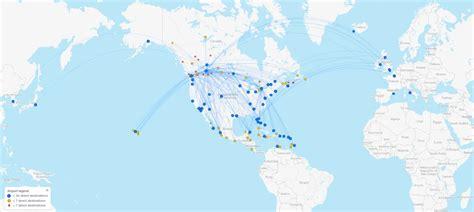
Canada’s second-largest airline is dramatically reshaping its international network, cutting 41 routes across the United States, Caribbean, Mexico, and Latin America as it pivots toward stronger-performing markets and adjusts to softer cross-border demand. The sweeping changes represent one of the most significant schedule restructurings in WestJet’s recent history, even as the carrier simultaneously launches new overseas services to Europe.
Based on schedule comparisons between January 2025-May 2026 and the airline’s planned network for June 2026-March 2027, the Calgary-based carrier has removed dozens of international routes that previously operated with at least five departures. The reductions highlight how rapidly travel patterns, economics, and geopolitical factors are reshaping airline strategy across North America.
WestJet still maintains a commanding presence within Canada’s aviation market. OAG schedule data shows the airline controls roughly 22% of domestic flights nationwide, while holding smaller shares in short-haul and long-haul international sectors. Yet the latest cuts reveal an airline becoming increasingly selective about where it deploys aircraft capacity.
The changes arrive at a fascinating moment for the carrier. On one hand, WestJet recently expanded with new transatlantic routes including Halifax-Madrid and Toronto-Glasgow. On the other, it is aggressively eliminating underperforming or seasonal international services closer to home.

US Routes Face the Sharpest Reductions
More than half of the eliminated routes involve destinations in the United States, underscoring how fragile demand has become in certain transborder markets. In total, WestJet cut 24 US routes, a major retreat that reflects weakening Canadian travel demand south of the border.
The reductions come as US Department of Transportation figures showed WestJet’s passenger traffic to the United States fell by 19% between March 2025 and February 2026 compared with the previous twelve-month period. Political tensions, economic uncertainty, and changing vacation preferences appear to be influencing Canadian travelers more than many airlines initially anticipated.
Several of the affected routes were relatively niche operations with limited weekly frequencies, meaning the overall seat reduction may not be as devastating as the headline figure suggests. Still, the cuts expose vulnerabilities in WestJet’s broader strategy of feeding passengers into partner airline hubs across the United States.
One particularly notable casualty is the Winnipeg-Atlanta route. Introduced in September 2023, the service was designed to funnel passengers into Delta Air Lines’ massive Atlanta network, the busiest airport hub in the world by passenger traffic. Despite the connectivity benefits, the route reportedly achieved only a 79% load factor before being discontinued in April 2026.
Other removed routes paint a similar picture of ambitious experimentation meeting softer-than-expected demand. Vancouver-Boston disappeared after operating only between June and October 2025, while Calgary-Raleigh/Durham suffered the same fate after a short seasonal run.
WestJet also eliminated several leisure-oriented services that once targeted vacation travelers and music tourism demand, including Edmonton-Nashville and Winnipeg-Nashville. Both routes lasted barely over a year before being dropped from future schedules.
Perhaps the most surprising cancellation is Vancouver-Tampa. The route operated only seasonally, but its disappearance now leaves the market entirely unserved after Air Canada also exited the sector. The dual withdrawal suggests demand between western Canada and Florida’s Gulf Coast proved insufficient to sustain competition.
Caribbean Network Shrinks After Sunwing Integration
WestJet’s Caribbean network is also undergoing major consolidation, particularly involving Cuba. The airline removed 14 Caribbean routes from its future schedule, all tied to Cuban destinations inherited through its acquisition of leisure carrier Sunwing.
At first glance, the suspensions could appear temporary because Cuba continues to struggle with jet fuel shortages that have disrupted operations for multiple airlines. However, these route eliminations are more permanent in nature. Unlike temporary suspensions, the affected services no longer appear in future scheduling plans through March 2027.
The distinction matters because WestJet still intends to maintain a significant Cuban presence overall. The airline plans to resume more than 20 Cuba routes beginning in October, but many smaller or weaker-performing city pairs failed to survive the network review.
Most of the eliminated services operated only during peak winter demand between December and February, highlighting how dependent Caribbean flying remains on seasonal Canadian vacation traffic. Routes with narrow operating windows are often the first to disappear when airlines seek efficiency improvements.
The Sunwing acquisition initially gave WestJet enormous scale in the leisure market, particularly across sun destinations in the Caribbean and Mexico. But integrating overlapping routes while managing profitability has proven more complicated than simply inheriting aircraft and airport slots.

Mexico and Latin America Also See Service Pullbacks
Mexico remains one of WestJet’s largest international markets despite the latest reductions. The country now accounts for approximately 27% of the airline’s flights, a massive increase from just 16% in 2022. Much of that growth came through absorbing former Swoop and Sunwing operations.
Even so, the airline has trimmed select routes where demand failed to justify continued operations. Regina-Mazatlán and Montreal-Los Cabos both disappeared from future schedules after limited seasonal runs.
The Montreal-San Andrés route may be the most intriguing cancellation outside the United States. Although San Andrés belongs to Colombia, the island sits geographically closer to Central America and functions largely as a Caribbean leisure destination. The service was another inherited Sunwing route that ultimately failed to fit within WestJet’s revised strategy.
These cuts suggest WestJet is becoming increasingly disciplined about focusing on markets with stronger year-round performance rather than relying heavily on highly seasonal vacation demand.
WestJet’s International Strategy Enters a New Phase
The scale of the restructuring reveals an airline recalibrating its identity in a rapidly evolving aviation market. WestJet spent years transforming from a low-cost domestic operator into a broader international network carrier competing with Air Canada across multiple continents.
Now, the airline appears to be entering a more cautious phase focused on profitability, optimized aircraft utilization, and stronger core markets. While Europe expansion continues attracting headlines, the quieter story may be WestJet’s retreat from thinner North American and Caribbean routes that no longer meet performance expectations.
For travelers, the changes mean fewer nonstop options from secondary Canadian cities to US and Caribbean destinations. For WestJet, however, the cuts may represent an essential reset designed to stabilize margins and strengthen long-term competitiveness in an increasingly volatile airline industry.