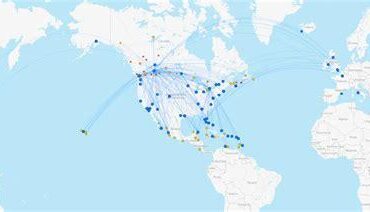
Canada’s second-largest airline is making one of its most significant transborder network adjustments in recent years. WestJet has removed 20 routes between Canada and the United States for the summer 2026 season, signaling a major strategic shift away from several leisure-focused American destinations and toward faster-growing markets in Europe, Mexico, the Caribbean, and Latin America.
While the broader Canada–U.S. aviation market remains relatively stable, WestJet’s reductions stand out for both their scale and concentration. The airline is not merely trimming underperforming services; it is reshaping its network around changing travel preferences among Canadian consumers, evolving economic conditions, and new opportunities enabled by its expanding Boeing 737 MAX fleet.
WestJet’s retreat comes at a time when Canadian leisure travel to the United States has weakened considerably. Rather than maintaining capacity on routes facing softer demand, the airline is redirecting aircraft toward destinations where vacation demand is stronger and yields appear more attractive.
WestJet’s U.S. Network Shrinks Dramatically in Summer 2026
Schedule data comparing the third quarter of 2026 with the same period in 2025 reveals the magnitude of the changes. WestJet is scheduled to operate approximately 7,696 Canada–U.S. flights, down from 8,956 flights a year earlier. The reduction of 1,260 flights represents a 14.1% decline, making WestJet the carrier with the largest absolute decrease among major airlines operating across the border.
The cuts are especially notable because the overall transborder market has remained almost unchanged year over year. Air Canada has modestly expanded its operations, U.S. airlines have added capacity, and Porter Airlines continues an aggressive growth phase. Against that backdrop, WestJet’s pullback appears highly deliberate rather than the result of a broad industry slowdown.
The airline is effectively repositioning itself away from several discretionary leisure markets that have become less attractive since early 2025. This strategy mirrors broader trends affecting Canadian vacation travel, particularly to destinations south of the border.

The 20 U.S. Routes WestJet Has Eliminated
The list of discontinued routes paints a clear picture of where the airline sees the greatest weakness. Many of the removed services connect Canadian cities with traditional holiday destinations popular among leisure travelers.
The cancelled routes include:
- Calgary – Fort Lauderdale
- Calgary – Kahului (Maui)
- Calgary – Raleigh-Durham
- Edmonton – Chicago
- Edmonton – Nashville
- Edmonton – San Francisco
- Edmonton – Seattle
- Halifax – Orlando
- St. John’s – Orlando
- Toronto – Las Vegas
- Toronto – Los Angeles
- Vancouver – Boston
- Vancouver – Nashville
- Vancouver – Orlando
- Vancouver – San Diego
- Vancouver – San Francisco
- Vancouver – Tampa
- Winnipeg – Atlanta
- Winnipeg – Nashville
- Winnipeg – Orlando
A closer examination reveals that many of these destinations depend heavily on vacation traffic. Florida alone loses multiple WestJet connections, including Orlando, Tampa, and Fort Lauderdale. Other affected leisure markets include Las Vegas, Maui, Nashville, and San Diego.
The concentration of cuts among vacation-oriented routes suggests that WestJet’s network planners are responding directly to changing traveler behavior rather than weakness across all categories of U.S. demand.
Why Canadians Are Traveling Less to the United States
The decline in Canadian travel demand to the United States has been building for more than a year. Industry data has consistently shown fewer Canadians crossing the border, particularly for leisure purposes.
A combination of economic pressures, currency considerations, political tensions, and shifting consumer preferences has contributed to the trend. Many travelers appear increasingly willing to explore alternatives beyond the United States, especially when comparable vacation experiences can be found elsewhere.
Statistics have shown a sustained decline in Canadian return trips from the United States, with air travel experiencing an even sharper reduction. As a result, airlines heavily exposed to discretionary leisure traffic have felt the greatest impact.
WestJet’s leadership has openly acknowledged the changing environment. Rather than attempting to stimulate weak demand through aggressive discounting, the airline has chosen to redeploy capacity into markets showing stronger booking trends and better long-term growth prospects.
Other Canadian Airlines Tell a Similar Story
WestJet is not the only carrier reducing its U.S. exposure.
Air Transat, long known for its vacation-focused business model, has effectively disappeared from the Canada–U.S. market in this period. Meanwhile, ultra-low-cost carrier Flair Airlines has significantly reduced its transborder operations.
These developments reinforce the view that the softest segment of the market is discretionary leisure travel. Airlines dependent on vacation traffic are experiencing greater pressure than carriers supported by corporate travel, premium passengers, and extensive connecting networks.
Air Canada has largely maintained stability because of its hub structure and broader mix of travelers. U.S. carriers benefit from similar advantages, allowing them to sustain capacity despite changing demand patterns.
Porter Airlines stands out as an exception. The airline continues to expand aggressively using its Embraer E195-E2 fleet, adding flights to cities such as Boston, Austin, Nashville, and Chicago. However, Porter’s growth reflects a broader expansion strategy rather than exceptionally strong transborder demand.

Mexico Has Become a Major Winner
As WestJet retreats from parts of the U.S. market, Mexico has emerged as one of the biggest beneficiaries.
Canada–Mexico air service has experienced remarkable growth, with flight volumes increasing dramatically compared with the previous year. WestJet has played a leading role in that expansion, adding thousands of additional flights and strengthening its position in key leisure destinations.
The appeal is easy to understand. Mexican resort markets continue to attract strong demand from Canadian travelers seeking warm-weather vacations, often offering favorable pricing and a wide range of all-inclusive options.
For WestJet, shifting aircraft from underperforming U.S. routes to high-demand Mexican destinations represents a more efficient use of resources and improves network profitability.
Europe Is Becoming a Strategic Priority
Perhaps the most intriguing aspect of WestJet’s transformation is its growing focus on transatlantic flying.
The airline is launching an impressive collection of new European routes during the summer 2026 season. These additions include services connecting Canadian cities with destinations across Iceland, Portugal, Spain, Wales, Scotland, and Denmark.
New routes include:
- Edmonton – Reykjavík
- Halifax – Copenhagen
- Halifax – Lisbon
- Halifax – Madrid
- Toronto – Cardiff
- Toronto – Glasgow
- Toronto – Ponta Delgada
- Winnipeg – Reykjavík
These services complement routes introduced previously and now returning for another season, creating a significantly larger European network than WestJet operated only a few years ago.
The expansion highlights the growing capabilities of the Boeing 737 MAX fleet. Enhanced range allows the airline to connect secondary Canadian cities directly with European destinations that traditionally required larger widebody aircraft or connecting itineraries.

A Broader Shift Toward Global Leisure Markets
The transformation extends beyond Europe and Mexico. WestJet is also increasing its presence across the Caribbean, Central America, and parts of South America.
Several existing routes are being upgraded from seasonal to year-round operations, reflecting stronger and more consistent demand. Additional winter expansion plans include destinations such as São Paulo, Guadalajara, Panama City, and Cozumel.
This broader strategy reflects a changing competitive landscape. Rather than concentrating heavily on traditional U.S. leisure markets, WestJet is diversifying its network across multiple international regions where growth opportunities appear stronger.
The approach also reduces dependence on a single market and allows the airline greater flexibility when responding to shifts in consumer demand.
What These Changes Mean for Travelers
For Canadian passengers, the immediate effect will be fewer nonstop options to several familiar American cities. Travelers in Vancouver, Edmonton, Winnipeg, Halifax, Toronto, Calgary, and St. John’s will see some destinations disappear entirely from WestJet’s route map.
At the same time, passengers gain access to a wider selection of international leisure destinations. Expanded service to Europe, Mexico, the Caribbean, and Latin America creates new travel opportunities that align with evolving vacation preferences.
WestJet’s decision ultimately reflects a broader reality within the aviation industry: airlines succeed by placing aircraft where demand is strongest. In 2026, that increasingly means looking beyond the United States. As Canadian travelers continue exploring new destinations abroad, WestJet is positioning itself to capture that demand, even if it means walking away from 20 established U.S. routes in the process.