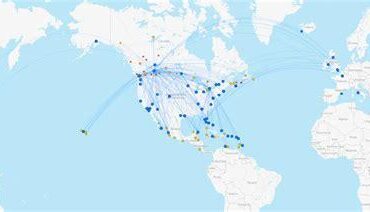
Canada’s second-largest airline is performing a delicate act of aerial pruning. WestJet has cut 11 routes between Canada and the United States, a significant recalibration of its transborder network that reflects softening demand, shifting traveler sentiment, and broader geopolitical headwinds influencing cross-border aviation.
The latest schedule filings to industry data providers such as Cirium Diio and OAG reveal not just isolated trims but a systemic contraction. Alongside the outright cancellations, WestJet is shortening operating windows and reducing frequencies across several remaining U.S. services. The pattern is unmistakable: capacity is being pulled back where profitability looks uncertain.
At the macro level, the numbers tell the story with clinical clarity. For June, WestJet has scheduled 16% fewer U.S. flights than it operated in 2025. Strip out the pandemic anomaly years, and this represents the airline’s lowest transborder footprint since 2016—a remarkable retreat for a carrier that once treated U.S. expansion as a central growth pillar.
Full List: The 11 U.S. Routes Removed
The eliminated routes span multiple Canadian gateways, though notably only one touches WestJet’s primary hub of Calgary. The cuts lean heavily toward non-core city pairs and experimental leisure markets—routes that often flourish in boom cycles but wither when demand cools.
- Calgary – Raleigh/Durham
- Edmonton – Chicago O’Hare
- Edmonton – San Francisco
- Edmonton – Seattle
- Halifax – Orlando
- Toronto – Los Angeles
- Vancouver – Boston
- Vancouver – Nashville
- Vancouver – San Diego
- Vancouver – San Francisco
- Winnipeg – Nashville
Several of these routes had only recently launched or resumed service between 2023 and 2025, underscoring how quickly network optimism can collide with market reality.
Vancouver Hit Hard as Secondary Markets Retract
Vancouver absorbs a disproportionate share of the cuts, losing four U.S. links. This is strategically revealing. While Vancouver is a major international gateway, its U.S. secondary routes rely heavily on discretionary leisure traffic and connecting flows rather than fortress-hub dominance.
The cancellation of Vancouver–Boston is particularly notable. At 2,184 nautical miles, it ranked as WestJet’s third-longest U.S. mainland route from Canada. Long thin routes—aviation shorthand for lengthy services with modest passenger volumes—are notoriously vulnerable when demand weakens.
Other Vancouver eliminations, including San Diego, San Francisco, and Nashville, further illustrate the airline’s retreat from competitive West Coast corridors where rivals like Air Canada and United maintain deeper corporate contracts and alliance feed.
Calgary–Raleigh/Durham: A Short-Lived Experiment
The Calgary to Raleigh/Durham service reads like a case study in cautious optimism meeting statistical gravity. The route launched on June 9, 2025, creating a brand-new nonstop link between Alberta and North Carolina.
Operationally, it was modest: 51 departures in its inaugural year, operated by a mix of 737-700, 737-800, and 737 MAX 8 aircraft, averaging about 170 seats per flight. Even before cancellation, WestJet had planned to downshift capacity in 2026—switching exclusively to the smaller 737-700 and reducing available seats by roughly 30%.
The reason sits in the load factor—the percentage of seats filled. U.S. Department of Transportation data shows the route averaged 73% occupancy. Respectable at a glance, but often insufficient once pricing pressure and operating costs are layered in. The economics simply failed to clear the airline industry’s unforgiving profitability bar.
Winnipeg–Nashville: Demand That Never Took Off
If Calgary–Raleigh was marginal, Winnipeg–Nashville was outright fragile. Launched in September 2024, the route attempted to stimulate tourism and music-driven leisure travel between central Canada and Tennessee.
Its operational timeline was intermittent—fall 2024, spring restart 2025, then summer continuation. Aircraft alternated between the 737-700 and 737 MAX 8, signaling flexible but cautious capacity planning.
Yet passenger uptake lagged sharply. Over its 13-month lifespan, the service averaged a 62% load factor. Summer performance was especially weak, with just 46% of seats filled in both July and August. For airlines, anything near half-empty during peak season is a flashing red warning light. November 2024’s 76% peak proved the exception, not the rule.
Brand-new markets often require time to mature, but airlines must balance patience against financial drag. In this case, the maturation curve never steepened.
Competitive Pressure and Airline Substitution
Importantly, WestJet’s exit does not always erase connectivity. Several routes retain service from competitors:
- Edmonton–Chicago O’Hare continues via United Airlines
- Edmonton–San Francisco remains served by Air Canada
- Edmonton–Seattle persists through Alaska Airlines
- Halifax–Orlando keeps links on Air Canada and Porter
- Toronto–Los Angeles stays heavily contested
This substitution dynamic reveals a strategic undertone: WestJet is withdrawing from markets where it lacks pricing power or alliance leverage, allowing larger network carriers to absorb demand.
A Transborder Strategy in Transition
Taken together, the cuts signal more than seasonal tinkering. They reflect a recalibration of WestJet’s identity within North American aviation. Once aggressively expansionist across the U.S., the airline is now emphasizing core hubs, higher-yield routes, and defensible leisure strongholds.
External forces loom large. Softer Canadian outbound demand—shaped partly by political climate and economic caution—has cooled transborder momentum. Airlines, exquisitely sensitive to demand signals, respond quickly when booking curves flatten.
Aviation networks behave like living organisms. Routes appear, evolve, and sometimes vanish when the ecosystem changes. WestJet’s latest shake-up is not retreat for its own sake, but adaptive restructuring—trading breadth for resilience in a market where profitability, not presence, determines which lines remain on the map.