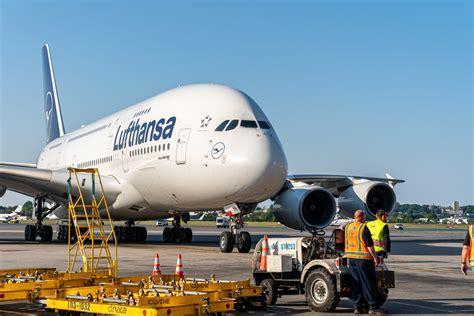
Lufthansa has quietly but decisively closed the chapter on Airbus A380 operations to 10 long-haul destinations, marking one of the most significant network contractions for the superjumbo since the pandemic era. While the aircraft remains an essential capacity tool for the German flag carrier, its footprint is now more selective, more Munich-centric, and more strategically aligned with yield rather than sheer volume.
The Airbus A380 still occupies a unique position within Lufthansa’s fleet. Eight aircraft remain active, all based at Munich Airport, while six frames have been permanently withdrawn. Among the operational aircraft is D-AIMH, currently in Shannon receiving Lufthansa’s 100th-anniversary livery, a symbolic nod to the aircraft’s continued relevance despite its shrinking route map.
Each active A380 is configured identically with 509 seats, underscoring Lufthansa’s commitment to consistency on its highest-capacity aircraft. The layout includes eight first-class suites, 78 business-class seats, 52 premium economy seats, and 371 economy seats. This configuration makes the A380 unrivaled in Lufthansa’s fleet for peak-demand markets, even as its deployment becomes more disciplined.
The superjumbo’s global reach, however, is no longer what it once was.
For more than a decade, Lufthansa’s A380s were familiar sights at some of the world’s busiest intercontinental gateways. That era has now ended for a group of major cities that once relied on the aircraft for seasonal or year-round capacity.
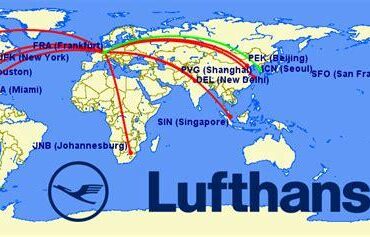
The destinations where Lufthansa has ended regular Airbus A380 service are:
- Singapore
- Miami
- Houston Intercontinental
- Beijing Capital
- New York JFK
- Shanghai Pudong
- Johannesburg
- Hong Kong
- Tokyo Narita
- Seoul Incheon
These airports were not occasional appearances. Each saw sustained, repeat A380 operations, often over many years, primarily from Frankfurt, and later from Munich.
Lufthansa originally stationed the A380 fleet at Frankfurt, its largest hub, beginning in 2010. According to Cirium Diio data, the aircraft flew extensively from Frankfurt until operations were suspended during the pandemic in 2020. Munich entered the picture in 2018, initially as a secondary base. When the A380 returned to service in 2023, Frankfurt was conspicuously absent.
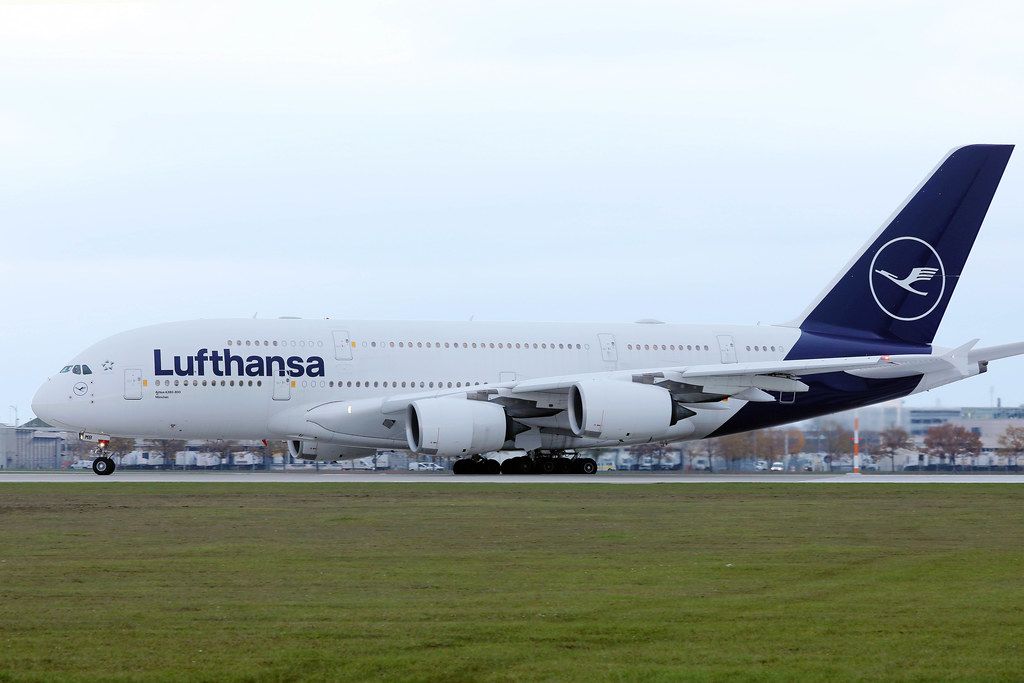
The decision to relaunch the A380 exclusively from Munich reflected more than operational convenience. Ongoing disputes over airport charges, combined with strong premium demand in Bavaria, made Munich the more attractive option. Performance data since the return suggests the strategy has worked, otherwise Lufthansa would likely have split operations between both hubs.
Among all discontinued routes, New York JFK stands apart. Unlike the others, JFK continued to see A380 service after the pandemic, with Munich–New York flights operating seasonally through October 2025. Flight LH410 departed Munich at midday, arriving in New York mid-afternoon, while the return leg, LH411, landed back in Bavaria the following morning.
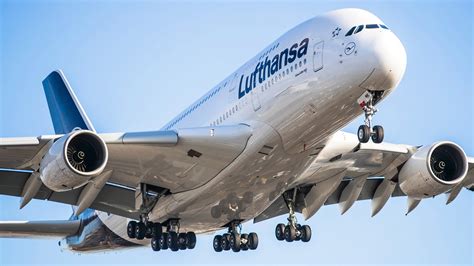
Despite a healthy 88% load factor between April and October 2025, the route was dropped from the A380 schedule for 2026. The aircraft has been replaced by the new Allegris-equipped Airbus A350-900, offering just 267 seats but a significantly upgraded premium product. The shift signals a clear pivot toward yield optimization rather than capacity maximization, particularly as transatlantic demand shows signs of softening.
Shanghai, Beijing, Singapore, and Hong Kong tell a different story. These routes largely ended A380 service during or before the pandemic, reflecting prolonged demand recovery challenges in Asia and evolving bilateral capacity dynamics. Johannesburg and Tokyo Narita disappeared even earlier, as Lufthansa reshaped its long-haul network well before COVID-19 disrupted global aviation.
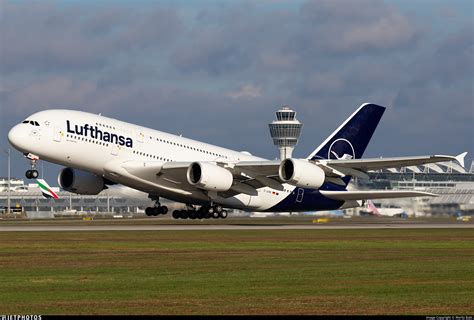
Looking ahead, Lufthansa’s A380 network in 2026 will be leaner but purpose-built. From Munich, the aircraft is scheduled to serve Bangkok, Boston, Delhi, Denver, Los Angeles, Mumbai, San Francisco, and Washington Dulles, with several routes operating only seasonally. In total, approximately 1,508 A380 departures are planned from Bavaria, representing a 7% reduction year-over-year.
Part of that decline is mathematical. Average stage length has increased slightly, indicating longer routes and fewer short-haul high-frequency deployments. The more meaningful factor is timing. Services in the final quarter of 2026 remain underdeveloped, down sharply compared to the previous year, suggesting further adjustments are likely.
What emerges is a clear picture of Lufthansa’s intent. The Airbus A380 is no longer a global workhorse spread across dozens of megacities. Instead, it has become a precision instrument, deployed where its size, prestige, and premium appeal can still outperform smaller widebodies. The superjumbo may be flying to fewer places, but where it flies, it still matters.