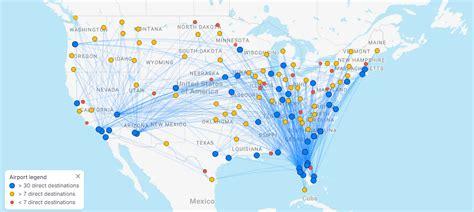
Florida remains the heart of Allegiant Air’s network, but the ultra-low-cost carrier is making significant changes to how it serves the state. Despite increasing overall flight activity in Florida, Allegiant has removed 34 routes that previously connected Sunshine State airports with smaller cities across the United States. The move highlights a broader strategy shift as the airline concentrates resources on routes that generate stronger demand and better financial returns.
From June through December 2026, Florida will account for approximately 63% of Allegiant’s entire network activity. The carrier continues to rely heavily on leisure travelers seeking affordable nonstop flights to vacation destinations, but recent route eliminations show that not every experiment has produced the expected results.
The changes affect eight Florida airports and dozens of communities that previously benefited from direct Allegiant service. While route churn is common among ultra-low-cost carriers, the scale of these reductions illustrates how aggressively the airline is refining its network.
Allegiant’s latest adjustments also reveal a growing focus on higher-density markets where larger passenger volumes can support increased frequencies and stronger profitability.

Why Allegiant Air Is Cutting Routes Across Florida
Allegiant has built its business model around serving leisure travelers rather than competing directly with major network airlines on busy business routes. The carrier frequently launches nonstop services between secondary airports and vacation destinations, often operating flights only two or three times per week.
This strategy allows Allegiant to avoid intense competition while stimulating demand in underserved markets. However, such an approach naturally results in ongoing experimentation. Routes that fail to achieve satisfactory load factors or revenue performance are often removed and replaced with more promising opportunities.
Between January 2025 and May 2026, Allegiant operated hundreds of Florida routes. A comparison with schedules beginning in June 2026 shows that 34 of those markets will no longer be served. While ten new routes are scheduled to launch during the same period, the net result is a smaller Florida route network.
Interestingly, the reduction in destinations does not mean a reduction in overall flying. Allegiant plans approximately 5% more Florida flights during the second half of 2026 compared with the same period a year earlier. Instead of spreading capacity across numerous smaller markets, the airline is concentrating aircraft on routes where demand is stronger and more predictable.
Fort Lauderdale And Orlando Sanford Experience The Largest Cuts
The most significant reductions involve Fort Lauderdale-Hollywood International Airport (FLL) and Orlando Sanford International Airport (SFB), which together account for 15 eliminated routes.
Several of these routes connected Florida with smaller cities that had limited competition and highly seasonal demand. Among the most notable cancellations are services from Orlando Sanford to Grand Forks and Minot in North Dakota.
The Minot route was particularly interesting because it ranked among Allegiant’s longest flights from Sanford. Operating between November 2023 and April 2025, the service transported nearly 36,000 round-trip passengers. While a 79.1% load factor would appear respectable at first glance, it fell below Allegiant’s broader network average during the same period.
Revenue performance may have been an even greater concern. Government data shows the average one-way fare on the Sanford–Minot route was only $69 before taxes and ancillary fees. Compared with other North Dakota services, the route generated lower yields despite its greater distance and operating costs.
As a result, Minot joins Grand Forks as a discontinued market. Fargo now remains the only North Dakota destination served from Orlando Sanford.
Complete List Of Major Route Eliminations
Several Florida routes have already ended or are scheduled to disappear by mid-2026. The affected airport pairs include:
- Fort Lauderdale – Bangor
- Fort Lauderdale – Flint
- Fort Lauderdale – Traverse City
- Fort Lauderdale – Columbia
- Fort Lauderdale – Norfolk
- Fort Lauderdale – Peoria
- Fort Lauderdale – Savannah
- Fort Lauderdale – Tri-State
- Orlando Sanford – Bismarck
- Orlando Sanford – Columbia
- Orlando Sanford – Grand Forks
- Orlando Sanford – Greensboro
- Orlando Sanford – Minot
- Orlando Sanford – Niagara Falls
- Orlando Sanford – Norfolk
Many of these markets will lose nonstop service entirely, while others retain alternative options through competing airlines operating from nearby airports.
The disappearance of some routes is particularly significant because travelers now face connections where nonstop flights previously existed. Cities such as Bismarck, Minot, Grand Forks, and Columbia are among the communities most affected by the network changes.
Additional Florida Markets Removed From The Network
Beyond Fort Lauderdale and Orlando Sanford, Allegiant has also eliminated service from several other Florida airports.
Destin-Fort Walton Beach lost its connection to Minneapolis. Jacksonville no longer has Allegiant service to Norfolk. Palm Beach lost flights to Indianapolis, a route that struggled for years despite remaining in operation from late 2019 through spring 2025.
Federal transportation data reveals that Palm Beach–Indianapolis carried more than 57,000 passengers during its lifespan. Yet aircraft seats were filled only 61.8% of the time, a figure well below what most airlines seek for long-term sustainability.
Many travelers continued using connecting itineraries through major hubs such as Atlanta and Charlotte rather than flying nonstop on Allegiant. This limited market share ultimately weakened the route’s viability.

Punta Gorda, Sarasota, And St. Pete Lose Multiple Destinations
Additional cuts affect three important leisure-focused Florida airports that have historically been central to Allegiant’s growth strategy.
Punta Gorda loses routes to Minneapolis, New Orleans, Plattsburgh, Richmond, Savannah, and Tri-State. Sarasota sees the removal of flights to Elmira, Minneapolis, Moline, Plattsburgh, Portsmouth, and Roanoke. Meanwhile, Tampa Bay’s St. Pete-Clearwater Airport loses service to Bismarck, McAllen, Norfolk, and Savannah.
Among these discontinued markets, St. Pete–McAllen stands out as one of the weakest performers. The route operated from June 2024 until March 2025 and carried just over 10,800 passengers. Load factors averaged only 59%, indicating insufficient demand to justify continued operation.
These results demonstrate the challenge of maintaining service on highly specialized leisure routes where passenger demand fluctuates dramatically throughout the year.
What Allegiant’s Florida Strategy Means Going Forward
Although 34 Florida routes are disappearing, the broader picture is not one of retrenchment. Instead, Allegiant is pursuing a more concentrated network strategy focused on maximizing aircraft utilization and improving profitability.
The airline continues to view Florida as its most important market and remains deeply committed to serving vacation travelers. By reallocating capacity away from underperforming destinations and toward stronger routes, Allegiant aims to improve operational efficiency while maintaining growth in its core leisure segment.
For passengers in affected cities, the loss of nonstop service may create inconvenience and longer travel times. For Allegiant, however, these decisions reflect a calculated effort to strengthen its network, improve financial performance, and reinforce its position as one of America’s leading leisure-focused ultra-low-cost carriers.