Allegiant Air is moving decisively to reshape its domestic footprint, launching 13 new and returning routes within just two days, a rare burst of network activity that underscores the carrier’s opportunistic strategy. While the ultra-low-cost airline ranks as the ninth-largest domestic operator in the United States by flights, its scale remains deliberately measured. In February, Allegiant averages 324 daily departures, a modest 3% decrease year over year, representing just one in every 67 domestic flights nationwide. Yet scale alone has never defined Allegiant’s playbook. Precision has.
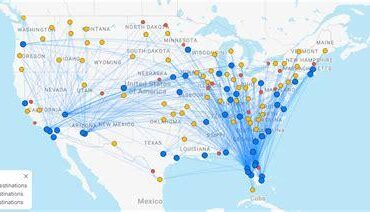
The carrier’s February network spans 121 airports across 42 states, with an unmistakable gravitational pull toward Florida. Roughly 70% of its flights operate to, from, or within the Sunshine State, reinforcing Allegiant’s core identity as a leisure-focused airline connecting mid-sized cities to vacation destinations. Across its 400 active routes this month, the airline balances stability with calculated experimentation. Even its sole overnight service—Las Vegas to Orlando Sanford—returns in March, reflecting a selective approach to operational complexity.
A 48-Hour Network Surge: Every Route Launching February 12–13
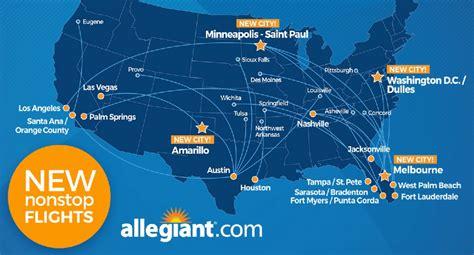
Between February 12 and February 13, Allegiant will introduce or reinstate 13 routes, each operating two to four times weekly. The expansion includes a mix of returning airport pairs and entirely brand-new markets never previously served nonstop.
Seven of the 13 routes are completely new airport combinations, highlighting Allegiant’s appetite for overlooked demand. These include:
- Burbank – Bellingham (2x weekly)
- Burbank – Provo (2–4x weekly)
- Orange County – Pasco (2x weekly)
- Phoenix Mesa – Bloomington (2x weekly)
- Punta Gorda – Atlantic City (2x weekly)
- Sarasota – Rochester (NY) (3x weekly)
- Tampa St. Pete – Atlantic City (2x weekly)
The remaining six routes reenter previously served markets, though most have seen fluctuating airline participation over the past two decades. Among them, Fort Lauderdale – Albany stands out as the only market already supported by nonstop service at launch, currently flown by JetBlue and Southwest. Southwest, however, is scheduled to exit the route on March 1—timing that suggests Allegiant is stepping in to capture transitional demand.
Burbank Joins Allegiant’s California Footprint
Allegiant’s arrival at Hollywood Burbank Airport marks a strategic milestone. On February 12, the carrier begins its first-ever commercial operations from the Los Angeles-area airport, immediately linking Burbank with Bellingham and Provo.
This addition expands Allegiant’s California network to eight active airports: Burbank, Fresno, Monterey, Oakland, Palm Springs, Orange County, Santa Maria, and Stockton. Historically, the airline has cycled through several other California gateways—including Long Beach, San Diego, and San Francisco International—demonstrating a willingness to experiment and recalibrate.
Competitive dynamics at Burbank are already evolving. Avelo previously operated from the airport before withdrawing late last year, while Breeze Airways has recently entered the market. Allegiant will compete directly with Breeze on the Provo route, adding another layer of rivalry in secondary West Coast markets.
Florida Remains the Anchor of Expansion
Despite California headlines, Florida remains the undisputed backbone of this growth wave. Fort Lauderdale alone accounts for multiple route additions this week, including Chattanooga, Rochester, Rockford, and Albany. Sarasota gains a new connection to Rochester, while Punta Gorda and Tampa St. Pete strengthen ties with Atlantic City.
This emphasis reflects Allegiant’s long-standing strategy: connect smaller or mid-sized northern cities with leisure-heavy Florida destinations on limited-frequency schedules. Operating only two or three times per week reduces risk while preserving aircraft utilization efficiency.
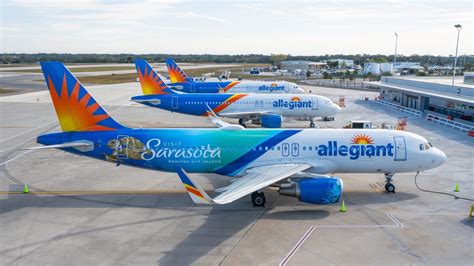
The Sarasota–Rochester route offers a revealing case study. At 972 nautical miles (1,800 kilometers) each way, it becomes Allegiant’s new shortest route from Rochester and its eighth-longest from Sarasota. U.S. Department of Transportation data shows approximately 27,000 indirect passengers traveled between the two cities in the year ending June 2025, with nearly half flying Southwest via Baltimore. Rochester ranked as Sarasota’s second-largest unserved domestic market, while Sarasota placed 11th among Rochester’s unserved destinations. Allegiant is not inventing demand; it is redirecting it nonstop.
Strategic Timing in Competitive Markets
Allegiant’s expansion is not indiscriminate. Only one of the 13 airport pairs will face sustained direct competition at launch, and even that situation appears temporary. The Fort Lauderdale–Albany market currently supports multiple carriers, but Southwest’s upcoming withdrawal suggests Allegiant is positioning itself to absorb displaced traffic.
Elsewhere, the carrier reenters markets it previously tested—such as Orlando Sanford–Huntsville and Phoenix Mesa–Orange County—indicating a belief that market conditions or cost structures have shifted favorably. Allegiant has historically shown little hesitation in pausing routes and reviving them years later when timing improves.
This nimbleness defines its business model. Unlike network carriers focused on hub connectivity, Allegiant thrives on point-to-point leisure demand, limited weekly frequencies, and ancillary revenue streams. That model allows it to experiment in thin markets that larger airlines may consider too volatile.
The Bigger Picture Behind the Expansion
While 13 routes in two days appears dramatic, the expansion does not represent aggressive fleet growth or sweeping geographic transformation. Instead, it reflects Allegiant’s disciplined approach: identify underserved demand pockets, enter with modest frequency, and monitor performance closely.
In a domestic market where consolidation has concentrated capacity among a handful of major airlines, Allegiant continues carving space in the margins. Its footprint—400 routes, 121 airports—remains entirely domestic, yet strategically diversified across 42 states. Florida anchors the network, but western and Midwestern secondary cities provide fertile ground for experimentation.
The broader takeaway is not scale, but adaptability. Allegiant’s February expansion demonstrates that even with a slight year-over-year decline in daily departures, a carrier can still generate momentum through targeted launches. The airline is not chasing dominance; it is chasing efficiency.
As February 12 and 13 unfold, these 13 routes will test whether calculated market selection can once again translate into sustainable leisure demand. In the ultra-low-cost world, growth is rarely about volume alone—it is about finding the right passengers in the right cities at precisely the right time.