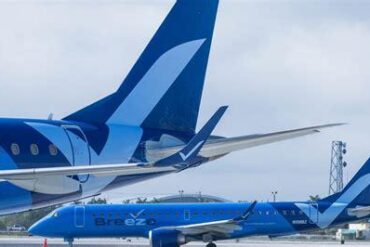
Breeze Airways is preparing for a series of temporary route suspensions and capacity reductions in September 2026, with four services involving Florida set to disappear from schedules for much of the month. The changes highlight the airline’s seasonal approach to leisure-focused markets while its broader network continues to expand rapidly.
The four suspended routes connect Fort Lauderdale-Hollywood International Airport, Fort Myers, and Orlando with destinations across the United States. Two of the Fort Lauderdale routes are particularly new, having launched only in July, while the Fort Myers and Orlando services have operated for considerably longer. Breeze is also reducing frequencies on three additional routes rather than suspending them completely.
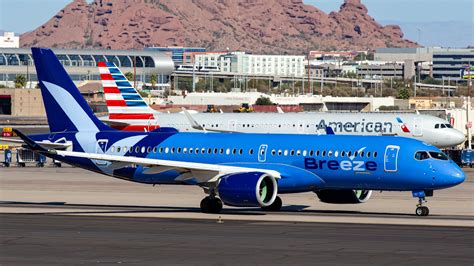
Four Breeze Airways Routes Will Be Temporarily Suspended
The most notable changes concern two routes from Fort Lauderdale-Hollywood International Airport (FLL). Breeze Airways currently operates twice-weekly services from Fort Lauderdale to Salisbury, Maryland, and Wilkes-Barre/Scranton, Pennsylvania. Both routes are scheduled to be suspended from September 2 through October 2, 2026, temporarily removing the services from Breeze’s network.
The two routes are among Breeze’s newer offerings, having only begun operating in July. Their limited operating history means there is not yet enough historical load-factor data to determine how well they were performing before the September suspension. That makes the decision especially interesting because the move appears to reflect broader network and seasonal considerations rather than simply a long-established route consistently underperforming.
Breeze will also suspend its Fort Myers–Albany service and its Orlando–Portsmouth route. The Fort Myers–Albany service will be paused during September, while Orlando–Portsmouth will cease operating from September 5 through October 2. These suspensions affect routes with substantially more operating history, offering a clearer picture of passenger demand.
Breeze Airways’ September Capacity Cuts
Not every route affected by Breeze’s September schedule changes will disappear. The airline is also trimming frequencies on three services, allowing them to continue operating while reducing available capacity.
The Fort Lauderdale–Akron/Canton route will fall from two weekly flights to one between September 5 and October 2. Orlando–Madison will decline from three weekly flights to two from September 6 through September 28. Meanwhile, Provo–Orange County will be reduced from 18 weekly flights to 17 between September 6 and October 2.
These changes are relatively modest compared with the complete suspensions, but together they demonstrate how Breeze can fine-tune its schedule rather than relying exclusively on permanent route decisions. For passengers, that means some markets will retain service even as flight availability becomes more limited.

Passenger Demand Helps Explain Some of the Changes
Historical scheduling data provides useful context for two of the suspended routes. Breeze has operated Fort Myers–Albany since December 2025, and between December and May 2026 the route recorded an average load factor of 70.45%. During that period, 4,922 of 6,987 available seats were occupied across 51 rotations.
That performance is not necessarily disastrous, particularly for a leisure-oriented airline experimenting with thinner markets. However, it was below Breeze’s overall network performance. The Orlando–Portsmouth route provides an even clearer example. Launched in October 2024, it recorded an average load factor of 67.5% during the 12 months through May 2026.
Breeze’s overall average load factor across its flights during the same period was 78.51%. Orlando–Portsmouth therefore operated roughly 11 percentage points below the airline-wide figure. While load factor alone does not determine route profitability, the gap helps explain why seasonal schedule adjustments can make sense.
Breeze Is Still Expanding Despite the Route Suspensions
The September suspensions should not be interpreted as evidence that Breeze Airways is shrinking. In fact, the opposite is true when the entire network is considered. According to Cirium scheduling data, Breeze is expected to operate 6,823 flights in September 2026, compared with 4,755 in September 2025.
That represents a substantial 43.5% increase in scheduled flights year over year. Seat capacity is growing even faster, rising by approximately 46.3%. The contrast is important: Breeze can suspend individual routes while simultaneously adding substantial capacity elsewhere.
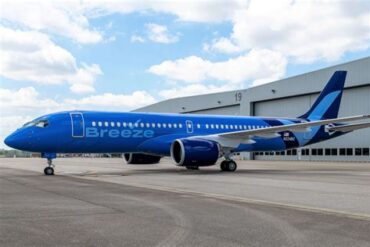
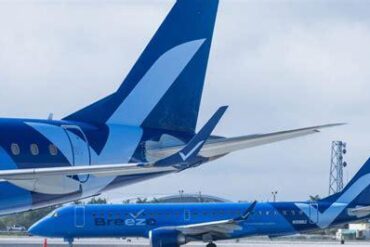
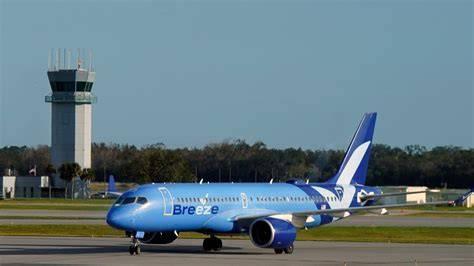
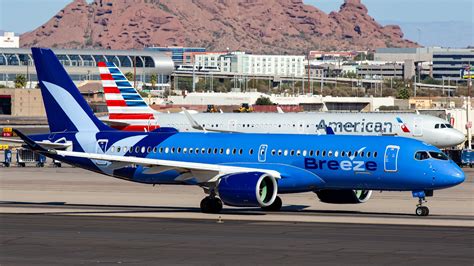
Fleet development is a major part of that growth. The airline is increasingly relying on the Airbus A220-300, which offers greater capacity than the smaller Embraer E190 and includes a premium cabin. By September 2026, the E190 is scheduled to operate only eight Breeze flights, illustrating how dramatically the carrier’s fleet mix has changed.
What Breeze Airways’ September Changes Mean
Breeze’s latest schedule adjustments show an airline actively reshaping its network rather than simply cutting capacity. Four routes will temporarily suspend, three more will receive frequency reductions, yet total scheduled flying will rise sharply compared with a year earlier.
For travelers, the practical lesson is straightforward: passengers planning September trips should verify their Breeze flight schedules carefully, particularly on the affected Florida routes. The suspensions are temporary, and the airline’s broader growth means that aircraft and capacity are being redeployed rather than removed from the network entirely.
The September schedule ultimately illustrates Breeze Airways’ strategy in a highly seasonal leisure market: reduce capacity where demand softens, preserve service where practical, and redirect growing fleet capacity toward stronger opportunities. With the Airbus A220-300 becoming increasingly central to its operation, Breeze is entering the fall season as a substantially larger airline than it was only one year earlier.