
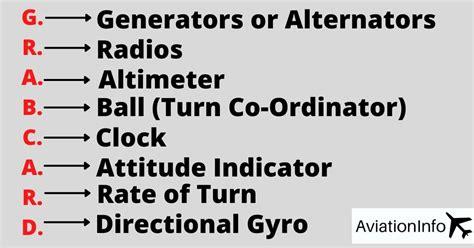
Understanding GRABCARD: A Critical Component of IFR Flight Requirements
When operating under Instrument Flight Rules (IFR) in the United States, pilots must adhere to stringent equipment standards to ensure safety and navigational precision in conditions where visual cues are unreliable or absent. Among the most critical acronyms in the FAA regulatory framework is GRABCARD — a mnemonic device that captures the essential instruments required specifically for IFR operations under 14 CFR § 91.205(d).
This article offers an in-depth examination of each component of the GRABCARD checklist, explaining not only what each item is but why it is indispensable in the context of IFR navigation, control, and compliance. These instruments are in addition to those required under VFR night conditions, reinforcing the need for complete instrumentation when visual references are compromised.
The Regulatory Foundation of GRABCARD
The Federal Aviation Administration (FAA) defines the mandatory minimum equipment for IFR flight in 14 CFR § 91.205(d). The mnemonic GRABCARD encapsulates this list in a memorable format, helping pilots ensure their aircraft are fully equipped before entering instrument meteorological conditions (IMC). It is important to note that these requirements supplement — not replace — the VFR night equipment listed in the same regulation. Therefore, any aircraft flying under IFR must have both the VFR night items and the GRABCARD instruments fully operational.
Failure to comply can lead to not only operational hazards but also potential enforcement actions, including certificate actions or civil penalties.
G — Generator or Alternator
The electrical power source is fundamental to sustaining instrument operation in an IFR environment. Either a generator or alternator is required to supply consistent power to the avionics, flight instruments, and lighting systems.
-
Ensures uninterrupted operation of gyroscopic instruments and navigation systems.
-
Must be capable of handling the full electrical load of the aircraft, including redundancy where applicable.
Without a functioning electrical source, instruments such as the attitude indicator, heading indicator, and radio navigation systems can fail — a catastrophic risk in IMC.
R — Radios (Appropriate for Flight)
Under IFR, pilots rely heavily on two-way radio communications to interact with Air Traffic Control (ATC), receive clearances, and report position updates.
-
Radios must be capable of transmitting and receiving on VHF frequencies.
-
Navigation radios (e.g., VOR, ILS) must also be installed and functioning.
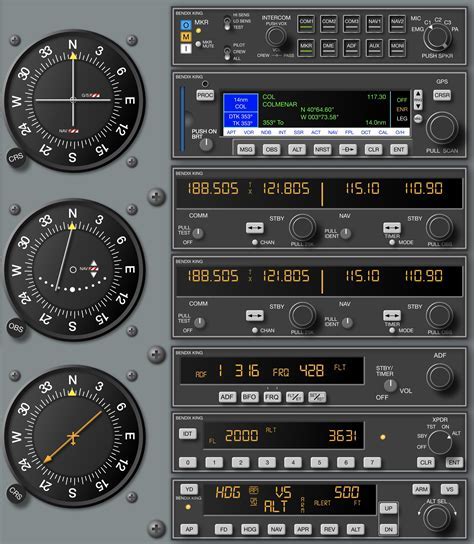
The key here is that the radios must be appropriate for the route and procedures being flown, which may include GPS, ADF, or DME capabilities depending on the airspace and type of approach.
A — Altimeter (Sensitive/Adjustable for Barometric Pressure)
The IFR environment necessitates precise altitude separation. A sensitive altimeter — adjustable for local barometric pressure settings — is essential for maintaining assigned altitudes and separation from other IFR traffic.
-
Must be calibrated and accurate to ensure compliance with ATC instructions.
-
Integrated with Mode C/S transponder systems for altitude reporting.
Altimeters that are not pressure-adjustable cannot compensate for atmospheric variances, which could lead to altitude deviations and loss of separation.
B — Ball (Inclinometer/Turn Coordinator Indicator)
Commonly part of the turn coordinator, the ball is a simple but vital device. It indicates coordinated or uncoordinated flight, helping pilots maintain stable flight during turns.
-
Crucial for maintaining control during partial panel scenarios.
-
Provides real-time feedback on yaw and slip/skid conditions.
Although often overlooked, the inclinometer becomes indispensable when primary instruments fail or visual references vanish entirely.
C — Clock (Digital or Analog with Sweep Second Hand)
IFR procedures often involve precise timing for approaches, holds, and transitions. The FAA mandates an operational clock with a sweep-second hand or digital readout.
-
Essential for holding patterns, non-precision approaches, and timing legs.
-
Used for verifying ETE, ETA, and time-based fixes.
Whether standalone or integrated into a glass cockpit, the clock ensures that timing remains accurate under all flight conditions.
A — Attitude Indicator
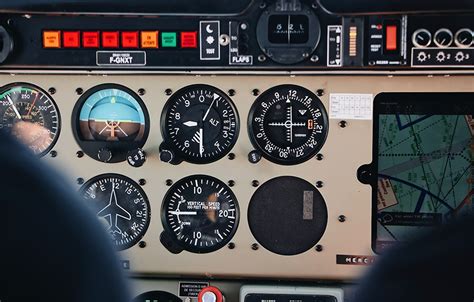
The attitude indicator is one of the most critical instruments in IFR flight. It provides the pilot with real-time orientation of the aircraft in pitch and bank relative to the horizon.
-
Core to maintaining spatial awareness in IMC.
-
Prevents spatial disorientation, especially during climbs, turns, and descents.
Contrary to popular belief, the attitude indicator is not required for VFR day or night flight — it is required only under IFR, a nuance often misunderstood by student pilots.
R — Rate of Turn Indicator
This instrument enables the pilot to execute standard-rate turns, a fundamental part of instrument procedures and holding patterns.
-
Typically combined with the turn coordinator.
-
Used for evaluating and maintaining standard-rate turns (3° per second).
When partial panel operations are required due to gyroscopic failures, the rate of turn indicator becomes one of the primary control instruments.
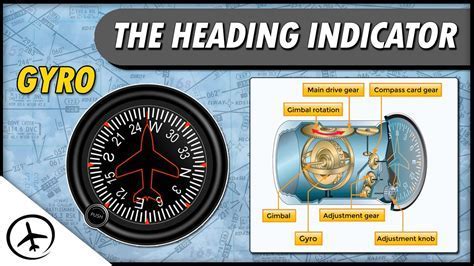
D — Directional Gyro (Heading Indicator)
Unlike a magnetic compass, which can be unreliable during turns and turbulence, the directional gyro offers stable and accurate heading information.
-
Provides better tracking accuracy during instrument procedures.
-
Calibrated against the magnetic compass to reduce deviation.
The heading indicator is central to course intercepts, holds, and approach procedures, especially in non-glass panel aircraft.
GRABCARD vs. ATOMATOFLAMES and FLAPS
It is important to delineate GRABCARD from other mnemonics like ATOMATOFLAMES (VFR day) and FLAPS (VFR night). The GRABCARD items are not redundant — they are additional, IFR-specific requirements.
-
ATOMATOFLAMES includes instruments like tachometer, oil temperature, and manifold pressure, which serve more engine and flight performance functions.
-
FLAPS adds night flying aids like position lights, fuses, and anti-collision lights.
However, the attitude indicator, though part of the standard “six-pack,” is not required for VFR — only for IFR. This distinction is critical and often misunderstood by pilots transitioning from VFR to IFR certification.
Importance of Full Compliance
Adherence to the full GRABCARD checklist is more than regulatory—it’s foundational to flight safety. In IMC, any lapse in instrumentation can rapidly escalate into a loss of situational awareness, spatial disorientation, or worse. The instruments specified in GRABCARD are not merely bureaucratic requirements; they are the minimum viable toolkit for safe navigation in environments where the only reality is the one reflected by dials, screens, and gyros.
Aircraft certified for IFR must undergo periodic inspections to ensure all GRABCARD instruments are functional, accurate, and properly certified. This includes pitot-static checks, transponder tests, and altimeter recalibration, often performed during annual or 100-hour inspections, depending on usage.

Technological Enhancements and Glass Cockpit Considerations
Modern avionics suites often integrate multiple GRABCARD functions into single display systems, like the Garmin G1000 or Dynon SkyView. However, the regulatory requirement remains: each function must be represented and operable.
-
Attitude, heading, and rate of turn may be synthesized by AHRS systems.
-
Redundancy must be built in; failure of a single screen should not eliminate access to required data.
For aircraft with technically advanced avionics, compliance hinges on software certification, installation standards, and pilot currency.
FAQ
What is the purpose of GRABCARD in IFR flight?
GRABCARD ensures that an aircraft is equipped with the necessary instruments for safe and legal flight under Instrument Flight Rules (IFR). Each item in GRABCARD supports navigation, communication, or control when outside visual references are unavailable.
Is the attitude indicator required for VFR flight?
No. While commonly part of the standard instrument layout, the attitude indicator is only legally required for IFR flight. It is not a mandatory item under the VFR day or night equipment lists.
Can modern avionics replace GRABCARD instruments?
Yes, provided that each GRABCARD function is represented in the avionics suite and that the system is FAA-certified for IFR use. Integrated systems like the Garmin G1000 fulfill GRABCARD requirements when installed and maintained correctly.