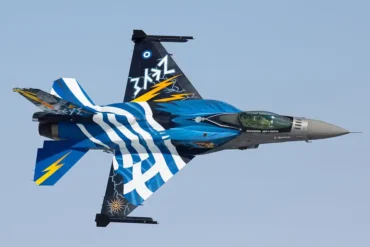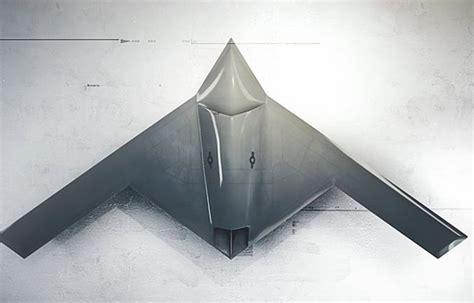
An unusual aerial sighting over central Greece has ignited intense scrutiny among defense analysts, following reports that a highly classified U.S. stealth drone, widely believed to be the RQ-180, may have landed near a key Hellenic Air Force installation. The aircraft, observed flying at low altitude with landing gear deployed over Larissa, represents one of the most compelling potential exposures of a next-generation stealth intelligence, surveillance, and reconnaissance (ISR) platform in recent years.
Unusual Sighting Over Larissa Raises Strategic Questions
Eyewitness accounts and photographic evidence captured on March 18, 2026, describe a flying-wing aircraft with no visible vertical stabilizers, gliding over a populated area before approaching the 110th Combat Wing at Larissa Air Base. The base has long served as a hub for NATO operations and U.S. deployments, making it a plausible—but still surprising—location for such a sensitive platform to appear.
Initial speculation misidentified the aircraft as a B-2 Spirit stealth bomber, yet closer inspection quickly revealed inconsistencies. The observed platform lacked the B-2’s distinctive serrated trailing edge and exhibited a different wing geometry. Nor did it align with the emerging B-21 Raider, whose structural features and landing gear configuration differ significantly.
Instead, analysts increasingly point toward the elusive RQ-180, a program shrouded in secrecy and rarely discussed in official channels.
Design Characteristics Point to a High-Altitude Stealth Platform
The aircraft’s configuration strongly suggests a High Altitude Long Endurance (HALE) system, engineered for persistent operations deep within contested airspace. Its broad wingspan, estimated to approach 40 meters, and its smooth, uninterrupted surfaces indicate a design optimized for both aerodynamic efficiency and radar evasion.
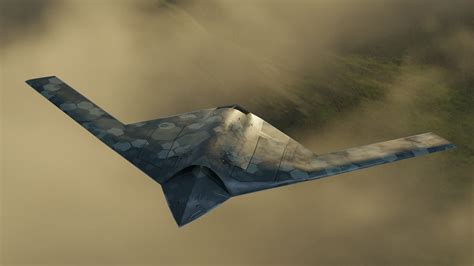
Unlike conventional aircraft, the flying-wing architecture minimizes radar cross-section by eliminating vertical surfaces and reducing angular reflections. The absence of visible air intakes or exhaust structures further implies the use of S-shaped ducts and shielded propulsion systems, both essential for suppressing infrared and radar signatures.
Photographs also reveal a pronounced central fuselage bulge, which may house internal sensor bays or mission systems. The wide spacing of the landing gear reinforces the impression of a large, heavy airframe capable of carrying advanced payloads over extended durations.
The RQ-180: America’s Most Secretive ISR Asset
Believed to be developed by Northrop Grumman under the Penetrating ISR (P-ISR) program, the RQ-180 is widely considered one of the most advanced surveillance platforms ever conceived. Designed to operate at altitudes exceeding 50,000 feet (15,000 meters), it can remain airborne for more than 24 hours, enabling persistent monitoring of vast geographic areas.
Its mission profile likely includes a suite of cutting-edge technologies:
- Active Electronically Scanned Array (AESA) radar for high-resolution imaging
- Synthetic Aperture Radar (SAR) capable of penetrating cloud cover and darkness
- Electro-optical and infrared sensors for real-time tracking and identification
These capabilities allow the platform to conduct deep-penetration reconnaissance missions in regions protected by sophisticated air defense systems, including those deployed by near-peer adversaries.
Why Daylight Exposure Is So Unusual
Perhaps the most striking aspect of the sighting is not the aircraft itself, but the conditions under which it was observed. Classified systems like the RQ-180 are typically operated under strict secrecy protocols, often flying at night or from remote locations to avoid detection.
The fact that this aircraft was seen in daylight, at relatively low altitude, and over a populated area is highly atypical. One plausible explanation is that the drone experienced a technical issue or operational diversion, forcing it to land under less-than-ideal conditions.
Such a scenario would explain the deployment of landing gear and the deviation from standard stealth operational practices. Even so, the exposure underscores the inherent risks of operating advanced systems in active theaters.
Larissa Air Base: A Strategic NATO Node
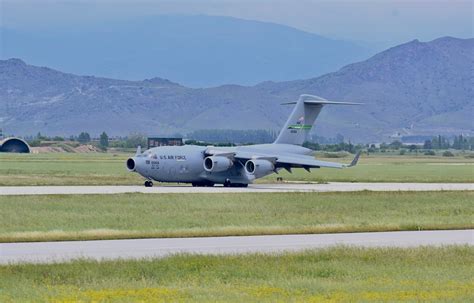
Larissa Air Base has grown in importance over the past decade, particularly as a forward operating location for U.S. Air Force assets in Europe. The base frequently hosts MQ-9 Reaper drones, which provide both surveillance and strike capabilities across the region.
Recent infrastructure upgrades have expanded the base’s capacity to support larger and more sophisticated aircraft, suggesting it could accommodate a platform like the RQ-180 if necessary. Its geographic position also offers strategic advantages, enabling rapid access to Eastern Europe, the Mediterranean, and the Middle East.
Logistical Clues: C-17 Flights and Strategic Movement
Flight tracking data adds another layer of intrigue to the घटना. Multiple C-17 Globemaster III transport aircraft were recorded flying between Edwards Air Force Base in California and Larissa in the weeks leading up to the sighting.

The C-17, capable of transporting over 70 tonnes of cargo, is often used to deploy sensitive military equipment, including classified systems. Edwards AFB, located near Palmdale, serves as a central hub for advanced aerospace development, including projects associated with Northrop Grumman.
These movements suggest a logistical chain supporting advanced operations, potentially involving the deployment, maintenance, or testing of next-generation platforms in Europe.
Ruling Out Alternative Theories
Some speculation has pointed to the possibility of an Israeli RA-01 drone, particularly given recent reports of advanced UAV development. However, the observed aircraft’s size, structural complexity, and operational context make this theory less convincing.
The platform seen over Larissa appears significantly larger and more sophisticated than known or rumored Israeli designs. Furthermore, the presence of established U.S. infrastructure and personnel at the base aligns more closely with American operational patterns.
The idea that a highly sensitive Israeli system would be exposed in daylight over a NATO-aligned base also raises questions about risk management and operational security, making it an unlikely candidate.
Strategic Implications for European Security
If confirmed, the presence of an RQ-180 in Greece would signal a significant evolution in U.S. ISR posture in Europe. The deployment of such a platform suggests an increased emphasis on persistent, stealth-enabled surveillance in regions where traditional assets may be vulnerable.
This aligns with broader trends in modern warfare, where information dominance and situational awareness are becoming as critical as kinetic capabilities. The ability to monitor adversaries without detection provides a decisive advantage in both deterrence and conflict scenarios.
At the same time, the incident highlights the challenges of maintaining secrecy in an era of ubiquitous cameras and real-time information sharing. Even the most advanced systems are not immune to exposure, particularly when operating outside controlled environments.
A Rare Glimpse Into the Black World of Aerospace
The suspected appearance of the RQ-180 over Larissa offers a rare and valuable glimpse into the shadowy realm of classified aerospace programs. While definitive identification remains elusive, the convergence of visual evidence, technical characteristics, and logistical indicators presents a compelling case.
What emerges is a picture of a platform designed not just for surveillance, but for strategic dominance in contested environments, combining stealth, endurance, and advanced sensing into a single, highly capable system.
Until official confirmation is provided, the aircraft’s true identity will remain a matter of informed speculation. Yet even in uncertainty, the sighting underscores a clear reality: the next generation of aerial warfare is already in motion—quietly, invisibly, and, on rare occasions, just visible enough to remind the world it exists.