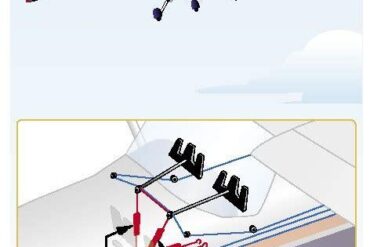
Ailerons are essential flight control surfaces that manage an aircraft’s movement around its longitudinal axis, known as “roll.” Located on the outboard trailing edges of each wing, ailerons operate in opposition to one another when the pilot or autopilot makes a control input. Some larger aircraft feature two ailerons per wing, where both are active during low-speed flight. However, at higher speeds, only the inboard aileron functions, while the outboard aileron remains locked.
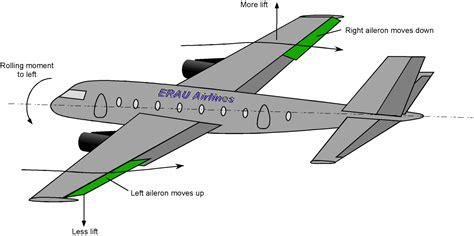
When the pilot turns the control wheel or stick to the right, the right aileron moves upward while the left aileron moves downward. This upward movement of the right aileron decreases the wing’s camber, leading to reduced lift on that side. In contrast, the downward movement of the left aileron increases camber and lift on the left wing. This difference in lift causes the aircraft to roll to the right. Some planes also use roll spoilers on the upper wing surface to enhance aileron performance.
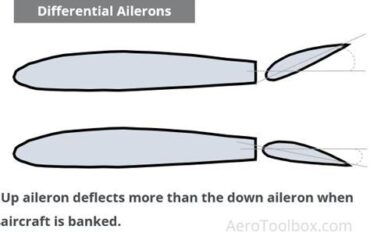
However, this increase in lift on the left wing also brings about a rise in drag. This added drag slows down the left wing slightly, which causes the aircraft to yaw, or rotate, around its vertical axis. To counteract this yaw and maintain coordinated flight, pilots must use rudder input when entering or exiting a turn. Engineers have developed various solutions, such as differential ailerons and coupled ailerons and rudder systems, to minimize adverse yaw during turns.