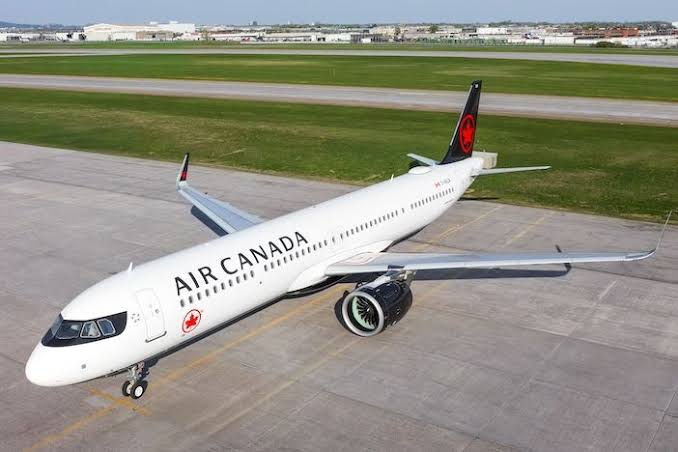
Air Canada is preparing for its biggest-ever European schedule, with 62 nonstop routes planned for July 2027 as the Canadian flag carrier expands both capacity and destination coverage across the Atlantic. The program reflects a push to strengthen its international network, with frequencies complementing opportunities created by the Airbus A321XLR.
Using Cirium schedule data for July 2027, the planned network shows Air Canada relying heavily on its major gateways at Montreal, Toronto, Vancouver, Calgary, Ottawa, and Halifax. Together, these airports connect Canada with major European hubs and leisure markets, while the airline continues to balance high-frequency trunk routes with thinner services that operate only several times each week.
Air Canada’s Busiest European Routes
Montreal will remain one of Air Canada’s most important transatlantic gateways, led by Paris Charles de Gaulle, which is scheduled to receive two daily flights. Frankfurt and London Heathrow are each planned at 13 flights per week, while Athens will receive 11 and Rome Fiumicino 10. These frequencies underline the strength of Montreal’s European role, particularly for business and connecting traffic.
Toronto Pearson will offer even greater frequency on several major routes. Frankfurt is scheduled for two daily flights, while Rome will receive 13 weekly departures and Athens 12. London Heathrow stands apart, with as many as five daily flights planned from Toronto. One of those services will use the A321XLR for Air Canada’s daytime transatlantic “Daytripper,” allowing passengers to leave Toronto in the morning, cross the Atlantic by day and arrive in London in the evening.

The A321XLR is important because its range allows Air Canada to serve markets that may not justify a larger widebody on every departure. At the same time, the aircraft is also being deployed on major routes such as Toronto–London, demonstrating that its value is not limited to secondary cities. It gives Air Canada additional flexibility in matching aircraft size and schedule frequency with demand.
20 European Routes Scheduled Daily
Beyond the highest-frequency services, Air Canada has 20 additional transatlantic routes planned at exactly one flight per day in each direction. Montreal again features prominently, with daily flights to Amsterdam, Barcelona, Brussels, Geneva, and Milan. Halifax has a particularly notable daily link to London Heathrow, giving Nova Scotia a direct connection to one of Europe’s largest aviation hubs.
Toronto is scheduled to have 11 European destinations operating daily at this frequency. The list includes Edinburgh and Manchester in the United Kingdom, Dublin in Ireland, and Amsterdam, Barcelona, Paris, Lisbon, Madrid, Munich, Vienna, and Zurich across continental Europe. The breadth gives Toronto passengers a wide selection of European markets without a connection in another Canadian city.

Vancouver also maintains an important long-haul role, with daily services to Frankfurt and London Heathrow. Calgary is scheduled to serve London Heathrow daily as well, reinforcing the importance of Western Canada in Air Canada’s international network. The gateway structure means Air Canada is not depending on a single Canadian hub.
Lower-Frequency European Routes
Not every European market requires daily service, and Air Canada’s July 2027 schedule reflects that reality. Montreal–Lisbon and Toronto–Reykjavik Keflavik are each planned at six flights per week. Five-times-weekly services include Toronto–Copenhagen and several Montreal routes, including Keflavik, Madrid, Nice, Porto, and Toulouse.
The next frequency tier includes four weekly flights on routes such as Vancouver–Dublin and Ottawa–London Heathrow, alongside additional services from Montreal and Toronto. Halifax will have another European connection to Brussels, scheduled three times per week, while several Montreal and Toronto routes also operate at three weekly frequencies. Toronto–Nice is currently planned for only two flights per week.
This layered approach allows Air Canada to maintain a broad European footprint without forcing every route into daily service. High-demand markets receive multiple departures each day, while smaller or more seasonal markets receive frequencies calibrated to expected demand.
A Record European Network for Summer 2027
The 62 European corridors represent more than a headline number. They show how Air Canada is combining traditional long-haul hubs with newer aircraft capabilities to create a network covering major business centers, connecting gateways, and leisure destinations.
For travelers, the result should be broader nonstop choice across the Atlantic in summer 2027. For Air Canada, the schedule demonstrates an increasingly flexible international strategy in which aircraft such as the A321XLR can support both high-profile routes and markets that would be difficult to sustain with larger aircraft.
If the published schedule remains intact, summer 2027 will mark a record European presence for Air Canada, with Montreal and Toronto leading the expansion while Vancouver, Calgary, Ottawa, and Halifax provide additional nonstop gateways. The combination of frequency, geographic reach, and aircraft flexibility makes the 62-route plan one of the airline’s most significant transatlantic schedules yet.