
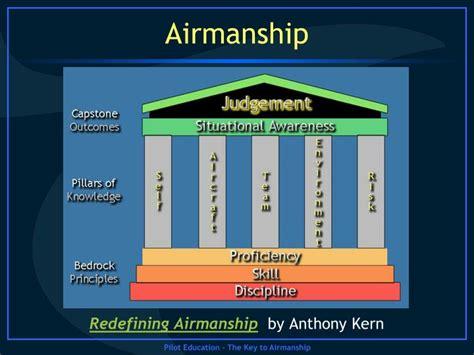
Airmanship is all about using good judgment and developed skills consistently to achieve flight goals. This consistency rests on strong flight discipline and is built through systematic skill development and proficiency. A critical part of airmanship is having a high level of situational awareness, which comes from understanding yourself, your aircraft, your surroundings, your team, and the associated risks.
Foundations of Airmanship
To excel in airmanship, three key areas of knowledge are essential:
-
Knowledge of Aircraft: It is crucial to understand the various subsystems, emergency procedures, cockpit automation, flight characteristics, and operating limits of your aircraft.
-
Knowledge of Environment: This includes grasping the physical environment’s effects on aircraft control, regulatory frameworks, and organizational challenges that impact airmanship.
-
Knowledge of Risk: Recognizing risks to discipline, skill, proficiency, situational awareness, judgment, and self-management is vital for safe flying.
Skills Required
Airmanship also involves various skills:
-
Physical Skills: These encompass flying, navigation, instrument flying, emergency handling, and survival skills.
-
Flight Deck Management Skills: Pilots must avoid automation pitfalls such as over-reliance and complacency. Strong information management and communication skills are also necessary.
-
Cognitive Skills: Pilots need to maintain situational awareness, solve problems, and make decisions effectively.
-
Team Skills: Monitoring performance, showing leadership, and communicating well with your team are all part of airmanship.
Attitudes Toward Airmanship
It’s important to understand five hazardous attitudes and their antidotes:
-
Anti-Authority: “The regulations are for someone else” → “Follow the rules; they exist for a reason.”
-
Impulsivity: “I must act now, there’s no time” → “Not so fast; think first.”
-
Invulnerability: “It won’t happen to me” → “It could happen to me.”
-
Macho: “I’ll show you; I can do it” → “Taking chances is foolish.”
-
Resignation: “What’s the use?” → “Never give up; there is always something I can do.”
Self-Improvement in Airmanship
To enhance your airmanship, focus on lifelong learning and self-assessment. Develop a strong desire for performance excellence and discipline, including thorough flight preparation, maintaining situational awareness, and adhering to operational policies. Post-flight evaluations and managing stress are also key components of self-discipline.