Driftdown Procedure
Definition
Driftdown refers to a descent technique used in multi-engine aircraft when one engine fails during climb or cruise. This situation arises when the aircraft can no longer maintain its altitude due to terrain clearance or other critical factors.
Description
The optimal cruising altitude for an aircraft operating with all engines is influenced by its weight and temperature deviations from the International Standard Atmosphere (ISA). Typically, the best cruising altitude is higher than the One Engine Inoperative (OEI) service ceiling. If an engine failure occurs above this ceiling, a descent is necessary, often following the driftdown procedure. This procedure involves applying maximum continuous power on the functioning engine(s) while counteracting any yaw with rudder. The autothrottle (AP/AT) system may need to be trimmed and disconnected, though it is essential to understand the specific procedures for each aircraft model.
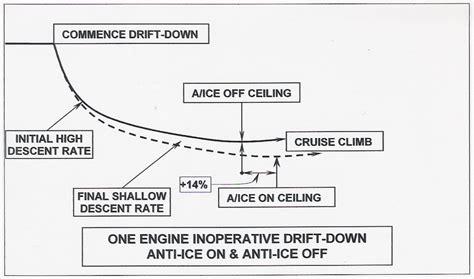
Once the appropriate checks are completed, the descent to the driftdown altitude begins at a suitable speed while maintaining maximum power. The OEI Service Ceiling is defined as the altitude that can be sustained after an engine failure, using maximum power on the operational engine and maintaining the planned OEI speed.
There are various strategies associated with driftdown, including fixed speed and obstacle clearance strategies. The obstacle clearance strategy allows the aircraft to remain at cruising altitude longer, resulting in the lowest descent rate and highest possible engine-out cruising altitude under given conditions. In this approach, maximum thrust is set, and if necessary, the autothrottle is disconnected. The target speed is adjusted to the best engine-out speed, and as the speed gradually decreases from the normal cruising speed, the descent at maximum continuous power begins once the target speed is reached. Throughout the descent, speed adjustments are made to ensure the best speed for the altitude until reaching the driftdown altitude. Afterward, cruising resumes at optimal speed and maximum power, allowing for potential climbs as the aircraft becomes lighter. If obstacle clearance isn’t a concern, descent can continue, adjusting power or speed accordingly.
In contrast, the fixed speed strategy employs immediate actions similar to the obstacle clearance method but begins the descent sooner at a higher speed, maintaining that speed throughout the drift down. This approach typically results in a lower cruising altitude in the event of an engine failure and may be necessary for ETOPS routes, with clear annotations provided by the operator in their Standard Operating Procedures (SOPs) or flight plans.
Handling Considerations
After an engine failure, the main handling priority is to counteract thrust asymmetry with rudder and trim to keep the aircraft balanced. In some aircraft, this allows the auto-flight system to stay engaged, ensuring control without reaching its limits. Ensuring maximum continuous thrust, either through the autothrottle system or manually, is crucial. Once these two aspects are managed, pilots have time to consider the descent profile and make necessary FMS/FMGS selections. Operations manuals typically provide tables for driftdown performance, enabling crews to compare aircraft weight and temperature deviations to determine their OEI service ceiling and speed regime. They can also calculate the time, distance, and fuel burn from cruising altitude to the Minimum Enroute Altitude (MEA), Minimum Off-Route Altitude (MORA), or safe altitude.
Operational Considerations
If an engine fails above the OEI service ceiling, a descent will be required. Factors like terrain, ATC directives, or organized track systems will determine whether to take the shallowest descent profile, delay the descent, or use normal economy speeds. Clear communication with ATC is vital, and declaring an emergency may be necessary to ensure compliance with the required flight profile.
-
Maximum Performance Required: For shallowest profiles to avoid terrain, accurate handling of the auto-flight system is crucial. Understanding the aircraft manufacturer’s/operator’s procedures is key to achieving optimal performance, particularly regarding FMS/FMGS indications and selections.
-
Delayed Descent Required: If traffic or ATC requires a delayed descent, maximum continuous power should be applied, allowing speed to drop below command speed but not below flaps-up maneuvering speed before beginning the descent. A solid grasp of FMS/FMGS selections is essential, especially in scenarios with restricted communication. Fuel and time considerations may necessitate a faster descent if needed.
-
No Terrain or Delayed Descent Factors: Here, maximum performance is not essential, and the aircraft can operate at OEI and normal company speeds or standard VNAV descent as required.
Route Considerations
When flying over mountainous terrain, if the OEI service ceiling is below the elevation of that terrain, flight planning must account for diversion airports along the route. This planning may divide the route into segments, specifying diversion airports and routes for each segment while ensuring terrain clearance during an engine-out scenario. This is often referred to as “Method 2” flight planning, whereas “Method 1” does not require en route diversion airports if OEI performance and terrain are not factors.
Icing & Aircraft Performance Considerations
Fuel planning typically considers only engine icing, though airframe icing can negatively impact aerodynamics and add weight. With one engine out, wing de-icing could be uneven. If the OEI descent involves passage through or stabilization within an icing layer, the commander should think about increasing descent speed to minimize exposure time. If necessary, establishing a lower single-engine cruise altitude below the icing layer is advisable. Prior to the flight, planning should have addressed any icing layers extending below the Minimum Safe Altitude (MSA). Availability of oxygen escape routes can assist in decision-making. Smaller twin-engine aircraft, which typically have less excess power and operate at lower altitudes, must frequently consider MSA, icing, and escape routes. Note that MSA is used generically, and operators may offer guidance on Grid MORA and minimum altitudes on escape charts. Additionally, factors such as aircraft age, servicing, and incorrect Zero Fuel Weight (ZFW) may influence drift down altitude and single pressurization pack performance, affecting crew decision-making.