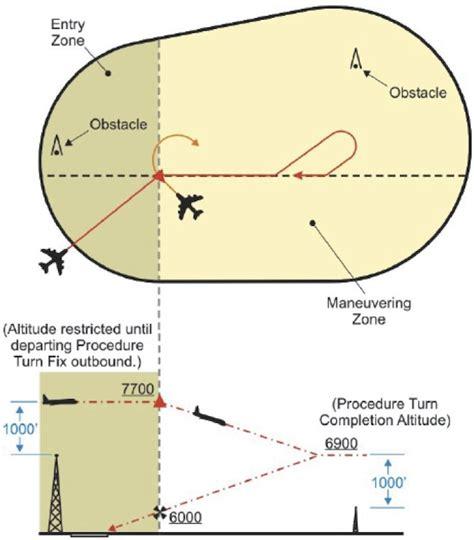
An IFR procedure turn is a maneuver used during instrument approaches to allow aircraft to reverse course and align properly with the final approach segment. This reversal is commonly represented by a barbed arrow on instrument approach charts. The maneuver becomes essential when an aircraft arrives at the initial approach fix (IAF) on a course that is not aligned with the final approach path.
Procedure turns are flexible in execution. Pilots may choose a standard 45-degree turn, a teardrop entry, or the 80°/260° reversal method. Regardless of the chosen method, the turn must be completed within a specified distance to maintain protection from terrain and obstacles.
The Source of Maximum Distance: Where Is It Measured From?
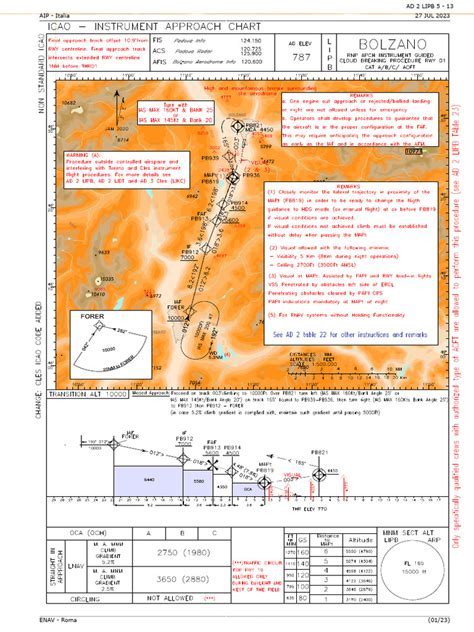
The maximum distance for a procedure turn is typically marked on approach charts as “Remain within 10NM.” But what is the reference point? The answer is subtly embedded in the FAA Aeronautical Chart User’s Guide, not explicitly detailed in the AIM or Instrument Flying Handbook. The key lies in identifying the Procedure Turn Fix (PT fix)—the specific fix, waypoint, or navaid from which the procedure turn’s distance is measured.
On FAA charts, this is noted in the profile view with a label and an arrow pointing to the fix. This point may be a VOR, an NDB, the final approach fix (FAF), or a specific named fix. It is not always the localizer or IAF, and misidentifying the PT fix can result in significant navigation errors.
Real-World Examples: Fix Identification and Distance Calculation
To fully understand the application of this rule, we can examine real-world instrument approaches where the procedure turn fix plays a critical role.
Consider the ILS or LOC RWY 4 at Southwest Oregon Regional (KOTH). Here, the PT fix is the EMPIRE LOM, which is 6.3 DME from the North Bend VOR (OTH). Since the chart specifies “remain within 10NM,” pilots must not exceed 16.3 DME from the OTH VOR during the procedure turn. The PT fix in this case doubles as the FAF.
Contrast this with the VOR RWY 35L approach at Grand Forks, ND (KGFK). Here, the PT fix is the GFK VOR itself. Without a separate FAF, the procedure turn must be executed within 10 DME of the GFK VOR. This tighter spacing requires earlier maneuvering, especially compared to approaches with more generous distances beyond the PT fix.
Additional Complexity: Multi-Navaid and ADF Scenarios
The ILS or LOC RWY 12 approach into Brookings Regional Airport (KBKX) adds another layer of complexity. This approach uses the CHRLZ NDB, a Compass Locator (CL), as both the FAF and the PT fix. The maximum PT distance is measured as 10NM from CHRLZ, translating to 17 DME from the I-BKX localizer. Importantly, an ADF is required to identify the CHRLZ NDB. Misreading DME from the localizer instead of the NDB would result in an illegal and potentially unsafe extension beyond the protected airspace.
Such intricacies underscore the importance of identifying not just any nearby navaid, but the exact PT fix as defined by the approach chart.
Jeppesen Charts: A More User-Friendly Alternative
While FAA charts require interpretation, Jeppesen approach plates often remove ambiguity. Jeppesen charts explicitly label the reference for PT distance, such as “10NM from GFK” or “10NM from CHRLZ,” making it clearer to pilots which fix governs the procedure turn limitation.
Jeppesen’s clarity is particularly helpful on complex approaches. For instance, on the same KGFK approach, the Jeppesen chart simplifies the understanding by marking the PT limit as being from the GFK VOR, rather than requiring interpretation from the FAA chart’s profile view.
Regulatory Exceptions and Distance Variations
According to the AIM, the standard maximum procedure turn distance is 10NM, but this may vary based on specific aircraft categories and approach requirements:
- Minimum of 5NM for Category A aircraft or helicopters
- Maximum of 15NM for high-performance or faster aircraft
These exceptions are rare but must be observed whenever published. The amended distances are noted in the approach procedure’s profile view. Deviating from these distances risks violating obstacle clearance protections, especially in areas of rising terrain.
Why This Matters: Terrain Clearance and Safety Margins
The PT distance limitation isn’t arbitrary—it ensures that aircraft remain within protected airspace. Obstacle clearance during a procedure turn is based on the assumption that aircraft remain within the charted distance from the PT fix. Exceeding this distance invalidates the altitude-to-terrain safety buffer.
Failing to adhere to the prescribed PT distance can have serious consequences, especially in mountainous areas. For example, a procedure turn flown beyond a 10NM limit might dip into unprotected airspace, placing the aircraft in jeopardy of terrain collision under IMC conditions.
Staying Compliant: Best Practices for Pilots
To ensure compliance, pilots must be vigilant in identifying and measuring from the correct PT fix. This means:
- Carefully reading the profile view of the approach chart
- Cross-checking DME source to confirm it’s keyed to the PT fix, not a nearby navaid
- Verifying equipment requirements such as ADFs for NDB-based fixes
- Consulting NOTAMs or amendments that may alter the published maximum distance
Modern avionics and GPS tools make it easier to monitor distance—but the responsibility remains on the pilot to use the correct reference point.
Common Pitfalls and How to Avoid Them
Several recurring issues lead to pilot error during procedure turns:
- Confusing the FAF with the PT fix — while sometimes they are the same, this is not guaranteed.
- Using incorrect DME readouts — tuning to the wrong navaid results in invalid distance measurements.
- Ignoring exceptions or amendments — always check for NOTAMs that might override the standard 10NM limit.
Situational awareness and strict adherence to the published procedure are non-negotiable elements of safe IFR flying.
Conclusion: Mastery of Procedure Turn Distances Is Critical
Understanding the maximum distance for IFR procedure turns is far more than a trivia question—it’s a matter of safety, legality, and precision. By correctly identifying the Procedure Turn Fix, respecting the published distance limitations, and using appropriate navigational references, pilots ensure that they remain within protected airspace and fly safe, compliant approaches. Whether flying FAA or Jeppesen charts, the ability to read and interpret the chart with accuracy is essential.
The IFR system provides the tools; it’s up to each of us to use them correctly.