
A windsock, also known as a wind cone, is a conical textile tube that looks like a large sock. It serves as a simple tool for determining wind direction and speed. Many airports illuminate their windsocks at night, using floodlights mounted above or lights shining from within the pole. For example, you might see a windsock at Freiburg Airport in Germany.
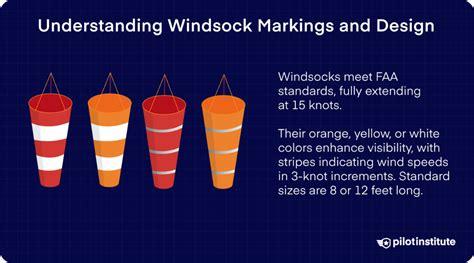
The direction of the wind is indicated by the way the windsock points. If it faces north, this means the wind is coming from the south. Wind speed is shown by the angle of the windsock in relation to its mounting pole. In light winds, the windsock droops, while in strong winds, it extends horizontally. Originally, alternating stripes of high-visibility orange and white were added to help gauge wind speed; each stripe indicates an increase of 3 knots. However, some mounting frames can hold the windsock open at one end, suggesting a wind speed of 3 knots even when anemometers show no wind. A fully extended windsock indicates a wind speed of 15 knots (or about 28 km/h; 17 mph).
According to standards set by ICAO and the UK CAA, a windsock should be 3.60 meters (12 feet) long with a 0.9-meter (36 inches) throat diameter at the larger end. The height of the mast should be 6.0 meters (20 feet), ensuring that the windsock fully extends at a wind speed of 15 knots. When airports operate at night, all wind direction indicators must be lit. Windsocks should rotate freely around a vertical shaft, accurately indicate true wind direction within +/- 5 degrees, and fully extend at 15 knots. To stand out against their surroundings, they must be colored white, yellow, or orange.
The FAA has two size classifications for windsocks. Size 1 measures 2.5 meters (8 feet) long with a throat diameter of 0.45 meters (18 inches). Size 2 is 3.60 meters (12 feet) long with a 0.9-meter (36 inches) throat diameter. Windsocks supported by low mass structures should not exceed 3.0 meters (10 feet) in height, while those on rigid structures can reach up to 4.8 meters (16 feet). According to AC 150/5345-27E, a properly functioning windsock will respond to breezes of at least 3 knots (5.6 km/h; 3.5 mph) and fully extend in winds of 15 knots (28 km/h; 17 mph). Furthermore, wind cone assemblies must withstand wind speeds of up to 75 knots (140 km/h or 86 mph) and temperatures ranging from -67°F (-55°C) to 131°F (+55°C).
Transport Canada also emphasizes that a 15-knot wind will fully extend a windsock, while a 10-knot wind will lower it to 5° below horizontal, and a 6-knot wind will drop it to 30° below horizontal.