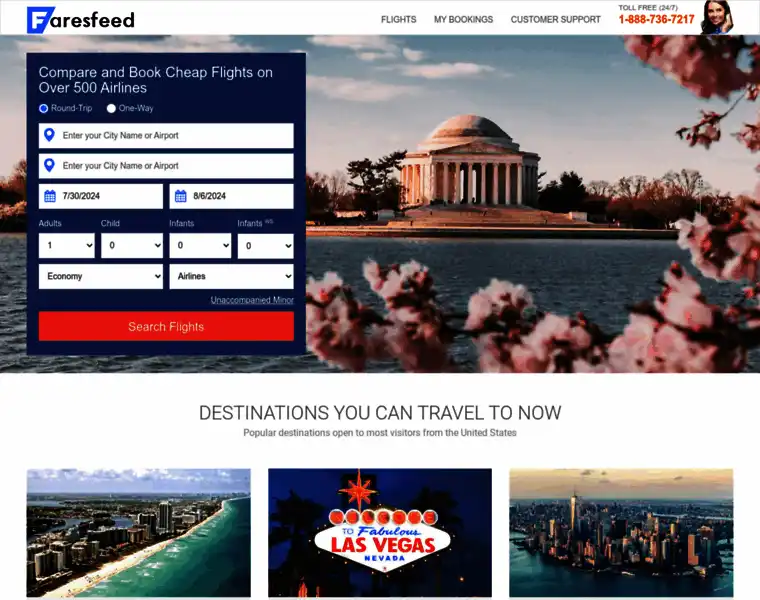
The rise of online travel booking platforms has made airfare comparison more accessible than ever, but it has also led to a proliferation of questionable agencies operating under the radar. One such site generating intense scrutiny is www.Faresfeed.com, a self-proclaimed cheap flight booking service with a significantly low Trustpilot rating of 2.3 from over 180 customer reviews. In this comprehensive investigation, we dissect the core operations, customer feedback, and credibility of the platform, analyzing whether Faresfeed is a bargain opportunity or a potential scam.
The Promise of Cheap Flights: Marketing vs. Reality
Faresfeed.com positions itself as a platform offering the lowest fares on flights, leveraging real-time search results and displaying attractive ticket prices that, at first glance, undercut even the largest booking engines. However, according to a substantial number of verified customer reviews, this initial promise is rarely honored.
Many users report a “bait and switch” tactic, in which they are lured by competitive prices only to be contacted shortly after booking. A call or email typically follows, informing them that the selected fare is no longer available and suggesting significantly more expensive alternatives. This pattern is not a one-off anomaly; it is consistently reflected across dozens of independent reports.

Deceptive Pricing Practices and Post-Booking Calls
A major theme across negative reviews is the claim that Faresfeed.com uses artificially low prices to encourage bookings. Customers like Omar Mabrok and Ace Fullilove detail experiences where they booked a fare, received a pending status notification, and were then prompted via phone to accept either a different destination or a price increase exceeding $100.
Such cases point to a troubling strategy that skirts the boundaries of consumer protection laws. Instead of immediately processing the fare, the system allegedly holds the booking in a limbo state, allowing agents to upsell or alter the terms—clearly a deviation from standard e-commerce practices in the travel industry.
Customer Service Red Flags: Accents, Attitudes, and Avoidance
Multiple reviews raise concerns about customer service accessibility and professionalism. Complaints frequently mention foreign accents and uncooperative or rude agents. Customers like Lisa Thompson and Reza Azadfard suggest that the support team may be located offshore, a detail that—while not inherently suspicious—becomes problematic in the face of limited accountability and evasive behavior.
Critically, several users state that Faresfeed does not answer calls or emails unless a booking is in progress, suggesting a reactive rather than proactive support structure. After-the-fact support appears to be nearly non-existent, making refunds or disputes difficult to resolve.

Refund Controversies and Cancellation Charges
Another major grievance is the refusal to refund or impose unexpected cancellation fees, even within the 24-hour cancellation window mandated by U.S. airline regulations for tickets purchased directly from airlines or OTAs. One reviewer recounts being told they would incur a $25 cancellation fee just hours after booking—a direct contradiction to industry norms.
There are rare instances of flexibility, such as Delzy Vecino’s experience with an agent named Richard, who allegedly waived a $100 cancellation fee. But these cases are the exception. The overwhelming feedback paints a picture of a company unwilling to honor customer-friendly policies unless pushed by escalations.
Mixed Reviews: A Few Outliers of Positive Experiences
Though most reviews lean negative, some users express satisfaction, particularly when dealing with specific agents like Henry Carter or Aanya, who are described as helpful, patient, and professional. However, this creates a dichotomy in Faresfeed’s identity: is it a legitimate site hampered by inconsistent staff, or a business model deliberately structured to exploit consumers?
This disparity is further complicated by suspicions that positive reviews might be fake or internally generated. Several reviewers go so far as to claim that the few high-star ratings could stem from employees or affiliates rather than genuine travelers. Without transparency from the company, this skepticism is hard to dismiss.

Company Transparency and Location Ambiguity
Faresfeed lists its headquarters as 1511 Route 22 Suite 245, Brewster, New York, but reviewers consistently question whether the operations truly originate from the U.S. The frequent mention of non-native English speakers, questionable service hours, and IP address routing further compound the ambiguity about the platform’s actual business location.
Such discrepancies in corporate transparency are major red flags in the online travel sector. Legitimate OTAs (Online Travel Agencies) typically offer a combination of clear terms and conditions, regulatory compliance, and verifiable contact information—elements that appear inconsistent or underdeveloped in Faresfeed’s case.
Trust Signals and Third-Party Oversight
Faresfeed’s Trustpilot page shows over 180 reviews, but the company has not responded to any of them. The lack of engagement on public review platforms is indicative of a passive or indifferent approach to reputation management, especially for a business where trust is paramount.
More troubling is the absence of any affiliation with IATA (International Air Transport Association), ARC, or any U.S.-based consumer travel authority. These accreditations are typically featured prominently by reputable OTAs to reinforce legitimacy and user trust.
Legal Implications and Consumer Recommendations
Customers affected by Faresfeed’s practices may have legal recourse, especially if they used a credit card for purchase. The Fair Credit Billing Act (FCBA) protects consumers from fraudulent charges and allows for chargebacks within 60 days. It is advisable that unsatisfied users immediately contact their card issuer, document all interactions, and avoid any verbal-only resolutions with the company.
We also urge consumers to verify flight availability directly with the airline prior to confirming a third-party booking. Price discrepancies that appear too good to be true often signal gray-market resellers or baiting mechanisms.
Final Verdict: Should You Book Through Faresfeed.com?
After evaluating both the quantitative reviews and qualitative user testimonials, the evidence suggests that Faresfeed.com operates on a high-risk, low-transparency business model that fails to meet industry standards of integrity. While a few users report positive interactions, these are vastly overshadowed by systemic issues including misleading pricing, customer service failures, cancellation controversies, and refund obstacles.
We do not recommend booking through this platform unless the company takes meaningful steps toward greater transparency, compliance, and public accountability. Until then, travelers are safer relying on recognized OTAs or direct airline websites where prices, policies, and support systems are firmly established.
In a world where travel scams are increasingly sophisticated, due diligence is no longer optional—it is essential.