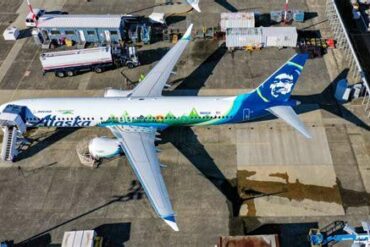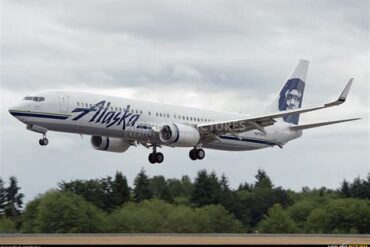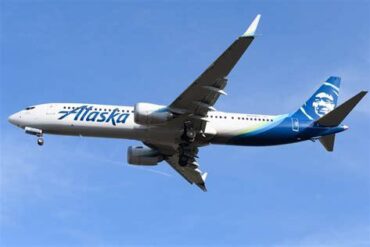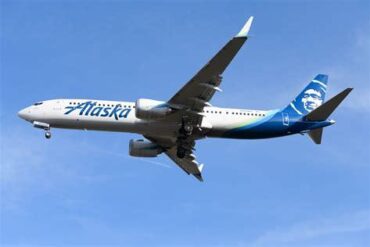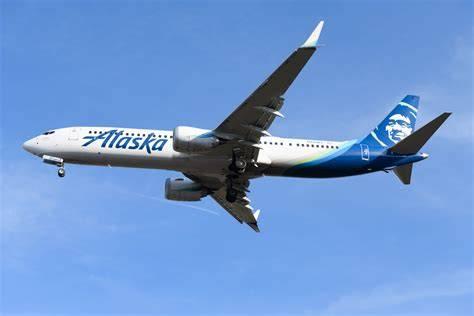
Alaska Airlines is taking its smallest 737 MAX variant to one of the Pacific’s longest narrowbody missions. Beginning in December, the carrier will fly nonstop between Honolulu International Airport (HNL) and two secondary Western markets, Boise, Idaho, and Spokane, Washington, deploying the Boeing 737 MAX 8 on block times of roughly seven hours in each direction. The move restores Hawaii links that disappeared more than a decade ago, and it quietly signals where Alaska’s network strategy is heading as its MAX fleet matures.
Alaska Airlines Restores Nonstop Hawaii Flights From Boise and Spokane
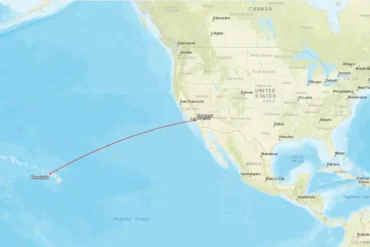
The first new service connects Boise Air Terminal, also known as Gowen Field (BOI), with Honolulu daily from December 17 through March 21, 2027, covering 2,831 miles (4,556 kilometers). Two days later, Alaska launches weekly Saturday flights between Spokane International Airport (GEG) and Honolulu over 2,877 miles (4,630 kilometers), with operations continuing through April 17. Both city pairs operate squarely in the peak winter travel window, when demand for Hawaii peaks and freezing mainland latitudes push leisure travelers toward the islands.
What makes the pair unusual is the asymmetry of frequency. Boise receives daily service, Spokane only weekly, yet the underlying traffic volumes are strikingly similar. In the 12 months ending June 2026, roughly 44,000 round-trip passengers flew between Spokane and Honolulu, while 42,000 traveled between Boise and Honolulu, both overwhelmingly via connections. The divergence likely reflects expected yields, seasonality and onward connection opportunities rather than raw demand, and the carrier has previously described both cities as underserved Hawaii markets. Boise’s steadier corporate and leisure base, combined with stronger load factor stability through the week, can justify a daily rotation where Spokane’s traffic concentrates around weekend departures.
Kirsten Amrine Frames the Hawaii Expansion Around the Alaska-Hawaiian Network
Announcing the routes earlier this year, Alaska Airlines vice president of network planning Kirsten Amrine tied the additions directly to the merged Alaska-Hawaiian network. “We’re excited to expand access to and from Hawaii with new nonstop Boise and Spokane service, giving guests in two growing markets an easier way to reach the Hawaiian Islands,” she said. “These routes, along with additional service between Honolulu and Las Vegas, reflect strong demand for Hawaii travel and our commitment to providing more convenient options for both visitors and Hawaii residents traveling throughout our network.” The emphasis on both directions matters: the flights carry island residents bound for the mainland as well as vacationers, and they position Honolulu as a gateway for onward connections to Maui, Kauai and the Big Island.
Allegiant’s Failed Hawaii Experiment Sets the Historical Benchmark
Attribution matters here. Last time Boise and Spokane have enjoyed nonstop Honolulu service, the operator was Allegiant Air, which launched both routes in February 2013 using 223-seat 757-200s. The experiment collapsed within months. Allegiant suspended the services later that year amid weaker seasonal demand and ultimately abandoned its broader Hawaii strategy as it phased out the 757 fleet, with its final Hawaii flight operating in October 2017. High operating costs and disappointing demand on several routes undermined the operation.
Alaska’s approach looks structurally different. The MAX 8 burns substantially less fuel per seat than a 26-year-old 757 and, perhaps more importantly, flies into a network far deeper than Allegiant’s leisure-only map. Connections feeding through Honolulu to neighbor-island services, plus a broader Mainland footprint, help fill seats beyond the local catchment, which is precisely what Allegiant lacked.
The New Routes Rank Among Alaska’s Longest 737 MAX 8 Flights
The MAX 8 is the range leader of Alaska’s narrowbody family. Boeing advertises 3,500 nautical miles, equivalent to 4,028 miles (6,482 kilometers), and Alaska’s principal configuration seats 161 travelers versus 178 on the MAX 9. That combination of longer legs and fewer seats, which is flexibility that matters when opening thin but long markets from smaller cities, is what makes these launches economically plausible.
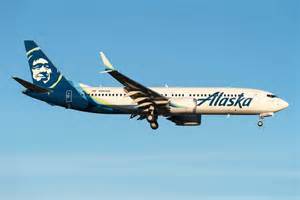
At 3,609 miles (5,808 kilometers), the longest MAX 8 service remains Seattle to Reykjavik’s Keflavik International Airport (KEF) in Iceland, a route that launched in May 2026 with a published block time of 7 hours 35 minutes. Anchorage to New York-JFK follows at 3,375 miles with 7 hours 14 minutes, and Anchorage to Boston at 3,371 miles with 7 hours 15 minutes. Seattle to Liberia, Costa Rica, sits fourth at 3,321 miles and 7 hours 7 minutes, with Honolulu to Salt Lake City fifth at 2,988 miles and 6 hours 24 minutes.
Spokane to Honolulu slots in sixth at 7 hours 3 minutes, with Boise to Honolulu seventh at 6 hours 47 minutes. Los Angeles to San Jose, Costa Rica, Seattle to Miami and Seattle to Lihue complete the top ten. The Boise figure represents the fastest of the two new services despite the longer published maximum block time quoted in the schedule, reflecting wind patterns across the Pacific in each direction.
Seven Hours in a Single Aisle Is the Passenger Tradeoff Worth Understanding
Six to eight hours aboard a narrowbody will not suit every traveler, and Alaska knows it. The alternative for Boise and Spokane passengers is almost always a connection, typically through Seattle onto a Hawaiian Airlines widebody, which adds ground time, baggage risk and a second boarding process. A nonstop that removes four to six hours of total journey time wins on total elapsed travel even if the cabin is narrower. Alaska has also expanded premium seating across its 737 fleet, a response to growing competition for travelers who want more comfort on longer segments.
Alaska’s 737 MAX Fleet Expansion Underpins Further Growth
Alaska currently operates 100 MAX aircraft, comprising 20 MAX 8s and 80 MAX 9s, with another 168 MAX-family airframes on firm order. The variants divide labor cleanly: the MAX 8 delivers the most range, the MAX 9 balances range with 178 seats, and the MAX 10 will seat approximately 190 in planned configuration, varying on aircraft fitted with Aurora suites. The carrier’s largest-ever order, announced in January 2026, added 105 MAX 10s and options for 35 more, and FAA type certification of the MAX 10 cleared the way for deliveries after years of delay. Alaska expects its first MAX 10 in the second quarter of 2027, with at least 25 aircraft eventually carrying Aurora lie-flat business suites on transcontinental routes.
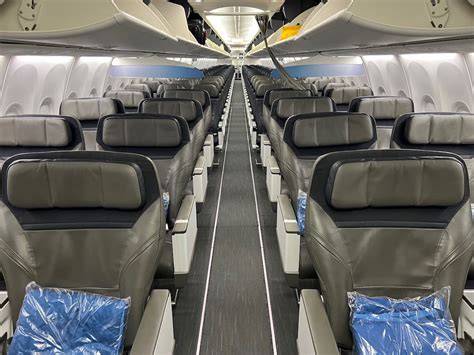
That fleet logic clarifies the Hawaii launch. MAX 10 capacity will push yields higher on dense established services, freeing MAX 8s to concentrate on long, lower-demand markets exactly like Boise and Spokane. The smallest MAX becomes a market-development tool, testing nonstop viability where a 178-seat aircraft would dilute load factors.
A 42% Hawaii Market Share and a 422-Weekly-Departure Winter Season
The Honolulu flights sit inside an increasingly integrated Alaska Air Group Hawaii network. The combined carrier will operate roughly 422 weekly Mainland-Hawaii departures over the winter season, equal to about 60 daily flights on average, making it the largest airline serving the Aloha State with a 42% market share. The strategy is consistent: add secondary-market nonstops while deploying larger aircraft on established high-demand routes.
For travelers in Boise and Spokane, the practical effect is immediate. A winter escape to Waikiki becomes a single boarding pass and one seven-hour flight instead of a connecting itinerary, timed to arrive in time for afternoon connections across the islands. The question now is whether those markets fill the cabin consistently enough to sustain daily Boise service beyond March 2027 and to promote Spokane from Saturday-only to a fuller schedule.