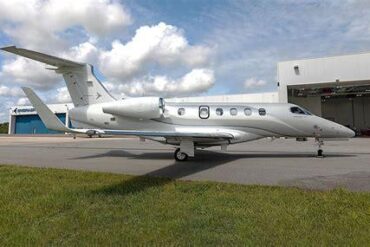
When discussing the best light jets for business travelers, the Embraer Phenom 100 consistently earns its reputation. Designed for performance, comfort, and flexibility, this jet delivers a premium experience for owner-operators, business executives, and private charter services alike.
The featured 2009 model—owned and flown by Abram Finklestein—is a testament to the Phenom 100’s enduring utility. With two Pratt & Whitney engines delivering 1,695 pounds of thrust each, the aircraft cruises at approximately 365 knots and reaches a ceiling of 41,000 feet. However, optimal performance is found in the mid-30s altitude range, where speed and efficiency align perfectly.

Versatility Meets Real-World Utility
Configured for four passengers, the Phenom 100 can accommodate up to seven occupants with a single pilot configuration, making it one of the most flexible light jets in its class. Its external baggage compartment enhances real-world travel capability, eliminating the typical limitations of small jet interiors.
For Finklestein, this aircraft serves as more than a travel tool—it’s a cornerstone of both personal and professional ventures. He regularly flies to Texas, North Carolina, and Las Vegas, attesting to the Phenom’s reliability and range. Typical missions are under 800 miles, which the aircraft handles with ease. With proper planning and favorable winds, even longer nonstop flights—like to New York or Cincinnati—are within reach.
Comfort, Cabin, and Charitable Missions
What separates the Phenom 100 from its peers isn’t just its specs—it’s the comfort of its cabin. Compared to other light jets like the Eclipse or Vision Jet, the Phenom offers significantly better legroom and cabin volume, critical for longer business or humanitarian flights.
Finklestein leverages this comfort in service to others. As a member of Veteran Airlift Command, and through organizations like Challenge Air for Kids and Friends and Vital Flight, he transports disabled children and veterans with dignity and care. The Phenom’s accessibility and ease of operation make it an ideal platform for volunteer flying.

Operational Simplicity and Preflight Precision
Despite its advanced avionics, the Phenom 100’s cockpit remains surprisingly intuitive. During preflight, Finklestein walks through a standard procedure: verifying engine indicators (N2, fuel flow, oil pressure, N1 within 10 seconds), checking battery reserves, disconnecting the GPU, and setting all avionics—AFCS, FMS, transponder, and altimeter.
Checklist items also include posting takeoff speeds, confirming the landing field elevation, and verifying ice protection status. The aircraft’s design supports a logical flow of tasks, allowing pilots to move efficiently through preflight without missing critical steps.
Flight Execution and Emergency Protocols
Takeoff from Runway 10R involves a rolling departure—a technique that adds realism and small performance compromises over static departures. Finklestein briefs clearly: any failure before 70 knots prompts an abort. Between 70 and V1, only major malfunctions like engine fire or control failure justify aborting. Beyond V1, the plan shifts to emergency departure followed by troubleshooting or a safe return.
Once airborne, he hand-flies to initial climb altitude, seamlessly integrating procedures with situational awareness. Despite the compact nature of the aircraft, its performance on departure and climb is fluid and powerful.
Business-Built Infrastructure: Wing Leader
One of the most compelling aspects of Finklestein’s story is how the Phenom 100 helped build his business. Recognizing a void in support for contract pilots and small corporate flight departments, he founded Wing Leader—a concierge-style operational support company.
Wing Leader offers end-to-end services including:
- Dispatch and scheduling
- Flight tracking and coordination
- Technology integration
- Accounting and trip support
The platform uses Scero, which centralizes trip details, offers mobile access for pilots, and ensures all stakeholders—from dispatchers to pilots—are aligned.
Aircraft Comparisons and Performance Realities
In evaluating alternatives, Finklestein contrasts the Phenom 100 with competitors like the Vision Jet and Eclipse Jet. While both alternatives offer solid entry-level jet capabilities, they fall short on useful load, cabin size, and altitude performance.
The Phenom 100’s cabin comfort, payload capacity, and cruising efficiency at high altitudes make it ideal for serious business use. Its close relative, the Phenom 300, offers greater speed and range but shares the same user-friendly avionics—providing an easy transition for pilots looking to upgrade.
From Student Pilot to Jet Professional
Finklestein’s aviation journey began with Cessna 172s in college. He earned his instrument rating during law school, and in 1998, co-purchased his first aircraft to support a growing business. Over time, he built hours, advanced through aircraft types, and about a decade ago began flying jets professionally as a contract corporate pilot.
His progression reflects the path many owner-operators dream of: merging entrepreneurial drive with aviation proficiency to serve both personal and professional goals. He also holds a seaplane rating, earned at Jack Brown’s Seaplane Base in Florida—a rating he describes as “pure fun,” though he admits to needing a currency refresh.
Avionics Redundancy and Safety Considerations
A critical factor for any business jet is system reliability, especially in glass cockpit environments. During a flight segment, the crew notices a slight mismatch between altimeters. Finklestein explains that FAA regulations require fully independent altitude sources, which may result in small discrepancies due to different probes and processors. A 20-foot variance, in this case, remains well within operational tolerance.
In case of total electrical failure, the Phenom 100 is designed to offer up to 45 minutes of battery life, assuming proper charge. As an additional safeguard, Finklestein carries a portable backup avionics unit with built-in GPS, altimeter, and attitude reference. While not ideal for extended operations, it would suffice in a last-resort scenario to land safely.

Landing Performance and Airport Procedures
Approach and landing phases reveal more about the aircraft’s stability and pilot workload. For this flight, approach speed is approximately 101 knots, with a target Vref of 96 knots. However, in busy airspace, ATC often delays deceleration, keeping speeds near 170 knots until a five-mile final. Once clearance is granted, the aircraft decelerates quickly and smoothly.
With a landing weight near 9,030 pounds, Finklestein adjusts speeds slightly based on book data: 97, 102, 103, and 121 knots for varying stages of approach and landing. All landing references are set electronically, and the descent checklist is completed in sequence—pressurization checks, seatbelt signs, lights, altimeter settings, and passenger advisory.
As the aircraft intercepts the ILS Runway 10R, visibility is regained through the clouds. The gear is lowered (confirmed with three green lights), full flaps deployed, and airspeed stabilized. Despite reports of birds on final and a moderate crosswind, the aircraft lands confidently, underscoring the Phenom’s handling stability even under challenging conditions.
Final Thoughts: Why the Phenom 100 Stands Out
The Embraer Phenom 100 proves to be a powerful asset in business aviation. For owner-operators like Abram Finklestein, its value goes far beyond numbers. It’s a platform for commerce, community service, and pure flying enjoyment.
Key advantages include:
- Outstanding cockpit usability and avionics clarity
- Real-world range for up to 800-mile missions
- Spacious and comfortable cabin layout
- Strong baggage capacity for practical travel
- Proven safety systems and redundancy
- Low barrier of entry for owner-operators transitioning to jets
The Phenom 100 isn’t just a light jet—it’s a gateway to business freedom, aerial adventure, and personal impact. For travelers and pilots seeking efficiency with prestige, it remains one of the most balanced and rewarding jets in its class.