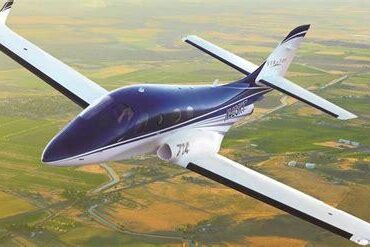
The Embraer Phenom 100 has distinguished itself as one of the most compelling aircraft in the very light jet (VLJ) market since its inception. Designed and manufactured by Brazil’s aerospace leader, Embraer, this sleek, high-performance jet was introduced in 2005, marking the company’s ambitious entry into the business aviation space. The aircraft took its maiden flight on 26 July 2007, received certification by December 2008, and began deliveries within the same month. With a mission to offer an affordable yet luxurious solution for private, commercial, and even military aviation sectors, the Phenom 100 has delivered both innovation and utility.

Development Vision: Embraer’s Strategic Entry into Business Aviation
In April 2005, Embraer’s executive board approved a bold plan to develop a new line of very light and light jets. With ambitions to capture 30% of the global VLJ market within a decade, the Phenom 100 was conceptualized to compete with established names like Cessna and Eclipse. The aircraft was formally announced in November 2005 during the NBAA convention, where a full-scale mock-up signaled Embraer’s serious intent.
Early on, Embraer sought to position the jet for air taxi services, expanding its utility beyond private ownership. To support this, the company selected the Garmin G1000 EFIS for cockpit avionics and swiftly completed the digital definition phase by March 2006. By the time of the EBACE conference in May of that year, 50 orders had already been confirmed, with further interest coming from across Latin America.
Development milestones followed rapidly. In October 2006, Pratt & Whitney began testing the aircraft’s PW617-F engines. Structural integration, including the wing-to-fuselage mating, was completed by April 2007, and the prototype was rolled out in June 2007. After successful ground tests, the Phenom 100 performed its maiden flight, launching the start of its rigorous flight test program at Gavião Peixoto.
Certification and Entry into Service
Despite encountering issues with the ice protection system and flaps during testing, Embraer addressed these challenges efficiently. In December 2008, the EMB-500, as officially designated, received dual certification from Brazil’s ANAC and the U.S. FAA, a critical achievement for international operations. The first customer delivery followed on 24 December 2008, signaling the Phenom 100’s official entry into active service.
Design Philosophy: Performance, Simplicity, and Comfort
The Phenom 100 was engineered with a focus on performance, structural integrity, and ergonomic luxury. Its low-wing, T-tail design and retractable tricycle landing gear lend both aerodynamic efficiency and stability. The fuselage, an elegant oval cross-section, houses a 7.985 m³ (282 ft³) cabin, with large windows and a cabin door measuring 1.47 m by 0.74 m for easy boarding.
Built to endure 28,000 flight cycles or 35,000 hours, the aircraft incorporates 20% composite materials, contributing to both structural resilience and weight optimization. The standard interior, shaped by BMW DesignworksUSA, reflects premium craftsmanship, with flexible seating configurations that allow for up to seven passengers using optional features such as a side-facing seat and belted lavatory.

Power and Propulsion: A Twin Turbofan Advantage
At the heart of the Phenom 100’s propulsion system are two Pratt & Whitney Canada PW617F turbofan engines, mounted at the rear. Each delivers 1,695 lb of thrust under ISA +10 °C conditions, managed by dual FADEC (Full Authority Digital Engine Control) systems.
In the event of an engine failure during takeoff, the Automatic Performance Reserve (APR) function boosts output to 1,777 lb. Later iterations of the engine, such as the PW617F–E, provide an extended ten-minute thrust rating of 1,820 lb, enhancing high-altitude and hot-weather performance. These features, combined with condition-based maintenance protocols, help operators lower operating costs without sacrificing safety or reliability.
Variants: Tailored Innovation Across Models
Over time, Embraer has expanded the Phenom 100 family to include several performance-enhanced and specialized variants:
- Phenom 100: The original production model, featuring Garmin G1000 avionics and PW617F-E engines.
- Phenom 100E: Enhanced version with multifunction spoilers, improving aerodynamic control.
- Phenom 100EV: Introduced in 2017, this “Evolution” model includes weight savings and enhanced engine thrust (1,730 lb). It cuts climb time to 41,000 ft from 33 to 25 minutes, features a modern Garmin G3000 touchscreen flight deck, and shortens takeoff distance at challenging airports.
- Phenom 100EX: Released in 2023, this version integrates Runway Overrun Awareness and Alerting System (ROAAS) and updated avionics.
- U-100: Military designation for Brazilian Air Force variants.
- Phenom T1: Used by the Royal Air Force for pilot training under the UK Military Flying Training System.
Widespread Adoption: Civil, Military, and Government Use
The Phenom 100’s operational versatility has led to adoption by numerous aviation sectors. In the civil domain, Emirates employs five Phenom 100EVs for cadet training and charter services, launched in 2023.
In military and state usage:
- The Brazilian Air Force operates two aircraft, designated U-100.
- The Pakistan Air Force uses six for VIP transport.
- The United Kingdom’s Royal Air Force uses five Phenom T1 jets to train aircrews until 2033, following a contract with KBR-Elbit Systems.
- In the United States, the Texas Department of Transportation maintains a fleet of four aircraft for official state use.

Manufacturing and Delivery Footprint
While initial production began in Brazil, Embraer announced in mid-2008 that a dedicated assembly line would be established in Melbourne, Florida. This move was aimed at supporting the booming North American market. By July 2016, all final assembly had transitioned to the U.S. plant, which was equipped to build up to 96 Phenom jets annually. By June 2016, more than 170 jets had already rolled out of the Melbourne facility, marking its success.
Although the company initially projected 15 deliveries in 2008 and up to 150 in 2009, only two aircraft were delivered in the launch year. Nonetheless, production ramped up quickly, with a total of 420 Phenom 100s delivered by Q4 2024.
Operational Incident and Lessons Learned
Despite a strong safety record, the Phenom 100 experienced a notable accident on 8 December 2014. Aircraft N100EQ crashed into a residential area in Gaithersburg, Maryland, during approach. All three on board and three on the ground perished. The NTSB investigation attributed the cause to the pilot’s failure to activate the ice protection system and poor speed management under the weather and weight conditions.
The Board recommended the development of systems to automatically notify pilots of deice system requirements, especially on single-pilot-certified jets like the Phenom 100.
Technical Specifications: Phenom 100EV
The Phenom 100EV integrates performance and comfort with precision:
- Crew: 1 or 2 pilots
- Passenger Capacity: 4–5 standard, up to 7 with optional seating
- Dimensions: Length 12.82 m, Wingspan 12.3 m, Height 4.35 m
- Weights: Empty – 3,275 kg, Max Takeoff – 4,800 kg
- Fuel Capacity: 1,272 kg
- Cabin Dimensions: Height 1.5 m, Length 3.35 m
- Powerplant: 2 × PW617F1-E turbofans, 1,730 lbf each
- Max Speed: Mach 0.7
- Cruise Speed: 750 km/h (470 mph)
- Range: 1,178 nmi (2,182 km)
- Service Ceiling: 41,000 ft
- Cabin Altitude: 8,000 ft at FL410
- Takeoff Run: 975 m
- Landing Run: 741 m
- Fuel Burn: 414 L/h (1st hour), 292 L/h (2nd hour)
Avionics: Command and Control Redefined
The Phenom 100EV comes equipped with Embraer’s Prodigy Touch Flight Deck, powered by Garmin G3000 avionics. This touchscreen interface enhances pilot situational awareness, reduces workload, and meets modern expectations for cockpit technology. From synthetic vision to advanced autopilot modes, it empowers single-pilot operation with intuitive control systems.

Conclusion: A Benchmark for Entry-Level Business Aviation
The Embraer Phenom 100 exemplifies how cutting-edge design, robust performance, and affordability can coexist in a compact airframe. Its continued evolution through the 100E, 100EV, and 100EX models shows Embraer’s responsiveness to market demands and technological progress. With over 420 aircraft delivered worldwide, the Phenom 100 has become more than just a business jet—it is a global reference point for innovation in the VLJ segment. From private operators to state missions, its versatility and reliability remain unmatched in its class.