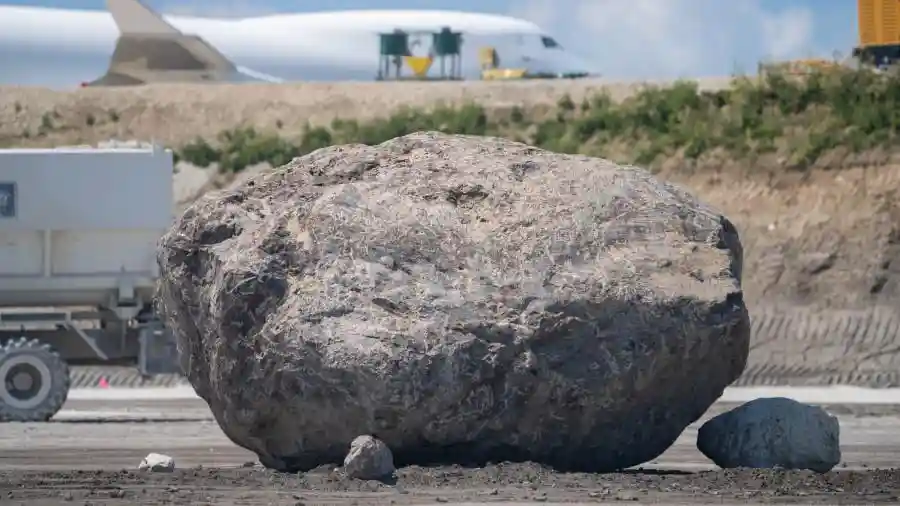
Construction crews working beneath Chicago O’Hare International Airport have pulled a 50-ton boulder from roughly 30 feet (9 meters) below the airfield, and the City of Chicago is now asking the public to decide what the massive rock should be called. The find surfaced during excavation for the South Detention Basin, a stormwater management facility tied to the airport’s sweeping ORDNext terminal expansion program. What began as routine groundwork has turned into one of the more unusual public-relations moments in the airport’s recent history, with nearly 3,000 naming suggestions already submitted and six finalists competing in an online vote that closes at 5 p.m. Central Daylight Time on November 2, 2026. The winner’s name will eventually accompany the rock in a new airport exhibit, though officials have confirmed it will not be carved into the stone itself.
Six Names, One Boulder: Inside O’Hare’s Public Naming Contest
Chicago’s Department of Aviation launched the naming campaign in September, inviting residents and travelers to submit ideas through an online form. The response dwarfed expectations. After sorting through nearly 3,000 entries, officials announced six finalists on October 16, 2026: Sweet Stone Chicago, No ORDinary Rock, Chicago Rocks, O’Rock, Orchard Rock, and Da Rock. The list reads like a cross-section of Chicago humor, aviation wordplay, and neighborhood pride, and it carries an unmistakable local flavor. No ORDinary Rock leans directly on the airport’s three-letter code, ORD, while Sweet Stone Chicago nods to the city’s musical heritage. Orchard Rock quietly references the airport’s original name, Orchard Field, which was renamed in 1949 to honor naval aviator Edward “Butch” O’Hare. O’Rock and Da Rock push the pun further into pure Chicago dialect, and Chicago Rocks works as both a literal description and a civic slogan. Voting is open through the city’s announced online portal, and the winning entry will be displayed alongside the boulder in its planned exhibit space.

What Lies Beneath the Runways: The Geology of the O’Hare Boulder
The rock is dolostone, a sedimentary carbonate composed primarily of the mineral dolomite, or calcium magnesium carbonate. Geologists identified the material as limestone-related, a rock type that forms when magnesium-rich groundwater alters existing limestone deposits over long stretches of geologic time. The boulder measures approximately 11.5 feet (3.5 meters) wide, 8 feet (2.4 meters) deep, and 7.5 feet (2.3 meters) tall, dimensions that make its 50-ton estimate easy to believe. Its presence beneath the airfield highlights the geological conditions construction teams can encounter during large-scale infrastructure work, and although the specimen is unusual in scale, it formed naturally over millions of years. Available reports do not indicate that the discovery disrupted flight operations, and airport officials have treated the find less as an obstacle than as a curiosity worth preserving.
Why a Stormwater Basin Dug Up O’Hare’s Biggest Rock
The boulder emerged from the South Detention Basin, a stormwater management facility being developed as part of ORDNext, which Chicago has described as the largest terminal expansion in its history. Stormwater infrastructure is critical at an airport of O’Hare’s size, where drainage systems must support immense expanses of paved surface and manage rainfall around runways, taxiways, and terminal facilities. The excavation therefore extends well beyond the passenger-facing areas travelers normally see, reaching deep beneath the airfield itself. Internally, airport officials initially referred to the rock as the “O’Hare bean,” a playful nod to Chicago’s famous Cloud Gate sculpture in Millennium Park, commonly known as The Bean. The naming contest takes that informal nickname a step further by letting the public shape a small piece of the airport’s institutional memory.
ORDNext and the $8.5 Billion Modernization Reshaping O’Hare
The boulder’s discovery sits within a far larger story. O’Hare is a major hub for both United Airlines and American Airlines and a key gateway for domestic and international travelers, which means improvements to its terminals and supporting infrastructure matter well beyond Chicago’s city limits. The airport’s $8.5 billion modernization includes a new Global Terminal, satellite concourses, and an extensive tunnel system designed to connect the complex more efficiently. That program requires enormous excavation, and the boulder is a tangible reminder of the engineering work unfolding beneath the surface while passengers move through the existing terminals above. The planned exhibit will give visitors a lasting connection to that hidden construction effort, converting an unexpected geological find into a piece of public storytelling.
From Construction Obstacle to Airport Exhibit
Rather than haul the rock away as debris, airport officials chose to preserve it and build a display around it, an approach that turns a costly excavation complication into a community asset. The contest builds on the airport’s broader efforts to engage travelers and Chicago residents during its ongoing transformation, and the winner will join the boulder in a new exhibit rather than being etched into the stone. Whether Chicago ultimately selects the aviation-themed No ORDinary Rock, the musical homage of Sweet Stone Chicago, the playful O’Rock, or one of the remaining finalists, the 50-ton discovery has already secured a permanent place in O’Hare’s expansion story. For now, the decision rests with the public, and the ballot closes on November 2, 2026.