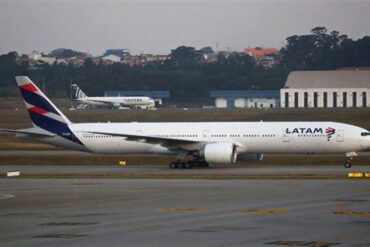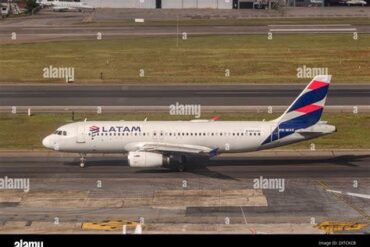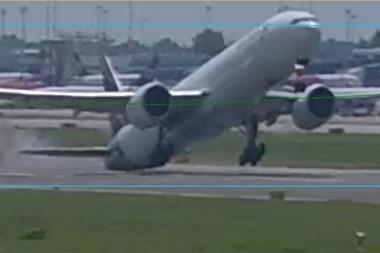
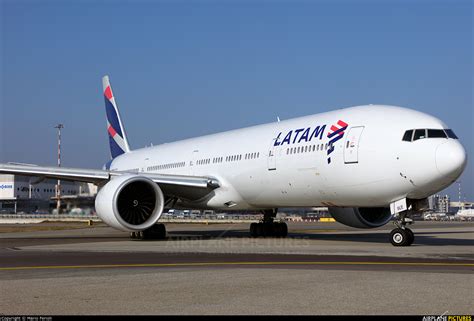
The investigation into a July 2024 LATAM Airlines incident at Milan Malpensa has delivered a sobering conclusion: a massive takeoff weight miscalculation, not a technical fault, caused a Boeing 777-300ER to strike its tail during departure. The aircraft, bound for São Paulo on a long-haul sector, rotated too early because its computed performance data was based on a grossly underestimated mass. Although the jet returned safely with no injuries, the scale of the damage led Italian authorities to formally classify the event as an accident.
Italy’s National Agency for the Safety of Flight (ANSV) reconstructed the chain of decisions and system interactions that allowed a roughly 100-ton discrepancy to slip through multiple safeguards. The case has resonated across the aviation industry because it illustrates how a single human error can propagate through automated planning tools when cross-checks become procedural rather than analytical.
A Long-Haul Departure With No Margin for Error
On July 9, 2024, the LATAM Boeing 777-300ER lined up on Runway 35L at Milan Malpensa carrying a heavy payload and fuel load typical of an intercontinental flight to Brazil. Such configurations demand precise performance planning. Rotation speed, thrust settings, and pitch behavior are finely balanced, and any deviation can have immediate consequences.
The captain, while calculating the aircraft’s takeoff weight, incorrectly deducted the expected taxi fuel, producing a figure far lower than the actual mass. The resulting number—228.8 tonnes instead of the correct 328.4 tonnes—was verbally announced and entered into both pilots’ electronic flight bags. Because the same incorrect value was used on both devices, the normal redundancy intended to catch errors simply reinforced the mistake.
How Automation Amplified a Human Error
Modern widebody operations rely heavily on electronic performance tools. These systems are highly accurate—provided the inputs are correct. In this case, the underestimated weight generated invalid thrust settings and V-speeds, including a rotation speed that was more than 30 knots too low for the aircraft’s true mass.
The Boeing 777’s flight-management system flagged a “V-speeds unavailable” message, indicating an inconsistency between entered data and expected parameters. Investigators found that the crew did not fully recognize the operational significance of this alert and did not consult the associated procedures. The takeoff was continued using manually derived speeds that were fundamentally flawed.
As the aircraft rotated at the incorrect speed, the pitch rate increased sharply. With insufficient lift to support the aircraft’s actual weight, the tail contacted the runway, producing a classic tail-strike profile during the early moments of the takeoff roll.
The Moment of Recognition After Liftoff
Once airborne, the crew sensed that the departure had not unfolded normally. Abnormal indications and aircraft behavior suggested possible structural contact. Rather than pressing on, the pilots stabilized the aircraft, coordinated with air traffic control, and elected to return to Milan.
To ensure a safe landing within structural limits, the crew jettisoned approximately 72,000 kilograms of fuel, reducing weight to acceptable levels for approach. The landing itself was uneventful, a testament to disciplined decision-making once the severity of the situation became clear. Only after post-flight inspection did the full extent of the damage become apparent.
Structural Damage and Accident Classification
Despite the absence of injuries, inspectors discovered significant damage to the rear fuselage, tail skid assembly, drain mast, and surrounding structural elements. The impact exceeded cosmetic thresholds and required detailed manufacturer involvement. Based on these findings, ANSV classified the event as an accident rather than a serious incident.
The aircraft, registered as PT-MUG, remained grounded for months while repairs and inspections were completed. Regulatory oversight was extensive, reflecting the seriousness of a tail strike on a widebody aircraft. LATAM returned the jet to service in February 2025, roughly seven months after the event.
Where Cockpit Defenses Broke Down
ANSV’s report emphasizes that no single failure caused the accident. Instead, multiple defensive layers eroded simultaneously. Critical weight figures were exchanged verbally without being rigorously cross-checked against the official load sheet. The same erroneous data populated both electronic tools, nullifying independent verification. System warnings were noted but not fully interrogated.
In isolation, any one of these lapses might not have resulted in an accident. Together, they formed a pathway that allowed a fundamentally unsafe takeoff to proceed. Investigators were explicit in rejecting mechanical or software malfunction as causal factors; the aircraft behaved exactly as commanded.
Industry Implications Beyond Milan
Tail strikes caused by performance-planning errors are uncommon but not unprecedented. Each occurrence reignites debate over additional safeguards, including real-time takeoff performance monitoring systems that independently assess acceleration and rotation behavior during the takeoff roll. Such systems can provide crews with an additional cue when aircraft behavior diverges from expected norms.
The Milan incident reinforces a less glamorous but more enduring lesson: automation does not replace judgment. Highly advanced flight decks still depend on accurate human inputs and disciplined procedural compliance. Cross-checking is only effective when it is skeptical, not confirmatory.
For airlines and training organizations, the findings are likely to influence simulator scenarios, checklist discipline, and the handling of ambiguous system alerts. The event stands as a precise, uncomfortable reminder that in aviation, small arithmetic errors can scale into large physical consequences—especially when a 300-ton aircraft begins to move.
In the end, the safe return of the LATAM 777 speaks to professional airmanship under pressure. The accident itself speaks to the relentless necessity of questioning numbers that seem to fit too easily, even in cockpits designed to make complexity feel routine.