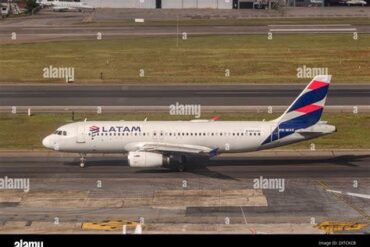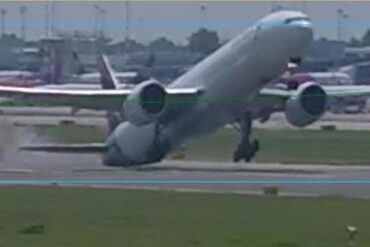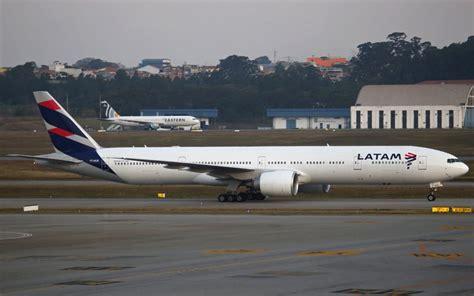
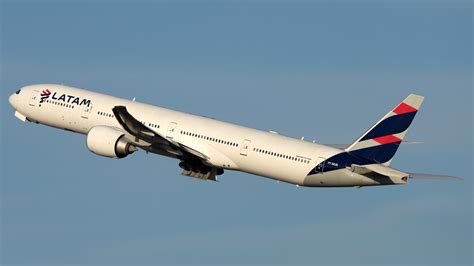
On a humid Sunday evening at São Paulo–Guarulhos International Airport (GRU), a routine long-haul departure to Lisbon turned into a razor-edge demonstration of aeronautical decision-making under extreme pressure. A LATAM Brasil Boeing 777-300ER, operating flight LA8146 to Humberto Delgado Airport (LIS), initiated rotation—nose lifting cleanly off the runway—before the crew made the extraordinary choice to reject the takeoff. What followed was a maximum-energy stop that pushed aircraft systems to their physical limits and left observers staring at footage that felt uncomfortably close to catastrophe.
The aircraft, registration PT-MUH, a 13-year-old widebody configured with 410 seats, had already experienced a departure delay of roughly 90 minutes. Shortly after 7:00 PM, it lined up on Runway 10L, a 3,700-meter (12,140-foot) strip of asphalt that normally offers generous performance margins for a transatlantic departure. What unfolded seconds later compressed those margins into a vanishingly small window.
As the jet accelerated through the high-speed regime—estimated at approximately 178 knots based on video timing and tracking data—the nose gear lifted from the runway. This is the moment pilots call rotation, the controlled pitch-up that transitions a 300-ton machine from rolling friction to aerodynamic lift. Then, in a move rarely seen and even more rarely survived without damage, the nose lowered again. Maximum braking was applied. Reverse thrust roared. The aircraft decelerated violently, consuming nearly all remaining runway before exiting onto a parallel taxiway near the far end.
The Physics of a High-Speed Rejected Takeoff
A rejected takeoff at low speed is procedural. A rejected takeoff near or after V1 is existential. V1 is the calculated decision speed—the threshold beyond which stopping within the available runway can no longer be guaranteed under certified assumptions. Past that speed, pilots are trained to continue the takeoff unless the aircraft is physically incapable of flight.
Rotation speed, or VR, typically occurs at or slightly after V1. The São Paulo event appears to have crossed both thresholds before the abort decision was executed. That places it in a category so rare that aviation investigators treat such cases with forensic intensity.
The reason is physics, and physics is indifferent to human stress. Kinetic energy increases with the square of velocity. Doubling speed quadruples energy. At nearly 180 knots, a fully loaded 777 carries staggering momentum. When braking systems attempt to convert that kinetic energy into heat, temperatures soar. Tires can fail. Brake assemblies can glow red-hot. Wheel wells can accumulate enough residual heat to pose a fire hazard.
Video and post-stop imagery confirmed severe tire damage and brake units radiating intense heat, consistent with a maximum-energy rejected takeoff. Airport fire services responded immediately, which is standard protocol whenever brake temperatures approach critical thresholds. Overheated brakes are not merely mechanical curiosities—they are potential ignition sources.
A Narrow Window Between Flight and Overrun
Once rotation begins, the aircraft is no longer simply a ground vehicle. The wings are generating lift. Control surfaces are shifting aerodynamic loads. The center of gravity is transitioning dynamically. Rejecting at this phase introduces structural stress patterns very different from a straight-line stop.
Directional control becomes more complex as lift unloads weight from the main landing gear. Lowering the nose back onto the runway at speed risks hard contact forces. Braking must be symmetrical to prevent yaw. Reverse thrust must be modulated to avoid destabilizing airflow.
History offers sobering parallels. Several documented cases of post-V1 rejects have ended in runway overruns, structural destruction, or fatalities. In 2008, a Learjet 60 accident in Columbia, South Carolina followed a late reject decision and resulted in loss of life. In 2014, a Gulfstream G-IV overran the runway in Bedford after a high-speed abort, killing all aboard. These are not routine events; they are case studies in how thin the safety margin becomes at the edge of performance envelopes.
That LATAM’s 777 stopped within the runway environment, with no reported injuries, reflects either remarkable luck, exceptional runway margin, disciplined crew coordination—or some combination of all three.
What Triggered the Abort?
The essential mystery now lies in timing and causation. Investigators will examine cockpit voice recordings and flight data to determine the precise instant the reject decision was made relative to V1 and VR callouts. They will analyze whether a warning system activated—engine anomaly, configuration alert, flight control caution—or whether an unexpected aircraft response prompted immediate rejection.
Performance calculations will be scrutinized: aircraft weight, flap settings, assumed temperature inputs, thrust configuration, and runway condition data. Modern airliners rely on flight management computers to generate takeoff speeds. If invalid data were entered, resulting speeds could be unreliable. Conversely, if a genuine system failure occurred at rotation, rejecting might have been the only defensible choice.
Brake energy data will be another focal point. Aircraft manufacturers publish limits defining how much kinetic energy brake assemblies can safely absorb before structural degradation or fuse plug tire deflation occurs. Engineers will download brake temperature telemetry, inspect wheel assemblies, and evaluate whether margins were exceeded.
Echoes of the Milan Tailstrike
The São Paulo event inevitably draws comparison to another recent incident involving a LATAM Boeing 777-300ER, this one departing Milan Malpensa (MXP) in July 2024. In that case, investigators later determined that a massive takeoff weight miscalculation—approximately 100,000 kilograms (220,000 pounds)—led to invalid performance data.
Despite flight management system alerts indicating that valid V-speeds were unavailable, the takeoff proceeded. Rotation occurred more than 30 knots below the correct speed for the actual aircraft weight. The tail struck the runway, scraping roughly 720 meters (2,360 feet) of asphalt before the aircraft managed to climb away and return safely.
The Milan investigation reclassified the occurrence as an accident due to structural damage severity. It underscored how performance data integrity is not clerical trivia but aerodynamic destiny. A mis-entered weight transforms lift calculations. Lift depends on airspeed squared; underestimate weight, and the wing simply cannot produce sufficient upward force at the computed rotation speed.
Whether the São Paulo rejection shares any procedural lineage with Milan remains unknown. There is, at present, no evidence suggesting a repeat of that error chain. But investigators will be alert to systemic patterns, especially in takeoff-phase decision-making.
The Human Factor at 178 Knots
In the cockpit, takeoff is a ritualized choreography. Speeds are called aloud. Hands hover over thrust levers. After V1, the mental commitment shifts: continue unless the aircraft cannot fly. Rejecting after that point requires overwhelming justification.
Pilots train for engine failures at V1. They practice asymmetric thrust scenarios in simulators. The doctrine is clear because ambiguity is dangerous. A last-second reversal of that doctrine means something appeared so severe that stopping felt safer than flying.
That judgment call occurs in fractions of a second. At 178 knots, the aircraft covers nearly 300 feet per second. A delay of two seconds consumes more than 600 feet of runway. Reaction time is not theoretical—it is distance disappearing under the wheels.
The 777’s braking system is engineered for extreme contingencies. Carbon brakes can withstand temperatures that would liquefy conventional materials. Autobrake systems modulate pressure to optimize deceleration without locking wheels. Yet even the most advanced hardware operates within finite limits defined by thermodynamics.
Runway Margin and Infrastructure
Runway 10L at Guarulhos is long by international standards, which likely contributed to the successful stop. Long-haul widebody departures are typically planned with conservative performance assumptions, but high gross weights for transatlantic missions compress margins.
A fully loaded 777-300ER departing for Lisbon would carry substantial fuel reserves. Every additional ton increases required takeoff speed and stopping distance. The interplay between runway length, aircraft weight, ambient temperature, and wind conditions forms a performance equation with no tolerance for arithmetic error.
Emergency services’ rapid arrival was not dramatic flourish but procedural necessity. Overheated brakes can ignite hydraulic fluid or tire rubber. Fuse plugs—designed to deflate tires safely under extreme heat—may activate hours after the event. Aircraft are often parked in isolated areas for cooling inspections following such rejects.
What Happens Next
The aircraft was removed from service pending detailed inspection. Maintenance teams will examine brake stacks, tires, landing gear struts, and structural attachment points for heat-induced stress. Investigators will reconstruct the acceleration profile second by second.
The broader aviation community will watch closely. High-speed rejected takeoffs after rotation sit at the extreme edge of operational doctrine. They test not only hardware tolerances but the philosophy of go-versus-stop embedded in pilot training worldwide.
Aviation safety advances through these uncomfortable moments. Each investigation adds nuance to the binary decision at V1. Continue or reject. Fly or brake. In São Paulo, that binary flickered into something rarer—a reversal after commitment, a decision made in the final sliver of runway reality.
The Boeing 777 is among the most capable long-haul aircraft ever built, engineered with redundancies layered like armor. Yet even the most sophisticated machine obeys unyielding physical laws. Speed squared becomes heat. Heat becomes stress. Judgment becomes consequence.
On that evening in Brazil, consequence stopped short of disaster. The runway ended; the aircraft did not. Aviation’s margins were tested, and—for now—they held.